
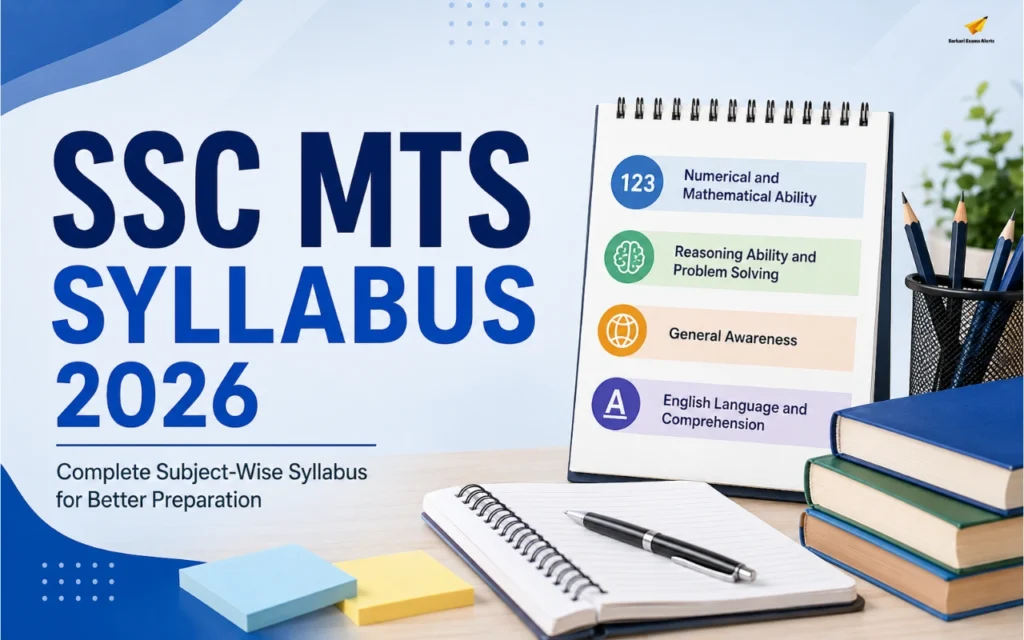
SSC MTS Syllabus: SSC MTS 2026 syllabus covers four subjects across two sessions. Session 1 includes Numerical and Mathematical Ability (20 questions, 60 marks) and Reasoning Ability and Problem Solving (20 questions, 60 marks) with no negative marking. Session 2 includes General Awareness (25 questions, 75 marks) and English Language and Comprehension (25 questions, 75 marks) with 1 mark negative marking. The syllabus is the same for both MTS and Havaldar posts. Understanding the complete topic-wise syllabus before starting preparation is the most important first step.
What is SSC MTS Syllabus?
SSC MTS syllabus is the list of all topics and subjects from which questions are asked in the Computer Based Exam. SSC defines the syllabus in the official notification. The syllabus has remained consistent over the years with no major changes after the exam pattern revision in 2023. The exam is now conducted in two sessions on the same day. Session 1 has no negative marking which is a significant advantage — you can attempt all questions freely. Session 2 requires careful strategy due to 1 mark negative marking.
| SSC MTS Result | SSC MTS Admit Card |
| SSC MTS Havaldar | SSC MTS Preparation Tips |
| SSC MTS Exam Pattern | SSC MTS Cut Off |
| SSC MTS Eligibility | SSC MTS Apply Online |
| SSC MTS Vacancy | SSC MTS Answer Key |
SSC MTS Syllabus 2026
The complete topic-wise SSC MTS syllabus 2026 is given below for both sessions based on the official SSC notification and previous year question paper analysis.
Also Read: SSC MTS Notification
SSC MTS 2026 Exam Pattern Overview
| Session | Subject | Questions | Marks | Duration | Negative Marking |
|---|---|---|---|---|---|
| Session 1 | Numerical and Mathematical Ability | 20 | 60 | 45 minutes | None |
| Session 1 | Reasoning Ability and Problem Solving | 20 | 60 | ||
| Session 2 | General Awareness | 25 | 75 | 45 minutes | 1 mark per wrong answer |
| Session 2 | English Language and Comprehension | 25 | 75 | ||
| Total | 90 | 270 | 90 minutes | ||
SSC MTS Syllabus Session 1
Numerical and Mathematical Ability (20 Questions, 60 Marks)
This section tests your basic mathematical skills. The questions are at Class 8 to 10 level. With no negative marking in Session 1, you can and should attempt all 20 questions.
| Topics | Important Concepts Covered |
|---|---|
| Number System | Natural numbers, whole numbers, integers, rational numbers, LCM & HCF, divisibility rules, factors & multiples, BODMAS, simplification of numerical expressions |
| Arithmetic Operations | Addition, subtraction, multiplication, division, fractions, and decimals |
| Percentages | Percentage calculation, increase & decrease, percentage error, profit-loss and discount applications |
| Ratio and Proportion | Simple ratio, compound ratio, direct & inverse proportion, mixture-based problems |
| Averages | Simple average, weighted average, and application-based questions |
| Simple & Compound Interest | SI & CI formulas, direct application problems, half-yearly compounding |
| Profit and Loss | Cost price, selling price, marked price, profit %, loss %, discounts, successive discount |
| Time and Work | Individual work, combined work, work efficiency, pipes and cisterns |
| Time, Speed, and Distance | Speed calculation, average speed, relative speed, trains, boats and streams |
| Mensuration Basics | Area & perimeter of square, rectangle, triangle, circle; volume of cube and cuboid |
| Lines and Angles | Parallel lines, transversal, angle properties, and basic geometry concepts |
| Data Interpretation | Reading and analysing tables, bar graphs, and pie charts |
| Square & Square Roots | Perfect squares, square roots, and cube roots of perfect cubes |
Topic-wise Expected Question Distribution (Numerical)
| Topic | Expected Questions per Paper | Priority |
|---|---|---|
| Percentage, Ratio, Profit-Loss | 5 to 7 | Very High |
| Time and Work, Time Speed Distance | 3 to 4 | High |
| Number System and Simplification | 3 to 4 | High |
| Simple and Compound Interest | 2 to 3 | Medium |
| Mensuration | 2 to 3 | Medium |
| Data Interpretation | 2 to 3 | Medium |
| Average | 1 to 2 | Medium |
Reasoning Ability and Problem Solving (20 Questions, 60 Marks)
Reasoning tests logical thinking, pattern recognition, and problem-solving without formal mathematical knowledge. This is often the highest scoring section for most candidates.
| Topics | Important Concepts Covered |
|---|---|
| Analogies | Word analogies, number analogies, figure-based analogies, identifying relationships and similarities |
| Classification (Odd One Out) | Identifying the different element from word groups, number sets, and figures |
| Series | Number series, alphabet series, alphanumeric patterns, mixed sequence problems, missing terms |
| Coding and Decoding | Letter coding, number coding, symbol coding, and logic-based decoding patterns |
| Blood Relations | Family tree questions, generation-based relations, and relationship identification |
| Directions and Distances | Direction sense, movement tracking, shortest distance, and final position problems |
| Ranking and Ordering | Ranking tests, seating positions, order arrangement, and comparison-based problems |
| Venn Diagrams | Logical grouping, overlapping sets, and set-based reasoning questions |
| Missing Numbers | Finding missing values in matrices, diagrams, patterns, and numerical arrangements |
| Calendar and Clock | Day-date calculations, leap year concepts, clock timing, and angle-based questions |
| Age-Based Problems | Age difference calculations, present/past/future age problems, ratio-based age questions |
| Non-Verbal Reasoning | Mirror images, water images, paper folding, paper cutting, embedded figures, figure series, figure counting |
| Problem Solving & Analytical Reasoning | Logical puzzles, analytical thinking questions, and reasoning-based problem-solving scenarios |
Topic-wise Expected Question Distribution (Reasoning)
| Topic | Expected Questions per Paper | Priority |
|---|---|---|
| Series (Number, Alphabet, Alpha-Numeric) | 4 to 5 | Very High |
| Analogies and Classification | 4 to 5 | Very High |
| Non-Verbal Reasoning | 4 to 6 | High |
| Coding-Decoding | 2 to 3 | High |
| Directions and Blood Relations | 2 to 3 | Medium |
| Venn Diagrams | 1 to 2 | Medium |
| Missing Numbers and Matrix | 1 to 2 | Medium |
SSC MTS Syllabus Session 2
General Awareness (25 Questions, 75 Marks)
General Awareness is the most scoring section for well-prepared candidates but requires consistent daily reading. With 1 mark negative marking, attempt only what you are confident about.
| Topics | Important Concepts Covered |
|---|---|
| Current Affairs | National & international events, government schemes, appointments, sports news, awards & honours, summits, defence updates, science & technology developments, ISRO missions, important reports and recent events from the last 6–8 months |
| Indian History | Ancient India (Maurya, Gupta, Chola dynasties), Medieval India (Delhi Sultanate, Mughal Empire, Bhakti & Sufi movements), Modern India (British rule, Revolt of 1857, freedom struggle, INC, Gandhi era, major national movements) |
| Indian Polity & Constitution | Preamble, Fundamental Rights & Duties, Directive Principles, President, Prime Minister, Parliament, Judiciary, Election Commission, Constitutional Amendments, Panchayati Raj system |
| Geography | Physical geography of India, rivers, mountains, climate, soils, vegetation, Indian states & capitals, world geography including continents, countries, oceans, deserts, and important geographical features |
| Indian Economy | GDP, GNP, inflation, fiscal deficit, Union Budget, RBI, banking system, taxation, GST, NITI Aayog, government economic policies and schemes |
| General Science | Basic Physics, Chemistry, Biology, environmental science, human body systems, electricity, motion, acids & bases, nutrition, diseases, pollution, and scientific inventions |
| Static GK | Important days & dates, books & authors, national symbols, UNESCO World Heritage Sites, international organizations & headquarters, famous personalities, firsts in India, wildlife sanctuaries & national parks |
English Language and Comprehension (25 Questions, 75 Marks)
The English section tests basic grammar and vocabulary. The level is moderate to easy for candidates who read in English regularly.
| Topics | Important Concepts Covered |
|---|---|
| Vocabulary | Synonyms, antonyms, one-word substitutions, idioms & phrases, spelling correction, word usage, and vocabulary-based questions |
| Grammar | Error spotting, subject-verb agreement, tenses, articles, prepositions, pronouns, sentence structure, sentence improvement, and fill in the blanks |
| Reading Comprehension | Short passages with questions based on main idea, details, vocabulary meaning, inference, and contextual understanding |
| Cloze Test | Paragraph-based fill-in-the-blank questions testing grammar, vocabulary, sentence flow, and contextual accuracy |
SSC MTS Syllabus Topic-wise Weightage Analysis
| Section | Easy Questions | Moderate Questions | Difficult Questions | Scoring Potential |
|---|---|---|---|---|
| Numerical Ability (20 Q) | 8 to 10 | 6 to 8 | 2 to 4 | 14 to 18 correct |
| Reasoning (20 Q) | 10 to 12 | 6 to 8 | 2 to 3 | 16 to 19 correct |
| General Awareness (25 Q) | 12 to 15 | 6 to 8 | 4 to 5 | 18 to 22 correct |
| English (25 Q) | 12 to 15 | 7 to 9 | 3 to 5 | 17 to 21 correct |
SSC MTS Syllabus Preparation Strategy
Session 1 Strategy (No Negative Marking)
Since Session 1 has no negative marking, attempt all 40 questions. Never skip a question. Even if you are unsure, make an educated guess. Start with Reasoning as it is generally faster for most candidates. Then move to Numerical Ability. Practice at least 30 to 40 Numerical Ability questions daily. Focus heavily on arithmetic topics as they account for 60% of the section.
Session 2 Strategy (1 Mark Negative Marking)
Session 2 requires more careful approach due to negative marking. Attempt only those questions where you are at least 70% confident. Skip questions you have no idea about. In English, grammar and vocabulary questions are easier to be confident about compared to comprehension inference questions. In General Awareness, skip questions on topics you have not studied.
Topic Priority for Maximum Marks
Start preparation with these high-priority topics: Percentage and ratio in Numerical Ability. Analogies and series in Reasoning. Current affairs for General Awareness. Error detection and synonyms-antonyms for English. These topics together account for approximately 50% of all questions.
Frequently Asked Questions on SSC MTS Syllabus
1. What is included in SSC MTS Syllabus 2026?
The SSC MTS Syllabus 2026 includes subjects such as Numerical Aptitude, Reasoning Ability, English Language, and General Awareness as prescribed by the Staff Selection Commission.
2. Is the SSC MTS 2026 syllabus the same for Havaldar posts?
Yes, the written syllabus for SSC MTS and Havaldar posts is generally the same, although Havaldar candidates must additionally qualify the Physical Efficiency Test (PET) and Physical Standard Test (PST).
3. Which topics are important in SSC MTS General Awareness section?
The General Awareness section usually covers current affairs, history, geography, polity, economics, science, and static GK topics.
4. Does SSC MTS Syllabus 2026 include current affairs?
Yes, current affairs and recent events form an important part of the General Awareness section in the SSC MTS exam.
5. How can I prepare effectively for SSC MTS Syllabus 2026?
Candidates should focus on understanding concepts, practicing mock tests, revising important topics regularly, and solving previous year papers to prepare effectively for the SSC MTS 2026 exam.