
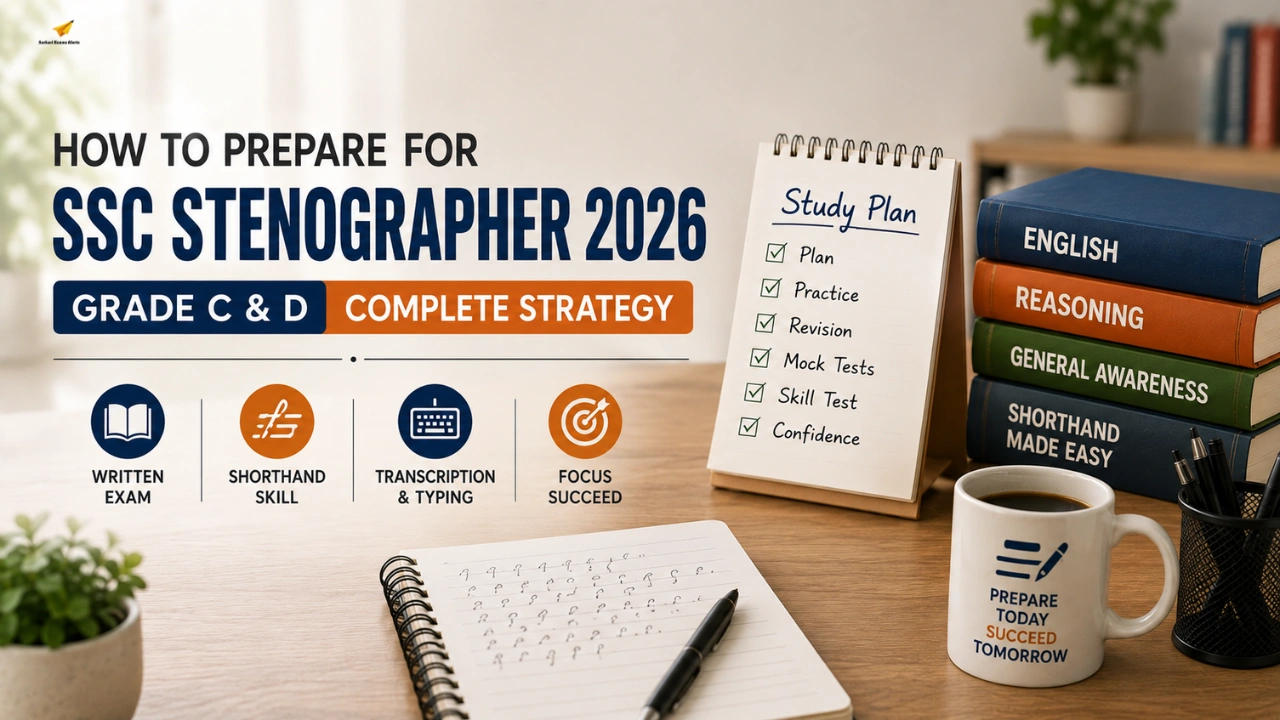
Prepare for SSC Stenographer: The SSC Stenographer Examination is one of the most popular recruitment exams conducted by the Staff Selection Commission for candidates aspiring to secure government jobs as Grade C and Grade D Stenographers. Unlike many SSC examinations, success in this recruitment process depends on clearing both the Computer-Based Examination (CBT) and the Stenography Skill Test, making it essential to prepare for knowledge as well as practical skills simultaneously.
Many candidates focus entirely on the written examination and postpone shorthand practice until later. This often becomes the biggest reason for not making it to the final selection list. The ideal preparation strategy combines General Intelligence, General Awareness, English Language, shorthand speed, typing accuracy, and regular practice from the very beginning.
If you’re planning to appear for SSC Stenographer 2026, these 15 practical preparation tips will help you build a balanced strategy for both the written examination and the skill test.
What is SSC Stenographer?
SSC Stenographer exam recruits Stenographer Grade C (Pay Level 6, Rs 35,400) and Grade D (Pay Level 4, Rs 25,500) for central government ministries and departments. The steno works with senior officers recording dictation and transcribing it. Qualification is Class 12 pass. Age limit is 18 to 27 years (Grade D) and 18 to 30 years (Grade C). Vacancies range from 500 to 1,500 annually.
Also Read: UPSSSC PET Notification
How to Prepare for SSC Stenographer After 12th?
Class 12 pass candidates can directly appear for SSC Stenographer. English carries 100 marks out of 200 in the written exam making it the most important subject, your Class 12 English base helps significantly. Start stenography classes immediately after Class 12. Professional stenography training at a local institute typically takes 6 to 12 months to reach the required speed. While learning steno, simultaneously prepare the written exam subjects.
Subject-wise Written Exam Strategy
The Computer-Based Examination is the first stage of the SSC Stenographer selection process, and performing well here is essential to qualify for the Skill Test. Instead of preparing all three subjects together, focus on strengthening one subject at a time while maintaining regular revision. A balanced preparation strategy improves both accuracy and confidence.
English Language Strategy
English is the highest-scoring section in the SSC Stenographer examination and often becomes the deciding factor between Grade C and Grade D selections. Since stenographers work extensively with official documents, letters, and communications, the examination tests your command over grammar and comprehension rather than just vocabulary.
Begin by strengthening the fundamentals of English grammar, including parts of speech, tenses, subject-verb agreement, articles, prepositions, active-passive voice, direct-indirect speech, and sentence correction. Once your basics are clear, move to vocabulary-building through daily reading and learning new words in context instead of memorizing word lists.
Practice reading newspapers, editorials, and government notifications regularly to improve reading comprehension and language familiarity. Solve topic-wise questions before attempting sectional mock tests, and analyse every mistake carefully to identify weak grammar areas. Consistent practice is the key to scoring well in English.
General Intelligence & Reasoning Strategy
The Reasoning section evaluates your logical thinking, observation skills, and ability to solve problems quickly. Since this section is less dependent on memorization, regular practice can significantly improve your score.
Focus on frequently asked topics such as analogy, classification, coding-decoding, series, blood relations, direction sense, syllogism, statement-based questions, puzzles, and non-verbal reasoning. Learn the underlying concepts first and then solve questions under timed conditions to improve speed.
Instead of attempting a large number of random questions, analyse the mistakes you make during practice. Understanding why an answer is wrong helps strengthen your reasoning ability and reduces repeated errors in future mock tests.
General Awareness Strategy
General Awareness is one of the easiest sections to score in if prepared consistently. Unlike English and Reasoning, this section requires continuous revision because factual information can easily be forgotten.
Cover static General Knowledge topics such as Indian History, Geography, Polity, Economy, General Science, Constitution, Awards, Important Days, Books and Authors, Sports, and International Organizations. Alongside static GK, follow current affairs related to government schemes, appointments, defence, science and technology, economy, and national and international events.
Prepare concise monthly revision notes instead of depending on multiple magazines. Revisiting these notes regularly helps retain important information and improves recall during the examination.
Weekly Habits of Successful SSC Stenographer Candidates
The difference between average candidates and successful candidates is rarely the number of study hours—it is the consistency of their weekly routine. Building productive habits helps improve both the written examination and the stenography skill test without creating unnecessary pressure.
At the end of every week, review your preparation honestly and check whether you have completed the activities that contribute to steady improvement.
A productive weekly routine should include:
Attempt at Least One Full-Length Mock Test
A weekly mock test helps evaluate your preparation, improve time management, and identify weak areas. Spend sufficient time analysing your mistakes rather than focusing only on your score.
Complete Five Shorthand Dictation Sessions
Regular dictation practice improves shorthand speed, listening ability, and confidence. Practicing multiple dictations every week also helps you become comfortable with different speaking speeds and accents.
Revise Vocabulary and Grammar
Set aside time every week to revise new vocabulary, grammar rules, idioms, and commonly confused words. Continuous revision improves accuracy in the English section.
Revise General Awareness
Instead of revising current affairs only before the examination, dedicate one session every week to revisiting important national and international events, government schemes, awards, and static GK topics.
Practice Typing and Transcription
After shorthand practice, immediately work on transcription. This helps improve typing speed, reduces spelling mistakes, and prepares you for the actual Skill Test environment.
Maintain an Error Notebook
Record every mistake you make in English, Reasoning, General Awareness, shorthand, and transcription. Revisiting these mistakes every week prevents repetition and gradually strengthens your weakest areas.
Following these habits consistently throughout your preparation journey creates steady improvement without making the process overwhelming.
The Last 30 Days Before SSC Stenographer 2026
The final month should focus on strengthening your existing preparation rather than learning entirely new topics. Divide the last 30 days into weekly phases to maintain balance between the written examination and the Skill Test.
Week 4: Revise Core Concepts
Use the first week to revise grammar rules, reasoning concepts, important General Awareness topics, and shorthand outlines. Go through your short notes instead of reading complete books again. The objective during this phase is to refresh your understanding and strengthen concepts that you have already studied.
Week 3: Increase Mock Test Practice
Begin attempting full-length mock tests under actual examination conditions. Solve previous years’ papers and sectional tests while focusing on time management and accuracy. Analyse every mock carefully and revise the topics where you make repeated mistakes.
Week 2: Prioritize the Skill Test
Dedicate more time to shorthand dictation and transcription practice. Increase the number of dictation sessions and gradually practice at the prescribed examination speed. Simulate the actual Skill Test environment by completing transcription within the official time limit.
Final Week: Build Confidence, Not Stress
The last week should be used for light revision, vocabulary review, current affairs revision, and maintaining shorthand practice. Avoid changing study material or experimenting with new preparation strategies. Ensure proper sleep, maintain a healthy routine, and enter the examination with confidence in your preparation.
Mistakes That Stop Candidates From Final Selection
Many aspirants perform well in the written examination but fail to secure final selection because of avoidable mistakes during preparation.
One of the most common mistakes is ignoring shorthand practice until after clearing the Computer-Based Examination. Since shorthand is a practical skill that requires months of consistent practice, postponing it often leads to poor performance in the Skill Test.
Another major mistake is neglecting typing speed and transcription accuracy. Even candidates with good shorthand speed struggle if they cannot accurately transcribe their notes within the prescribed time. Daily transcription practice is just as important as shorthand practice.
Many candidates also skip mock tests, believing that completing the syllabus is enough. Mock tests improve time management, increase confidence, and reveal weak areas that may otherwise go unnoticed.
A weak command of English can also become a major obstacle. Since English contributes significantly to the written examination and transcription, improving grammar, vocabulary, and comprehension should remain a continuous process throughout preparation.
Some aspirants spend months studying new topics but rarely revise. Without revision, information fades quickly, reducing accuracy during the examination. Preparing concise notes and revisiting them regularly is essential for long-term retention.
Finally, not practising transcription under timed conditions is a mistake many candidates make. Practicing only shorthand without completing the transcription process creates a false sense of confidence. Both skills must be developed together to perform well in the actual Skill Test.
Conclusion
Cracking SSC Stenographer 2026 is about much more than qualifying a written examination. It is about developing the professional skills expected from a government stenographer, listening carefully, recording information accurately, transcribing efficiently, and communicating effectively.
A successful candidate prepares for both stages of the selection process from the very beginning. By strengthening English, improving reasoning ability, staying updated with current affairs, and practicing shorthand and transcription consistently, you gradually build the confidence and competence required for the role.
Instead of chasing shortcuts, focus on disciplined daily practice, regular revision, and continuous improvement. Every mock test you analyse, every dictation you complete, and every transcription you finish brings you closer not just to clearing the examination, but to becoming a skilled stenographer ready to perform efficiently in a professional government office.
Frequently Asked Questions (FAQs)
- How should beginners prepare for SSC Stenographer 2026?
Beginners should first understand the exam pattern and syllabus, then prepare simultaneously for the Computer-Based Examination and the Stenography Skill Test. Daily shorthand practice, English preparation, reasoning practice, General Awareness revision, and regular mock tests should all be part of the study routine.
- Is it necessary to practice shorthand before clearing the SSC Stenographer written exam?
Yes. Shorthand is a practical skill that improves gradually through consistent practice. Waiting until after the written examination leaves very little time to develop the speed and accuracy required for the Skill Test.
- How can I improve my shorthand speed for SSC Stenographer?
Start with slow dictation to strengthen shorthand outlines, then gradually increase the speaking speed. Practice dictation every day, transcribe immediately after writing, analyse your mistakes, and maintain consistency to improve both speed and accuracy.
- Which section is the most important in the SSC Stenographer written examination?
While all sections contribute to the overall score, English Language is generally considered the highest-scoring section because it tests grammar, vocabulary, comprehension, and language proficiency. Strong English skills also support better performance during transcription.
- What is the biggest mistake candidates make during SSC Stenographer preparation?
The most common mistake is treating the written examination and the Skill Test as separate stages. Candidates who prepare both simultaneously—by balancing academic study with daily shorthand and transcription practice, are generally better prepared for final selection.