
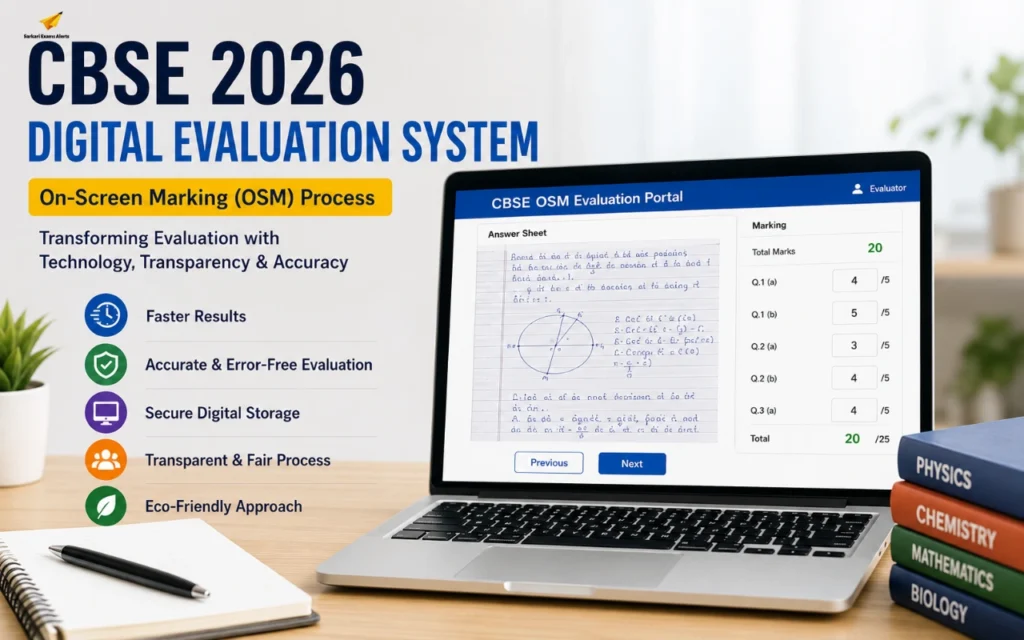
CBSE Digital Evaluation System: The Central Board of Secondary Education has come under discussion after the implementation of its new On-Screen Marking (OSM) system for the Class 12 Board Examination 2026 evaluation process. While the board introduced the digital evaluation system to improve transparency, reduce manual errors, and speed up result processing, several students, parents, and teachers have raised concerns regarding unexpected scores and possible discrepancies in the assessment process.
Soon after the declaration of the CBSE Class 12 Result 2026, many students took to social media claiming that their marks in subjects such as Physics, Chemistry, Mathematics, and Biology were significantly lower than expected. Some students who had qualified competitive examinations like JEE Main also claimed they failed or received unusually low marks in board exams, leading to widespread discussions around the newly introduced OSM evaluation method.
In response to the growing concerns, CBSE released an official statement defending the OSM system and clarified that the digital evaluation process is designed to improve consistency and accuracy in marking. The board also advised dissatisfied students to apply for re-evaluation or answer sheet verification through the official post-result grievance process.
What Is CBSE On-Screen Marking (OSM) System?
The On-Screen Marking (OSM) system is a newly introduced digital evaluation method implemented by the Central Board of Secondary Education for Class 12 board examinations from the 2026 session onward. Under this process, physical answer sheets are scanned and uploaded digitally, allowing examiners to check copies online through a secure computer-based evaluation platform instead of manually checking physical answer booklets.
Also Read: CBSE 12th Result
Why Are Students Demanding Changes in the OSM System?
After the announcement of the CBSE Class 12 Result 2026, many students and teachers started expressing dissatisfaction regarding the digital evaluation system. Social media platforms witnessed multiple posts where students alleged that their marks did not match their expectations, especially in core science subjects.
Teachers also raised concerns regarding login issues, slow systems, and adjustment difficulties during the initial phase of implementation. Some reports suggested that evaluators faced technical delays during mock evaluation sessions as well.
Several students demanded that CBSE discontinue or review the OSM system, claiming:
- Evaluators may miss handwritten steps during digital checking
- Poor handwriting visibility on scanned copies can affect marks
- Technical glitches may impact evaluation accuracy
- Digital checking feels stricter compared to traditional evaluation
CBSE’s Official Response on OSM Evaluation Controversy
The Central Board of Secondary Education has officially defended the On-Screen Marking system and denied claims that technical glitches affected the evaluation process. The board clarified that OSM is a structured and secure system developed to improve fairness and reduce human errors during assessment.
CBSE further explained that: The system automatically prevents totaling errors, Evaluators strictly follow standardized marking schemes, Digital allocation ensures unbiased checking, Students can still apply for re-evaluation if dissatisfied.
The board also introduced a revised post-result grievance framework where students can first access scanned copies of answer sheets before applying for re-evaluation or corrective action.
Major Changes Introduced Under CBSE OSM System 2026
The digital evaluation system has brought several major reforms in the Class 12 board examination process.
Key Changes in OSM Evaluation
| Feature | Earlier System | New OSM System 2026 |
|---|---|---|
| Evaluation Mode | Physical Checking | Digital On-Screen Checking |
| Answer Sheets | Manually Distributed | Scanned & Uploaded Online |
| Totalling Process | Manual | Automated |
| Verification of Marks | Allowed | Discontinued for Class 12 |
| Evaluation Time | Longer | Faster Processing |
| Transparency | Limited | Increased Tracking & Monitoring |
Benefits of CBSE Digital Evaluation System
Faster Declaration of Results
The digital evaluation system speeds up the answer sheet checking process by eliminating physical transportation and manual distribution of copies. This helps Central Board of Secondary Education declare board results more quickly and efficiently.
Reduction in Manual Totalling Mistakes
The OSM system automatically calculates marks and records scores digitally, reducing the chances of human errors in totaling or mark entry. This improves overall accuracy in result preparation.
Improved Transparency in Evaluation
Digital monitoring allows the board to track the evaluation process more effectively and ensure fair marking practices. It also increases accountability among evaluators during answer sheet checking.
Secure Digital Storage of Answer Sheets
Scanned answer sheets are securely stored online, reducing the risk of loss, damage, or misplacement of physical copies. This also makes future verification and re-evaluation easier.
Random Allocation of Answer Copies to Evaluators
The system randomly assigns answer sheets to evaluators, helping reduce bias and ensuring a more neutral evaluation process. Evaluators generally do not know the identity of the student whose copy they are checking.
Better Monitoring of Evaluators
CBSE can monitor evaluator performance digitally, including marking speed, accuracy, and consistency. This helps maintain standardized assessment quality across all evaluation centres.
Standardization of Marking Across Regions
The digital platform ensures that evaluators across different regions follow the same marking scheme and instructions. This helps maintain uniformity in the evaluation process nationwide.
Easier Re-evaluation and Verification Process
Since answer sheets are already available digitally, the rechecking and re-evaluation process becomes faster and more organized. Students can access scanned copies more conveniently through the official portal.
Challenges Reported in the CBSE OSM System
While the Central Board of Secondary Education On-Screen Marking (OSM) system offers several advantages, students and teachers have also highlighted a few challenges during its initial implementation phase. Many concerns are related to technical difficulties, readability of scanned copies, and adjustment issues for evaluators.
Difficulty Reading Scanned Handwritten Answers
Some students and teachers reported that unclear handwriting or lightly written answers may become difficult to read after scanning. This can sometimes affect the evaluator’s ability to properly assess lengthy descriptive answers.
Technical Login and System Issues
Evaluators reportedly faced technical problems such as login errors, slow servers, and software glitches while accessing the digital evaluation portal. These issues occasionally delayed the answer sheet checking process.
Slow Loading of Digital Scripts
During peak evaluation hours, some examiners experienced slow loading of scanned answer sheets on the system. This affected the speed and convenience of the evaluation process.
Increased Dependence on Internet Connectivity
The digital evaluation system heavily depends on stable internet access and proper computer infrastructure. Any network issue or connectivity problem can interrupt the evaluation workflow.
Adjustment Difficulties for Evaluators
Many teachers who were accustomed to physical answer sheet checking needed time to adapt to digital on-screen evaluation. Evaluating long answers on a computer screen was considered more tiring by some examiners.
Concerns About Strict Digital Evaluation
Some students felt that the digital system follows a stricter marking approach compared to traditional checking methods. This led to concerns regarding unexpectedly low marks in certain subjects.