
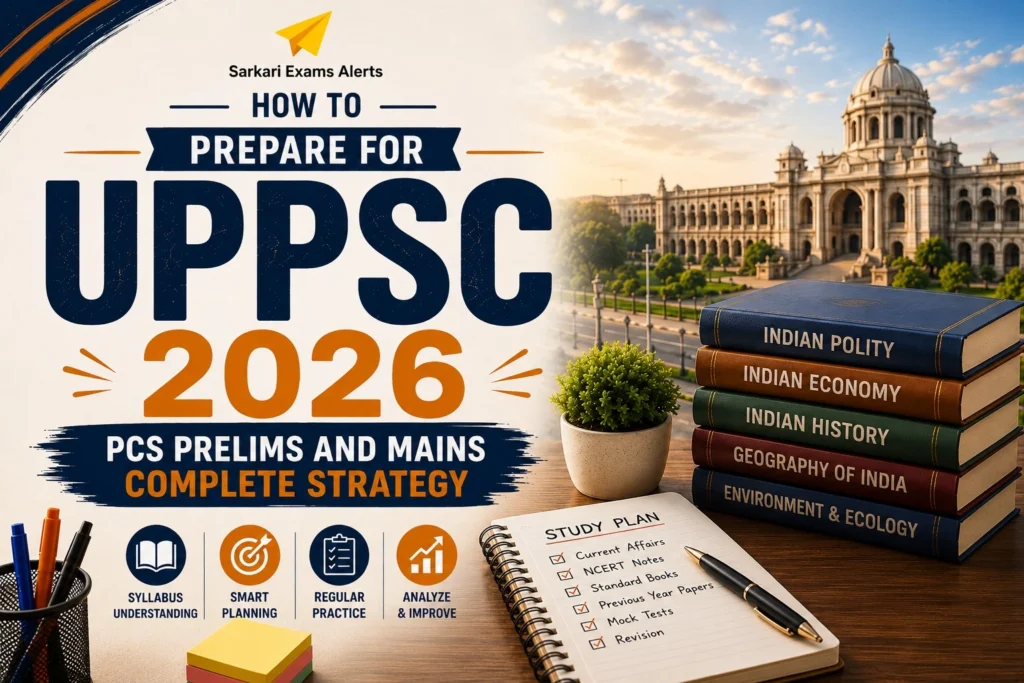
Prepare for UPPSC: The Uttar Pradesh Public Service Commission (UPPSC) conducts the Provincial Civil Services (PCS) Examination to recruit officers for various administrative posts in the Uttar Pradesh government. Every year, lakhs of aspirants compete for a limited number of vacancies, making the UPPSC PCS Exam one of the most competitive state civil services examinations in India.
Cracking the UPPSC PCS 2026 exam requires more than just hard work, it demands a clear understanding of the syllabus, smart time management, regular answer writing practice, and continuous revision. Since the examination consists of multiple stages, candidates need a preparation strategy that covers both objective and descriptive aspects of the exam.
In this comprehensive guide, you’ll learn the complete UPPSC 2026 preparation strategy, including the exam pattern, subject-wise preparation tips for Prelims and Mains, book recommendations, study plan, answer-writing techniques, common mistakes to avoid, and expert preparation tips.
Understanding the UPPSC PCS 2026 Selection Process
Before beginning your UPPSC PCS 2026 preparation, it is important to understand the complete recruitment process. The examination is conducted in multiple stages, and each stage is designed to assess different abilities such as subject knowledge, analytical thinking, decision-making, communication skills, and personality traits. Candidates must successfully qualify at every stage to move forward in the selection process and secure a place in the final merit list.
The UPPSC PCS 2026 Selection Process consists of the following four stages:
- Preliminary Examination (Prelims)
- Main Examination (Mains)
- Personal Interview
- Final Merit List
Also Read: UPPSC GIC Lecturer Admit Card
Stage 1: Preliminary Examination (Prelims)
The Preliminary Examination is the first stage of the UPPSC PCS selection process. It is an objective-type examination conducted to shortlist candidates for the Main Examination. Although the marks obtained in the Prelims are not included in the final merit list, clearing this stage is mandatory to qualify for the Mains.
Since the competition is extremely high, candidates need a strong command of static General Studies subjects, current affairs, and effective time management to score above the cutoff. A well-planned preparation strategy focusing on conceptual understanding and regular mock test practice is essential for success in this stage.
Also Read: UPPSC RO ARO Final Result
Stage 2: Main Examination (Mains)
Candidates who qualify for the Preliminary Examination become eligible to appear for the Main Examination. This is the most important stage of the selection process because the marks obtained in the Mains are considered while preparing the final merit list.
Unlike the objective nature of the Prelims, the Mains examination consists of descriptive papers that evaluate a candidate’s depth of knowledge, analytical thinking, writing ability, logical presentation of ideas, and understanding of administrative and social issues. Candidates are expected to present balanced, well-structured answers supported by relevant examples, government initiatives, constitutional provisions, and current affairs.
Since answer-writing skills play a crucial role in scoring well, aspirants should begin practicing descriptive answers from the early stages of preparation instead of waiting until after clearing the Prelims.
Stage 3: Personal Interview
Candidates who successfully clear the Main Examination are called for the Personal Interview conducted by the Uttar Pradesh Public Service Commission. The interview is designed to assess the overall personality of the candidate rather than simply testing academic knowledge.
During this stage, the interview board evaluates qualities such as communication skills, confidence, leadership ability, decision-making skills, presence of mind, ethical values, awareness of current affairs, and understanding of issues related to Uttar Pradesh and national governance. Questions may also be asked about the candidate’s educational background, work experience, hobbies, optional subjects, and opinions on contemporary social, economic, and administrative issues.
Candidates should stay updated with current affairs, improve their communication skills, and develop a balanced approach to discussing important topics to perform confidently in the interview.
Stage 4: Final Merit List
The final selection is based on the combined performance of candidates in the Main Examination and Personal Interview. The marks obtained in the Preliminary Examination are not considered while preparing the final merit list, as the Prelims serves only as a qualifying stage.
Candidates who secure high marks in the Mains and perform well in the Interview are included in the final merit list and are allotted various administrative posts based on their rank, category, and available vacancies.
UPPSC PCS 2026 Exam Pattern
Understanding the UPPSC PCS 2026 Exam Pattern is equally important before starting your preparation. A clear understanding of the number of papers, nature of questions, and marking scheme enables candidates to create an effective study plan and allocate sufficient time to every subject.
The UPPSC PCS examination is broadly divided into two written stages—Prelims and Mains—followed by the Personal Interview.
UPPSC PCS Prelims Exam Pattern
The Preliminary Examination consists of two objective-type papers conducted in offline mode using multiple-choice questions (MCQs).
General Studies Paper I
General Studies Paper I is the most important paper of the Preliminary Examination because its marks determine whether a candidate qualifies for the Main Examination. The paper covers a wide range of subjects, including Indian History, Geography, Polity, Economy, Environment, Science & Technology, Current Affairs, Government Schemes, and Uttar Pradesh-specific topics.
Success in this paper depends on strong conceptual understanding, continuous revision, regular current affairs preparation, and effective time management during the examination.
General Studies Paper II (CSAT)
General Studies Paper II, commonly known as CSAT (Civil Services Aptitude Test), is a qualifying paper. It assesses a candidate’s aptitude through questions on reading comprehension, logical reasoning, analytical ability, decision making, basic mathematics, and data interpretation.
Although the marks obtained in CSAT are not considered for the merit list, candidates must secure the prescribed qualifying marks to become eligible for the evaluation of General Studies Paper I. Therefore, aspirants should not ignore this paper and should practice reasoning, comprehension, and quantitative aptitude regularly throughout their preparation.
UPPSC PCS Mains Exam Pattern
Candidates who qualify in the Preliminary Examination are shortlisted for the UPPSC PCS Main Examination, which consists of descriptive papers designed to assess in-depth subject knowledge and analytical abilities.
The Mains examination generally includes papers such as:
- General Hindi
- Essay
- General Studies Papers
- Optional/Prescribed papers (as per the latest examination scheme, if applicable)
Unlike the Preliminary Examination, the Mains focuses on the candidate’s ability to analyze issues, present logical arguments, interpret facts, and write well-structured answers within the prescribed word limit and time. Candidates are expected to support their answers with constitutional provisions, government reports, committee recommendations, statistics, examples, and current affairs wherever relevant.
Since descriptive writing is the deciding factor in the Main Examination, aspirants should develop the habit of writing answers daily, improving presentation skills, and practicing time-bound writing well before the examination. Strong conceptual clarity combined with effective answer-writing techniques can significantly improve scores and increase the chances of securing a high rank in the UPPSC PCS 2026 examination.
Prepare for UPPSC PCS 2026 Prelims
1. General Studies
General Studies is the backbone of the UPPSC PCS examination. This section covers History, Geography, Polity, Economy, Environment, Science & Technology, Current Affairs, Uttar Pradesh-specific topics, and Government Schemes.
Instead of memorizing isolated facts, candidates should focus on building conceptual understanding and connecting static subjects with current affairs. Reading NCERT books, standard reference books, newspapers, and government reports regularly helps build a strong foundation. Preparing concise notes and revising them weekly improves retention and reduces revision time before the examination.
2. Current Affairs
Current affairs play a crucial role in both the Prelims and Mains examinations. Aspirants should read a national newspaper daily and stay updated with important developments related to Uttar Pradesh, Indian polity, economy, environment, science, international relations, government schemes, and social issues.
Monthly current affairs magazines, PIB updates, Budget highlights, Economic Survey, and Uttar Pradesh government initiatives should also be included in your preparation. Consistent revision is essential, as current affairs often overlap with static General Studies topics.
3. Indian Polity
Indian Polity is one of the highest-scoring sections in UPPSC PCS. Candidates should thoroughly understand the Constitution, Fundamental Rights, Directive Principles, Parliament, State Legislature, Judiciary, Constitutional Bodies, Local Government, Elections, and Governance.
Instead of rote learning, focus on understanding constitutional provisions and their practical application in governance and administration. Linking current constitutional developments with static topics can significantly improve conceptual clarity.
4. History
History preparation should cover Ancient, Medieval, and Modern Indian History, with special emphasis on the Indian Freedom Movement and the historical contribution of Uttar Pradesh. Candidates should understand major events, reform movements, personalities, and their impact on India’s political and social development.
Preparing chronological timelines and revision notes can help remember important historical events effectively.
5. Geography
Geography includes Physical Geography, Indian Geography, World Geography, and Uttar Pradesh Geography. Candidates should focus on maps, rivers, climate, agriculture, natural resources, industries, and environmental issues.
Understanding geographical concepts rather than memorizing locations enables candidates to answer analytical questions more confidently.
6. Economy
The Economy section evaluates understanding of economic concepts, government policies, banking, inflation, taxation, Budget, Economic Survey, employment, agriculture, and rural development.
Candidates should regularly follow current economic developments and understand how government policies impact society. Basic concepts should be strengthened before moving on to current economic issues.
7. Environment and Ecology
Environmental issues have gained significant importance in recent years. Preparation should include biodiversity, climate change, pollution, wildlife conservation, environmental laws, international conventions, and sustainable development.
Relating environmental concepts with current affairs improves understanding and retention.
8. CSAT
Although CSAT is qualifying in nature, it should never be ignored. This paper assesses comprehension, logical reasoning, analytical ability, quantitative aptitude, and decision-making skills.
Regular practice of comprehension passages, reasoning questions, and basic mathematics is sufficient to comfortably clear the qualifying cutoff.
Importance of Mock Tests
Mock tests help candidates understand the exam pattern, improve time management, identify weak areas, and reduce exam anxiety.
Attempt Prelims mock tests regularly while simultaneously practicing descriptive answer writing for the Mains. Analyze every mock carefully to understand mistakes and improve future performance.
Previous Year Papers
Previous year question papers provide valuable insights into important topics, question trends, and the level of analytical thinking expected by UPPSC.
Solve at least the previous five to ten years’ papers under exam conditions and analyze your answers critically.
Conclusion
Cracking the UPPSC PCS 2026 Examination requires a combination of smart planning, conceptual clarity, disciplined preparation, and consistent revision. Since the examination consists of multiple stages—Prelims, Mains, and Interview—aspirants should adopt an integrated preparation strategy instead of studying for each stage separately. Building a strong foundation in General Studies, staying updated with current affairs, practicing answer writing regularly, and solving mock tests are essential for improving both knowledge and exam performance.
Success in the UPPSC PCS 2026 exam is not determined by the number of books you study but by how effectively you understand concepts, revise important topics, and apply your knowledge in the examination. A focused study plan, regular revision, balanced preparation for Uttar Pradesh-specific topics, and continuous self-evaluation through previous year papers and mock tests can significantly enhance your chances of securing a high rank. Stay consistent, remain patient, and approach every stage of the selection process with confidence to achieve your goal of becoming a Provincial Civil Services Officer in Uttar Pradesh.
Frequently Asked Questions
1. How should I start preparing for UPPSC PCS 2026?
The best way to begin UPPSC PCS 2026 preparation is by thoroughly understanding the latest syllabus and exam pattern. Start with NCERT books to build a strong conceptual foundation, then move on to standard reference books for subjects like Polity, History, Geography, Economy, and Environment. Alongside static subjects, develop the habit of reading daily newspapers, following Uttar Pradesh-specific current affairs, and practicing answer writing regularly for the Mains examination.
2. How many months are required to prepare for the UPPSC PCS 2026 exam?
Most successful candidates recommend 8 to 12 months of dedicated preparation for UPPSC PCS 2026. This duration provides sufficient time to complete the syllabus, revise multiple times, cover current affairs, practice descriptive answer writing, solve previous year papers, and attempt mock tests. Beginners may benefit from starting even earlier to strengthen their fundamentals and improve consistency.
3. Is the CSAT paper compulsory in the UPPSC PCS Preliminary Examination?
Yes, General Studies Paper II (CSAT) is a compulsory qualifying paper in the UPPSC PCS Preliminary Examination. Although its marks are not included in the final merit list, candidates must secure the prescribed qualifying marks to become eligible for the evaluation of General Studies Paper I. Therefore, regular practice of comprehension, logical reasoning, and basic aptitude questions is essential.
4. What are the best books for UPPSC PCS 2026 preparation?
Some of the most recommended books for UPPSC PCS 2026 include M. Laxmikanth’s Indian Polity, Spectrum’s Modern Indian History, Ramesh Singh’s Indian Economy, Shankar IAS Environment, G.C. Leong’s Geography, and NCERT textbooks for building conceptual clarity. Candidates should also follow a national newspaper, monthly current affairs magazines, PIB updates, and Uttar Pradesh government publications to stay updated with current events.
5. Can I crack UPPSC PCS 2026 without coaching?
Yes, it is entirely possible to crack UPPSC PCS 2026 without coaching through disciplined self-study. Many successful candidates have cleared the examination by following a structured study plan, using quality study materials, practicing answer writing consistently, solving previous year question papers, and taking regular mock tests. The key to success lies in maintaining consistency, revising regularly, and continuously evaluating your preparation rather than relying solely on coaching classes.
.