
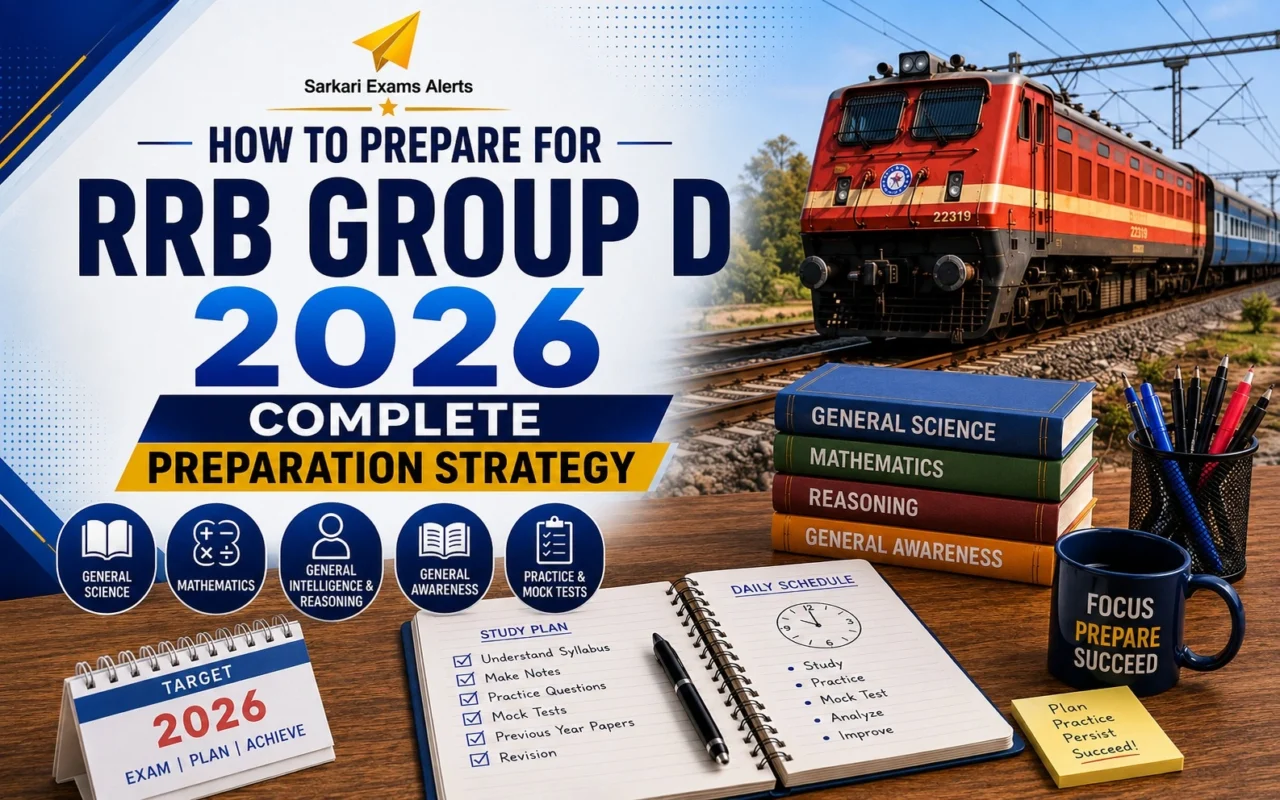
Prepare for RRB Group D: The Railway Recruitment Board (RRB) Group D examination is one of India’s largest government recruitment drives, attracting millions of applicants every year. The recruitment offers opportunities in various Level-1 posts across the Indian Railways, making it an excellent career option for candidates seeking job security, attractive benefits, and long-term growth.
While the syllabus for RRB Group D is comparatively straightforward, the real challenge lies in the intense competition. Since lakhs of candidates compete for a limited number of vacancies, success depends on smart preparation, consistent practice, and effective time management rather than simply studying for long hours.
If you’re planning to appear for RRB Group D 2026, this guide provides a practical roadmap covering every stage of your preparation, from understanding the exam to clearing the Computer Based Test (CBT) and preparing for the Physical Efficiency Test (PET).
How to Prepare for RRB Group D After 10th
Class 10 pass candidates are the primary applicant pool. Your school subjects directly cover the CBT syllabus. NCERT Maths, Science, and Social Studies from Class 6 to 10 contain almost everything you need. Start preparation immediately after Class 10 if this is your target career. 2 to 3 months of focused preparation is sufficient.
Stage 1: Understand the Examination Before You Start
Every successful preparation begins with understanding the examination itself. Before creating a study timetable, familiarize yourself with the latest syllabus, exam pattern, marking scheme, and selection process.
The RRB Group D recruitment process generally includes:
Computer Based Test (CBT)
Physical Efficiency Test (PET)
Document Verification
Medical Examination
Since only candidates who qualify the CBT are called for the PET, your primary focus should initially be on scoring well in the written examination while gradually building your physical fitness.
Stage 2: Build a Strong Foundation
Many aspirants immediately jump into solving mock tests without strengthening their basics. This often leads to repeated mistakes and low confidence.
Spend the first phase of your preparation understanding fundamental concepts in Mathematics, Reasoning, General Science, and General Awareness. Build conceptual clarity before focusing on shortcuts or advanced tricks.
Once your basics are clear, solving objective questions becomes much easier and significantly improves your confidence.
Also Read: RRB Group D Exam City Intimation Slip
Stage 3: Master Mathematics Through Daily Practice
Mathematics is one of the most scoring sections in RRB Group D, provided you practice consistently. Rather than studying numerous topics at once, focus on mastering one chapter before moving to the next.
Start with Arithmetic topics such as Percentage, Ratio and Proportion, Profit and Loss, Average, Time and Work, Time, Speed and Distance, and Simple Interest. Once comfortable, gradually move towards Algebra, Geometry, Mensuration, and Data Interpretation.
Instead of memorizing formulas, understand their practical applications and revise them every week.
Stage 4: Improve Logical Thinking Through Reasoning
Reasoning Ability rewards regular practice more than memorization. The more question patterns you solve, the quicker you become at identifying logical relationships.
Dedicate daily practice sessions to topics like Coding-Decoding, Blood Relations, Number Series, Alphabet Series, Direction Sense, Syllogism, Seating Arrangement, Analogies, Classification, and Puzzle-based questions.
Initially focus on accuracy. Speed will naturally improve as you become familiar with different question types.
Stage 5: Prepare General Science Conceptually
The General Science section in RRB Group D is primarily based on concepts studied up to Class 10 level.
Rather than reading advanced books, strengthen your understanding of basic Physics, Chemistry, and Biology through NCERT textbooks. Focus on scientific principles, everyday applications, environmental science, human biology, electricity, motion, chemical reactions, and basic physics concepts.
Conceptual clarity will help you answer unfamiliar questions with greater confidence.
Stage 6: Treat General Awareness as a Daily Activity
General Awareness cannot be mastered in the final month before the examination. It requires consistent preparation throughout your journey.
Spend 30–45 minutes daily reading current affairs, government schemes, railway-related developments, sports, awards, important personalities, history, geography, polity, economy, and science updates.
Preparing monthly revision notes will make the final revision much easier.
Stage 7: Solve Previous Years’ Papers
Previous years’ question papers remain one of the most valuable preparation resources because they provide insight into the actual examination pattern and frequently repeated concepts.
Attempt these papers in a timed environment and evaluate your performance honestly. Identify weak areas, revise the related concepts, and solve similar questions until you become comfortable with them.
This practice not only improves accuracy but also boosts confidence before the examination.
Stage 8: Include Mock Tests in Your Weekly Routine
Mock tests help bridge the gap between preparation and actual performance.
Initially, attempt sectional tests after completing individual subjects. Once a major portion of the syllabus is complete, begin solving full-length mock tests every week.
Don’t focus only on your score. Analyze every mock carefully to understand why mistakes occurred and how they can be avoided in the future.
A detailed mock test analysis is often more valuable than attempting multiple tests without reviewing them.
Stage 9: Build Fitness for the Physical Efficiency Test (PET)
One of the biggest mistakes candidates make is preparing for the PET only after clearing the CBT.
The Physical Efficiency Test is qualifying in nature, but failing it means losing the opportunity despite performing well in the written examination.
Develop a simple fitness routine alongside your academic preparation. Include regular walking, jogging, running, stretching, and endurance exercises several times a week. Building stamina gradually is much safer and more effective than intensive training at the last moment.
Stage 10: Revise Smarter During the Final Months
The last two months before the examination should focus on strengthening what you’ve already learned rather than starting entirely new topics.
Revise short notes, formulas, important current affairs, and frequently asked concepts. Continue taking mock tests, but spend more time analyzing them than simply attempting new papers.
Avoid switching between multiple books or learning new shortcut methods at this stage. Confidence comes from revision, not from collecting additional study material.
A Daily Study Routine for RRB Group D Aspirants
Following a structured routine helps maintain consistency and prevents last-minute stress.
| Time | Activity |
|---|---|
| 7:00 AM – 7:45 AM | Current Affairs & Newspaper Reading |
| 8:00 AM – 9:30 AM | Mathematics Practice |
| 10:00 AM – 11:30 AM | Reasoning Ability |
| 2:00 PM – 3:00 PM | General Science |
| 3:00 PM – 4:00 PM | General Awareness |
| 5:00 PM – 6:00 PM | Previous Year Questions |
| 7:00 PM – 8:00 PM | Mock Test / Revision |
| 8:00 PM onwards | Light Exercise / PET Preparation |
Common Mistakes to Avoid
Many candidates miss the cutoff because of simple mistakes during preparation.
Some common mistakes include:
- Ignoring the Physical Efficiency Test until the written exam is over.
- Studying from multiple books instead of revising a few reliable resources.
- Avoiding mock tests because of low scores.
- Ignoring current affairs.
- Practicing without a timer.
- Spending excessive time on difficult questions.
- Skipping revision after completing the syllabus.
Conclusion
Preparing for RRB Group D 2026 is not about studying the most hours—it’s about following the right strategy consistently. Build strong fundamentals, practice Mathematics and Reasoning daily, strengthen your General Science concepts, stay updated with current affairs, and solve mock tests regularly.
At the same time, don’t overlook the Physical Efficiency Test. Developing physical fitness alongside academic preparation ensures that you’re ready for every stage of the recruitment process.
With disciplined preparation, consistent revision, and regular practice, you can maximize your score in the CBT and confidently move towards securing a position in the Indian Railways.
Frequently Asked Questions
- How should I start preparing for RRB Group D 2026?
Begin by understanding the latest syllabus and exam pattern. Build strong fundamentals in Mathematics, Reasoning, General Science, and General Awareness, then gradually move to mock tests and previous years’ papers while maintaining a consistent study schedule.
- Is the Physical Efficiency Test (PET) important in RRB Group D?
Yes. The PET is a qualifying stage of the selection process. Candidates who clear the CBT must also qualify the Physical Efficiency Test to proceed further in the recruitment process. Starting fitness preparation early is highly recommended.
- Which books are best for RRB Group D 2026 preparation?
Candidates can prepare using Quantitative Aptitude by R.S. Aggarwal for Mathematics, A Modern Approach to Verbal & Non-Verbal Reasoning for Reasoning, Lucent’s General Knowledge for General Awareness, NCERT Science books for General Science, along with previous years’ papers and quality mock tests.
- How many hours should I study daily for RRB Group D 2026?
Most successful candidates study 4–6 focused hours every day. Instead of concentrating on study hours alone, prioritize completing daily targets, revising regularly, solving mock tests, and maintaining consistency throughout your preparation.
- Are previous years’ question papers enough for RRB Group D preparation?
Previous years’ papers are an essential resource because they help you understand the exam pattern and important topics. However, they should be supplemented with regular mock tests, conceptual study, current affairs preparation, and systematic revision for the best results.