
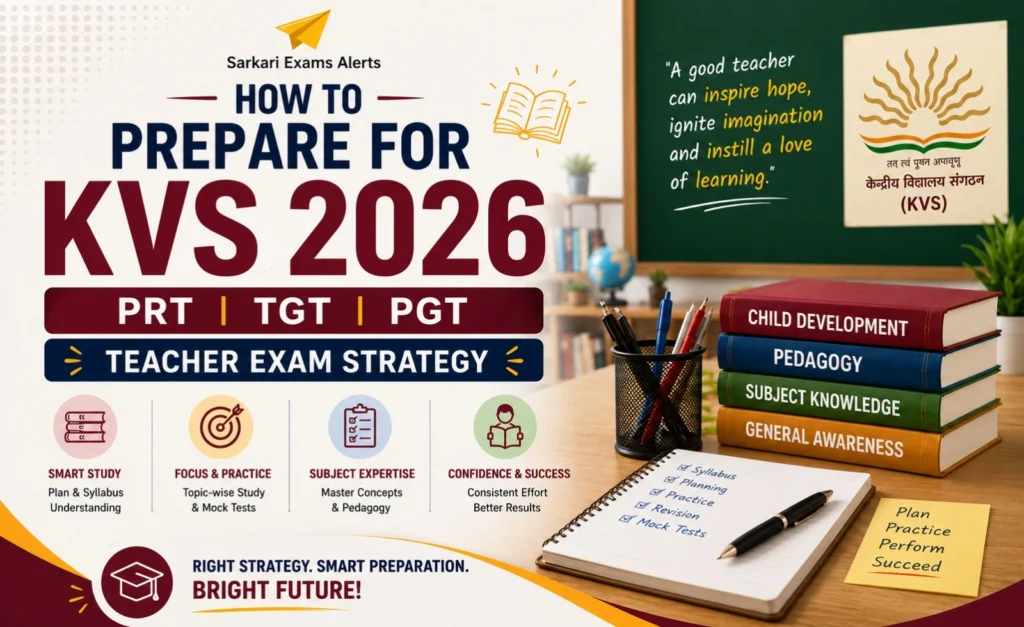
Prepare for KVS: If your dream is to become a teacher in a Kendriya Vidyalaya (KV), then the KVS Recruitment 2026 is one of the biggest opportunities to secure a prestigious central government teaching job. Every year, thousands of teaching aspirants compete for vacancies across Primary Teacher (PRT), Trained Graduate Teacher (TGT), and Post Graduate Teacher (PGT) posts, making the competition tougher than ever.
However, clearing the KVS examination isn’t just about studying hard, it’s about studying smart. Candidates who understand the latest exam pattern, prepare according to the syllabus, strengthen their teaching concepts, and practice consistently are far more likely to secure a place in the final merit list.
Whether you’re a first-time aspirant or preparing for another attempt, this comprehensive guide will help you understand how to prepare for KVS 2026, including post-wise strategies for PRT, TGT, and PGT, subject-wise preparation tips, study plans, book recommendations, mock test strategy, and common mistakes to avoid. Let’s understand how you can prepare effectively and maximize your chances of becoming a KVS teacher.
What is KVS?
KVS (Kendriya Vidyalaya Sangathan) is an autonomous body under Ministry of Education running Kendriya Vidyalayas primarily for children of central government employees. KVS teachers get Pay Level 7 (TGT, Rs 44,900 basic), Level 8 (PGT, Rs 47,600 basic). In-hand salary with HRA and other allowances approximately Rs 60,000 to Rs 85,000. B.Ed is compulsory. CTET qualification is additionally required (NVS requires CTET for TGT posts, KVS accepts both CTET and its own test).
Prepare for KVS Teacher Written Test
General English (10 marks), General Hindi (10 marks), General Knowledge and Current Affairs (10 marks), Reasoning Ability (10 marks), Computer Literacy (10 marks), Pedagogy (20 marks for PRT, 30 marks for TGT), Subject Knowledge (80 marks for TGT/PGT). Subject Knowledge is the most important component, prepare your subject from NCERT Class 6-10 for TGT and Class 11-12 for PGT thoroughly. Pedagogy section covers teaching methods, learning theories, assessment, KVS specific pedagogy books available. Previous year KVS papers from Arihant Publication are essential.
| KVS NVS Tier 2 Answer Key | KVS Syllabus |
| KVS Application Form | KVS NVS Tier 2 Admit Card |
| KVS Admission | KVS City Intimation Slip |
Subject-Wise Preparation Strategy for KVS 2026
Preparing for KVS is not about completing one subject after another without direction. The most successful candidates follow an integrated preparation strategy where each subject complements the others. Instead of studying randomly, focus on building strong fundamentals first and gradually move towards advanced practice and revision.
Strengthen Your General Aptitude First
General English, General Hindi, Reasoning Ability, Numerical Ability, Computer Literacy, and General Knowledge are common sections in the KVS written examination. Since these subjects require regular practice rather than last-minute preparation, dedicate at least two to three hours every day to them.
For English and Hindi, improve your grammar, vocabulary, comprehension, and sentence correction skills through consistent practice. In Reasoning and Numerical Ability, focus on understanding concepts first and then solving topic-wise questions to improve speed and accuracy. Computer Literacy can be prepared through basic concepts such as MS Office, operating systems, networking, internet applications, and digital technologies.
General Knowledge should be prepared alongside Current Affairs rather than as a separate subject. Reading a quality newspaper and revising monthly current affairs will help you cover important national and international events, government schemes, education policies, science developments, and awards.
Give Maximum Importance to Your Teaching Subject
The subject-specific section plays a crucial role in determining your final score, especially for TGT and PGT candidates. Whether your specialization is Mathematics, English, Hindi, Commerce, Physics, Chemistry, Biology, Computer Science, Economics, History, Geography, or any other subject, complete the syllabus systematically instead of studying randomly.
Start by understanding each topic conceptually, prepare concise notes in your own language, revise them regularly, and solve previous-year questions after completing every unit. This approach not only strengthens your concepts but also helps you identify frequently asked topics and improves retention.
Avoid collecting too many study materials. One reliable textbook, combined with thorough revision and practice, is far more effective than reading multiple books only once.
Don’t Ignore Teaching Aptitude and Pedagogy
Many candidates spend months preparing their academic subject but overlook teaching methodology and pedagogy. Since KVS recruits teachers, your understanding of classroom teaching, learning theories, assessment methods, inclusive education, classroom management, and educational psychology is equally important.
Instead of memorising definitions, try relating these concepts to real classroom situations. This practical understanding will not only help in the written examination but also during the demo teaching and interview stage.
A Practical 90-Day Study Plan for KVS 2026
Preparing for the KVS 2026 Teacher Recruitment Exam becomes much easier when you divide your preparation into manageable phases instead of trying to complete the entire syllabus at once. A structured 90-day study plan helps you cover the syllabus systematically, revise effectively, and dedicate sufficient time to mock tests and teaching practice before the examination.
Here’s a practical three-month preparation roadmap that can help both beginners and repeat aspirants.
First 30 Days: Build Your Foundation
The first month should be dedicated to understanding the examination and building strong conceptual clarity. Avoid rushing to complete the syllabus. Instead, focus on understanding every topic thoroughly, as strong fundamentals will make revision and mock tests much easier later.
Start by carefully going through the latest KVS syllabus and exam pattern for your respective post, PRT, TGT, or PGT. Divide the syllabus into weekly targets and create a realistic timetable that you can consistently follow.
During this phase, your primary goals should include:
- Understanding the latest syllabus and exam pattern.
- Building strong fundamentals in General English, Hindi, Reasoning, Numerical Ability, Computer Literacy, and General Knowledge.
- Completing nearly 40–50% of your subject-specific syllabus with conceptual clarity.
- Beginning daily Current Affairs preparation through newspapers or monthly magazines.
- Solving basic topic-wise practice questions after completing each chapter.
- Preparing short handwritten notes for quick revision later.
Next 30 Days: Complete the Syllabus and Start Testing Yourself
Once your basics are clear, the second month should focus on completing the remaining syllabus while gradually shifting towards exam-oriented preparation.
This is the phase where you should increase your question-solving practice and begin evaluating your preparation through previous-year papers and sectional mock tests. During these 30 days, focus on:
- Completing the remaining subject-specific topics.
- Solving previous-year KVS question papers to understand the exam trend and frequently asked concepts.
- Attempting sectional mock tests for individual subjects like Reasoning, Pedagogy, General Knowledge, and your teaching subject.
- Preparing concise revision notes containing formulas, important concepts, definitions, teaching theories, and frequently revised topics.
- Identifying weak subjects and allocating extra study time to improve them.
- Continuing daily Current Affairs preparation and weekly revision.
Final 30 Days: Revise, Practise, and Improve Your Exam Performance
The last month before the examination should be dedicated entirely to revision, mock tests, and confidence building. This is not the right time to start new books or unfamiliar topics. Instead, concentrate on strengthening what you have already studied.
During this phase, revise your handwritten notes repeatedly and attempt full-length mock tests under actual exam conditions. Analyse every mock carefully to identify mistakes, improve time management, and strengthen weak areas. Your priorities during the final month should include:
- Revising the complete syllabus multiple times.
- Attempting regular full-length mock tests to improve speed and accuracy.
- Analysing every mock test instead of focusing only on scores.
- Revising Current Affairs, Teaching Aptitude, and Pedagogy thoroughly.
- Practising lesson planning, classroom communication, and demo teaching if applicable to your recruitment process.
- Working on time management, accuracy, and confidence rather than learning new topics.
Previous Year Papers and Mock Tests: Your Most Powerful Preparation Tools
Completing the syllabus is only one part of the preparation journey. The real improvement begins when you start evaluating yourself through previous-year papers and mock tests.
Previous-year question papers help you understand the level of the examination, identify frequently asked topics, improve time management, and recognise your weak areas. Solve at least the last five to ten years’ relevant papers to become familiar with the exam trend.
Similarly, include mock tests in your weekly preparation plan. During the initial months, attempt sectional tests after completing major topics. As the examination approaches, shift to full-length mock tests that simulate the actual exam environment.
Most importantly, analyse every mock test carefully. Your mistakes reveal which concepts need more revision and where you are losing marks. Consistent analysis and improvement are what separate successful candidates from the rest.
Best Books for KVS 2026 Preparation
| Subject | Recommended Books |
|---|---|
| Child Development & Pedagogy | Arihant CTET & Teaching Aptitude Books |
| Reasoning | R.S. Aggarwal |
| Quantitative Aptitude | R.S. Aggarwal |
| English | Objective General English by S.P. Bakshi |
| Hindi | Lucent Samanya Hindi |
| General Knowledge | Lucent General Knowledge |
| Computer Awareness | Arihant Computer Awareness |
| Subject-Specific | NCERT + Standard Graduation/Postgraduation Textbooks |
Conclusion
Cracking the KVS 2026 Teacher Recruitment Exam requires much more than completing the syllabus. It demands a well-planned preparation strategy, conceptual clarity, regular revision, and continuous practice. Whether you are preparing for PRT, TGT, or PGT, your success depends on maintaining consistency, strengthening your teaching subject, improving your pedagogical understanding, and regularly evaluating your performance through mock tests and previous-year question papers.
Remember that becoming a Kendriya Vidyalaya teacher is not only about qualifying an examination, it is about demonstrating the knowledge, teaching skills, and confidence expected from an educator. If you prepare with discipline, stay updated with the latest KVS notifications, and follow a structured study plan, you can significantly improve your chances of securing a teaching position in KVS Recruitment 2026.
Frequently Asked Questions (FAQs)
1. How should I start preparing for KVS 2026?
Begin by understanding the latest KVS 2026 syllabus and exam pattern for your target post. Create a realistic study timetable, complete the syllabus systematically, strengthen your subject knowledge, practise mock tests regularly, and revise consistently.
2. Is the preparation strategy for KVS PRT, TGT, and PGT the same?
No. While sections like General English, Hindi, Reasoning, Computer Literacy, and General Knowledge are common, PRT focuses more on pedagogy and elementary teaching concepts, TGT requires strong graduation-level subject knowledge, and PGT demands postgraduate-level conceptual understanding along with teaching competence.
3. Are CTET-qualified candidates at an advantage in KVS preparation?
Yes. Candidates who have already prepared for CTET often find significant overlap in topics such as Child Development & Pedagogy, teaching aptitude, classroom management, and educational psychology, particularly for PRT and TGT posts. However, subject-specific preparation remains equally important.
4. How important are previous-year papers and mock tests for KVS 2026?
Previous-year papers and mock tests are among the most valuable preparation resources. They help candidates understand the exam pattern, identify important topics, improve time management, enhance accuracy, and build confidence before the actual examination.
5. How can I prepare for the KVS Demo Teaching and Interview?
Start preparing early by practising lesson planning, explaining concepts clearly, improving classroom communication, and developing confidence in delivering short teaching demonstrations. Reading about child-centric teaching methods and educational psychology also helps perform better during the Professional Competency Test.