
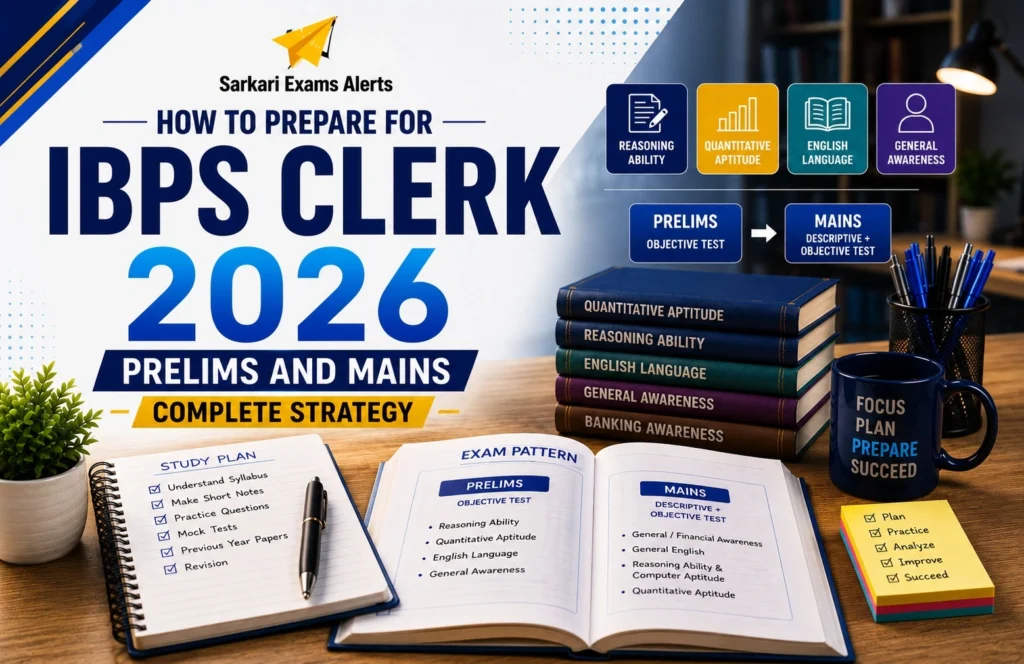
Prepare for IBPS Clerk: The IBPS Clerk examination is one of the most popular banking recruitment exams in India, attracting lakhs of aspirants every year. It offers an excellent opportunity to build a stable career in public sector banks as a Customer Service Associate (formerly Clerk). The role comes with job security, career growth, attractive salary, and valuable banking experience.
However, with increasing competition every year, clearing the IBPS Clerk 2026 examination requires much more than hard work. Candidates need a structured preparation strategy that focuses on speed, accuracy, conceptual clarity, and consistent revision.
Since the recruitment process consists of Preliminary Examination and Main Examination (there is no interview for IBPS Clerk), aspirants should prepare for both stages simultaneously instead of waiting until after the Preliminary exam. The final selection is based on performance in the Main Examination.
This complete guide covers everything you need to know about preparing for IBPS Clerk 2026, including the exam pattern, subject-wise strategy, best books, daily study plan, revision techniques, and common mistakes to avoid.
What Should Be Your IBPS Clerk 2026 Preparation Strategy?
Success in the IBPS Clerk examination comes from consistency rather than studying for long hours. Divide your preparation into different phases to ensure complete syllabus coverage and sufficient revision.
Start by strengthening your fundamentals in Quantitative Aptitude, Reasoning, and English. Once your basics are clear, solve chapter-wise questions and previous years’ papers. As your preparation improves, include sectional tests, full-length mock tests, and daily current affairs revision in your routine.
Instead of collecting multiple books, revise a few trusted resources repeatedly. Regular practice and mock test analysis will gradually improve your speed and accuracy.
Also Read: IBPS Clerk Mains Result
Prepare for IBPS Clerk Prelims
The Preliminary Examination is primarily a test of speed. Candidates have only 60 minutes to solve 100 questions with sectional timing, making time management extremely important.
Your preparation should focus on understanding concepts first and then improving solving speed through continuous practice. Solving previous years’ question papers and sectional mock tests helps familiarize you with the examination pattern and improves confidence.
English Language Strategy
English is one of the easiest sections to improve with regular practice. Instead of memorizing grammar rules alone, develop strong reading habits and improve vocabulary gradually.
Read newspaper editorials or business news daily to strengthen comprehension skills. Practice Reading Comprehension, Cloze Tests, Error Detection, Sentence Improvement, Fill in the Blanks, and Para Jumbles regularly. Learning new vocabulary every day also improves performance in multiple question types.
Consistent practice is more effective than studying English occasionally.
Numerical Ability Strategy
Numerical Ability requires conceptual understanding as well as calculation speed. Many candidates lose marks because they spend too much time solving lengthy calculations.
Begin with Arithmetic topics such as Percentage, Profit and Loss, Ratio and Proportion, Average, Time and Work, Time, Speed and Distance, and Simple and Compound Interest. Once these topics are mastered, move to Number Series, Simplification, Approximation, Quadratic Equations, and Data Interpretation.
Daily practice with a timer helps improve calculation speed and reduces mistakes during the examination.
Reasoning Ability Strategy
Reasoning Ability is often considered the highest-scoring section in the IBPS Clerk examination. Since most questions are logic-based, consistent practice can significantly improve your score.
Focus on Seating Arrangement, Puzzles, Blood Relations, Coding-Decoding, Inequalities, Direction Sense, Syllogism, Order and Ranking, and Alphanumeric Series. Start with easy-level questions before gradually solving high-level puzzles under time constraints.
Regular mock practice is the best way to improve reasoning speed.
IBPS Clerk Mains Preparation Strategy
The Main Examination is more competitive than the Preliminary Examination and requires a deeper understanding of concepts. Candidates should prepare for the Mains from the beginning instead of waiting until the Preliminary results are announced.
General & Financial Awareness Strategy
General Awareness plays a decisive role in the Main Examination because it can be prepared efficiently with regular reading and revision.
Read newspapers daily and prepare monthly notes covering banking awareness, RBI updates, financial institutions, government schemes, economy, budget, banking terminology, appointments, awards, important reports, and current affairs.
Monthly revision is essential because current affairs become difficult to remember if left until the final weeks.
Quantitative Aptitude Strategy
The Quantitative section in the Main Examination is more analytical than in the Preliminary Examination.
Strengthen your arithmetic concepts before practicing advanced Data Interpretation, Caselet DI, Missing DI, Quantity Comparison, Probability, and Data Sufficiency questions.
Focus on improving both speed and question selection, as attempting every question is not always the best strategy.
Reasoning Ability Strategy
Reasoning questions in the Main Examination are more complex and require analytical thinking.
Practice advanced Seating Arrangements, High-Level Puzzles, Input-Output, Data Sufficiency, Logical Reasoning, Statement-Based Questions, Critical Reasoning, and Machine Input regularly.
The key to mastering this section is solving different varieties of puzzles every day.
English Language Strategy
The English section in the Main Examination evaluates comprehension, grammar, and vocabulary at a higher level.
Continue reading newspapers and editorials while practicing Reading Comprehension, Vocabulary-Based Questions, Sentence Connectors, Error Detection, and Para Completion. Developing reading speed helps improve both accuracy and time management.
Best Books for IBPS Clerk 2026 Preparation
Choosing the right study material simplifies preparation and prevents unnecessary confusion.
| Subject | Recommended Books |
|---|---|
| Quantitative Aptitude | Quantitative Aptitude by R.S. Aggarwal, Fast Track Arithmetic by Rajesh Verma |
| Reasoning Ability | A Modern Approach to Verbal & Non-Verbal Reasoning by R.S. Aggarwal |
| English Language | Objective General English by S.P. Bakshi |
| Banking & Financial Awareness | Arihant Banking Awareness, Monthly Banking Capsules |
| Current Affairs | The Hindu, Indian Express, Monthly Current Affairs Magazine |
| Practice | Previous Year Papers and Online Mock Tests |
Daily Study Plan for IBPS Clerk 2026
A disciplined daily routine ensures complete syllabus coverage while leaving sufficient time for revision.
| Time | Activity |
|---|---|
| 7:00 AM – 8:00 AM | Newspaper & Current Affairs |
| 8:00 AM – 10:00 AM | Quantitative Aptitude |
| 10:30 AM – 12:00 PM | Reasoning Ability |
| 2:00 PM – 3:30 PM | English Language |
| 4:00 PM – 5:00 PM | Banking Awareness |
| 6:00 PM – 7:00 PM | Sectional Mock Test |
| 8:00 PM – 9:00 PM | Revision & Error Analysis |
Mock Test and Revision Strategy
Mock tests are one of the most effective tools for improving exam performance. Begin with sectional tests after completing individual topics and gradually move to full-length mock tests under actual exam conditions.
After every mock test, spend time analyzing incorrect answers instead of immediately attempting another paper. Identify whether mistakes occurred because of conceptual gaps, calculation errors, poor question selection, or time management issues.
Maintain an error notebook and revise it regularly to avoid repeating the same mistakes.
Conclusion
Cracking IBPS Clerk 2026 requires smart preparation, consistent practice, and disciplined revision. Instead of focusing only on clearing the Preliminary Examination, prepare simultaneously for both Prelims and Mains. Strengthen your fundamentals in Quantitative Aptitude, Reasoning, and English while dedicating regular time to Banking Awareness and Current Affairs.
Make mock tests a regular part of your preparation, revise short notes frequently, and continuously analyze your performance to identify weak areas. Remember that success in the IBPS Clerk examination is not about studying the longest hours—it is about studying with consistency and following the right strategy.
With a structured study plan, regular practice, and confidence in your preparation, you can significantly improve your chances of securing a position as a Customer Service Associate in a public sector bank.
Frequently Asked Questions
How should I start preparing for IBPS Clerk 2026?
Begin by understanding the latest exam pattern and syllabus. Build strong fundamentals in Numerical Ability, Reasoning Ability, and English Language while preparing Banking Awareness and Current Affairs alongside. Follow a structured timetable and practice mock tests regularly.
- Which books are best for IBPS Clerk 2026 preparation?
Some of the most recommended books include Quantitative Aptitude by R.S. Aggarwal, A Modern Approach to Verbal & Non-Verbal Reasoning, Objective General English by S.P. Bakshi, banking awareness books, and previous years’ question papers. Regular mock tests are equally important for success.
- How many hours should I study daily for IBPS Clerk 2026?
Most successful candidates study 4–6 focused hours daily. Working professionals can also prepare effectively by studying consistently for 3–4 productive hours every day. Completing daily targets and revising regularly is more important than the total number of study hours.
- Is current affairs important for the IBPS Clerk Mains exam?
Yes. General and Financial Awareness is an important scoring section in the Main Examination. Candidates should regularly read newspapers, banking news, RBI updates, government schemes, and monthly current affairs magazines to perform well in this section.
- Are mock tests necessary to crack IBPS Clerk 2026?
Absolutely. Mock tests improve speed, accuracy, time management, and confidence while helping candidates understand the latest exam pattern. Analyzing every mock test and correcting mistakes is one of the most effective ways to improve your score and increase your chances of selection.