
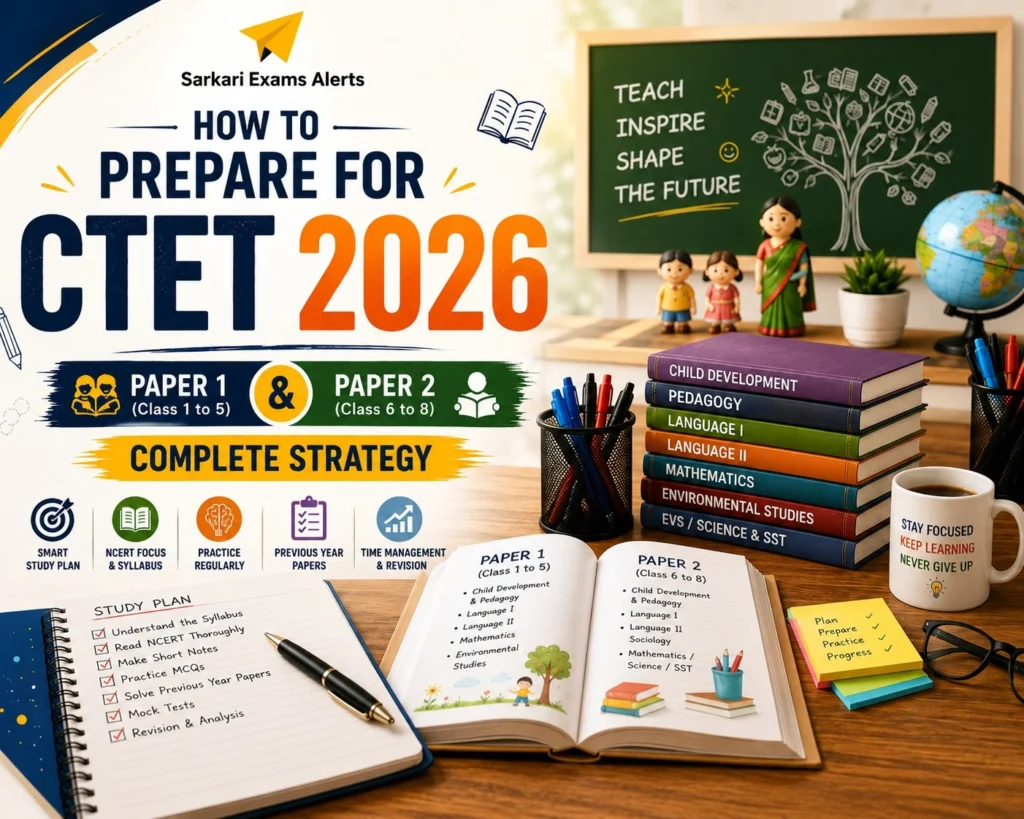
Prepare for CTET: The Central Teacher Eligibility Test (CTET) is one of the most important teaching eligibility examinations in India. Conducted by the Central Board of Secondary Education (CBSE), CTET serves as the qualifying examination for candidates aspiring to become teachers in central government schools such as Kendriya Vidyalaya (KVS), Navodaya Vidyalaya (NVS), and other schools accepting CTET scores. Qualifying the CTET 2026 Exam not only enhances your teaching credentials but also opens the door to various state and central teaching recruitment opportunities.
Although CTET is considered a qualifying examination, the level of competition continues to grow every year as lakhs of candidates appear for the exam. Success requires more than simply reading textbooks—it demands conceptual clarity, a strong understanding of child pedagogy, regular practice, and an effective revision strategy.
Whether you are preparing for CTET Paper 1 (Classes I–V) or CTET Paper 2 (Classes VI–VIII), this comprehensive guide will help you understand how to prepare efficiently with a structured study plan, subject-wise strategy, preparation tips, revision techniques, and common mistakes to avoid.
What is CTET?
CTET stands for Central Teacher Eligibility Test. CBSE conducts it twice a year. CTET qualification is mandatory to apply for teaching posts in central government schools. Paper 1 qualifies candidates for teaching Classes 1 to 5 (Primary). Paper 2 qualifies for Classes 6 to 8 (Upper Primary). Candidates can appear for both papers in the same examination cycle.
Understanding the CTET 2026 Exam
Before beginning your preparation, it is important to understand the purpose of the CTET examination. Unlike recruitment exams, CTET is an eligibility test, meaning candidates who secure the prescribed qualifying marks receive a CTET certificate, making them eligible to apply for teaching positions in schools that recognize CTET scores.
The examination primarily evaluates a candidate’s teaching aptitude, subject knowledge, child psychology, classroom understanding, language proficiency, and pedagogical skills. Therefore, preparation should focus on conceptual understanding instead of rote memorization.
Also Read: CTET Application Form
Prepare for CTET Paper 1 vs Paper 2
Candidates often get confused about which paper they should appear for.
CTET Paper 1
Paper 1 is intended for candidates who wish to teach Classes I to V (Primary Level). The paper emphasizes Child Development & Pedagogy, Language I, Language II, Mathematics, and Environmental Studies.
CTET Paper 2
Paper 2 is designed for candidates aspiring to teach Classes VI to VIII (Upper Primary Level). Along with Child Development & Pedagogy and language papers, candidates choose either Mathematics & Science or Social Studies/Social Science depending on their teaching specialization.
Subject-Wise Preparation Strategy
Students are advised to check out all the subject-wise preparation strategy for CTET examination mentioned below:
Child Development & Pedagogy (CDP)
Child Development & Pedagogy is one of the most important and highest-scoring sections in both CTET papers. Instead of memorizing educational theories, candidates should understand child psychology, learning theories, inclusive education, teaching methodologies, classroom management, and assessment techniques. Focus on applying concepts to classroom situations, as many questions are application-based rather than theoretical.
Language I
Language I evaluates a candidate’s proficiency in the language chosen as the medium of instruction. Preparation should focus on grammar, vocabulary, reading comprehension, language pedagogy, and effective communication skills. Reading regularly and practicing comprehension passages can improve both accuracy and confidence.
Language II
Language II assesses comprehension and communication in a second language. Instead of focusing only on grammar rules, candidates should develop reading habits, improve vocabulary, and practice pedagogy-related questions. Understanding language acquisition and teaching methods is equally important.
Mathematics
Mathematics preparation should emphasize conceptual clarity rather than formula memorization. Candidates should revise basic arithmetic, geometry, algebra (for Paper 2), and mathematical pedagogy. Solve practice questions regularly and focus on explaining concepts the way a teacher would teach students.
Environmental Studies (Paper 1)
Environmental Studies combines concepts from science, social science, and environmental awareness. Focus on understanding everyday concepts, classroom applications, teaching methods, and NCERT-based topics. Instead of memorizing facts, learn how to explain concepts in a child-friendly manner.
Mathematics & Science (Paper 2)
Candidates opting for Mathematics & Science should strengthen subject knowledge while also preparing pedagogical concepts. Questions often evaluate teaching methods, conceptual understanding, laboratory activities, misconceptions among learners, and practical classroom situations.
Social Studies/Social Science (Paper 2)
Candidates choosing Social Studies should focus on History, Geography, Political Science, Economics, and Social Science pedagogy. Understanding how to teach concepts effectively is as important as mastering the subject itself.
14 Expert Preparation Tips for CTET 2026
Preparing for the CTET 2026 Examination requires more than simply completing the syllabus. Since CTET evaluates a candidate’s subject knowledge as well as teaching aptitude, aspirants should focus on conceptual learning, pedagogy, regular practice, and continuous revision. The following expert tips will help you prepare more effectively and improve your chances of qualifying for both CTET Paper 1 and Paper 2.
- Understand the Latest CTET Syllabus Thoroughly
Before starting your preparation, carefully read the latest CTET syllabus and exam pattern released by CBSE. Understanding the syllabus helps you identify important topics, prioritize high-weightage sections, and avoid spending time on irrelevant material. Create a subject-wise study plan based on the official syllabus so that every important topic is covered systematically.
- Strengthen Child Development & Pedagogy
Child Development & Pedagogy (CDP) is one of the most important sections in both CTET papers and often determines the overall score. Instead of memorizing educational theories and definitions, focus on understanding concepts such as child psychology, learning theories, inclusive education, classroom management, assessment methods, and teaching strategies. Many questions are application-based, requiring candidates to apply pedagogical principles to classroom situations rather than simply recalling facts.
- Read NCERT Books Carefully
NCERT textbooks are considered one of the best resources for CTET preparation because many questions are directly or indirectly based on NCERT concepts and teaching methodologies. Study NCERT books thoroughly, especially for Mathematics, Environmental Studies, Science, and Social Studies. Pay attention to the teaching approach used in these books, as CTET frequently tests pedagogical understanding alongside subject knowledge.
- Focus on Teaching Methodology
Unlike many competitive examinations, CTET evaluates your ability to teach rather than just your academic knowledge. Candidates should understand child-centered learning, activity-based teaching, constructivist approaches, classroom management techniques, lesson planning, learning outcomes, and evaluation methods. Developing a teacher’s perspective while studying every subject will help you answer pedagogy-based questions more accurately.
- Practice Previous Year Papers Regularly
Previous year question papers provide valuable insights into the examination pattern, frequently asked concepts, and the difficulty level of questions. Solving these papers under timed conditions helps improve speed, accuracy, and confidence while familiarizing you with the type of pedagogy-based and conceptual questions asked in CTET. Make it a habit to analyze every paper carefully to identify recurring themes and your weaker areas.
- Attempt Weekly Mock Tests
Mock tests are one of the most effective tools for improving your exam performance. They simulate the real examination environment, helping you develop speed, accuracy, confidence, and effective time management skills. Instead of focusing only on your score, review every mock test thoroughly to identify conceptual mistakes, careless errors, and topics that require additional revision. Regular mock test practice also reduces examination anxiety.
- Improve Reading Comprehension Skills
Both Language I and Language II include reading comprehension passages that test understanding, interpretation, and language skills. Develop the habit of reading newspapers, educational articles, children’s literature, and editorials regularly to improve vocabulary and comprehension ability. Consistent reading also enhances your grammar, sentence structure, and overall language proficiency, making it easier to tackle language-based questions.
- Prepare Short Revision Notes
Creating concise revision notes while studying saves considerable time during the final stages of preparation. Summarize important pedagogy theories, child psychology concepts, grammar rules, mathematical formulas, scientific principles, and teaching methodologies in an organized manner. Well-structured notes make revision faster, improve retention, and help reinforce key concepts before the examination.
- Revise Child Psychology Frequently
Many CTET questions assess a candidate’s understanding of how children learn rather than testing theoretical definitions. Therefore, revise child psychology, learning theories, intelligence, motivation, inclusive education, and classroom scenarios regularly. Frequent revision helps you develop the ability to apply these concepts to practical teaching situations, which is a common feature of CTET questions.
- Strengthen Your Weak Subjects
Every aspirant has certain subjects that require additional attention. Use mock tests and practice papers to identify your weaker areas and allocate extra study time to improve them. Rather than repeatedly practicing subjects you are already comfortable with, work consistently on weaker sections to achieve balanced preparation and maximize your overall score.
- Avoid Too Many Study Resources
One of the most common mistakes candidates make is collecting multiple books, PDFs, online notes, and coaching materials without completing any of them thoroughly. This often creates confusion and reduces revision time. Select a few trusted resources, study them carefully, and revise them multiple times. Mastering limited but high-quality material is much more beneficial than superficially reading numerous sources.
- Maintain a Consistent Study Schedule
Consistency plays a much greater role in CTET preparation than studying for long hours occasionally. Prepare a realistic daily timetable that includes subject study, revision, practice questions, mock tests, and current affairs. Even three to four hours of focused study every day can produce excellent results if followed consistently over several months. Avoid irregular study habits that lead to gaps in preparation.
- Analyze Every Mock Test
Simply attempting mock tests is not enough. The real improvement comes from carefully analyzing your performance after each test. Review every incorrect answer and determine whether the mistake occurred because of conceptual misunderstanding, lack of attention, poor time management, or incorrect interpretation of the question. Maintaining an error notebook and revising those mistakes regularly can significantly improve your accuracy in future tests.
- Stay Calm and Revise in the Final Weeks
The last few weeks before the examination should be dedicated entirely to revision and confidence building. Avoid starting new books or unfamiliar topics during this period, as they often create unnecessary stress. Instead, revise your self-made notes, important pedagogy concepts, previous year questions, and mock test mistakes multiple times. Maintain a healthy routine, get adequate sleep, and approach the examination with a positive mindset. A calm and confident approach, combined with consistent revision, can make a significant difference in your final performance in the CTET 2026 Examination.
Frequently Asked Questions
- How should I prepare for CTET 2026 Paper 1 and Paper 2?
To prepare for CTET 2026, first understand the latest syllabus and exam pattern, then build a strong foundation using NCERT textbooks and standard CTET preparation books. Focus on Child Development & Pedagogy, language papers, and your subject-specific sections while regularly practicing previous year question papers and mock tests. Consistent revision and conceptual understanding are the keys to qualifying both CTET Paper 1 and Paper 2.
- How many months are enough to prepare for the CTET 2026 exam?
Most candidates can prepare effectively for CTET 2026 in 3 to 4 months with a disciplined study plan. This duration is sufficient to complete the syllabus, revise important topics multiple times, solve previous year papers, and attempt regular mock tests. Beginners or candidates preparing alongside a job may benefit from starting 5 to 6 months in advance.
- Are NCERT books enough for CTET 2026 preparation?
NCERT books are among the most important resources for CTET 2026 preparation, especially for Mathematics, Environmental Studies, Science, and Social Studies. However, candidates should also study Child Development & Pedagogy, language pedagogy, teaching methodologies, previous year papers, and mock tests to ensure comprehensive preparation for both objective and pedagogy-based questions.
- What is the most important subject in the CTET 2026 exam?
Child Development & Pedagogy (CDP) is considered one of the most important sections in both CTET Paper 1 and Paper 2 because it carries significant weight and tests a candidate’s understanding of child psychology, learning theories, inclusive education, and teaching methodologies. Developing conceptual clarity in CDP can greatly improve your overall CTET score.
- Can I qualify for CTET 2026 without coaching?
Yes, it is entirely possible to qualify for CTET 2026 without coaching through self-study. Many candidates clear the examination every year by following a structured study plan, using NCERT textbooks and quality preparation books, practicing previous year question papers, taking regular mock tests, and revising consistently. Maintaining discipline, understanding pedagogy concepts, and practicing regularly are far more important than joining a coaching institute.