
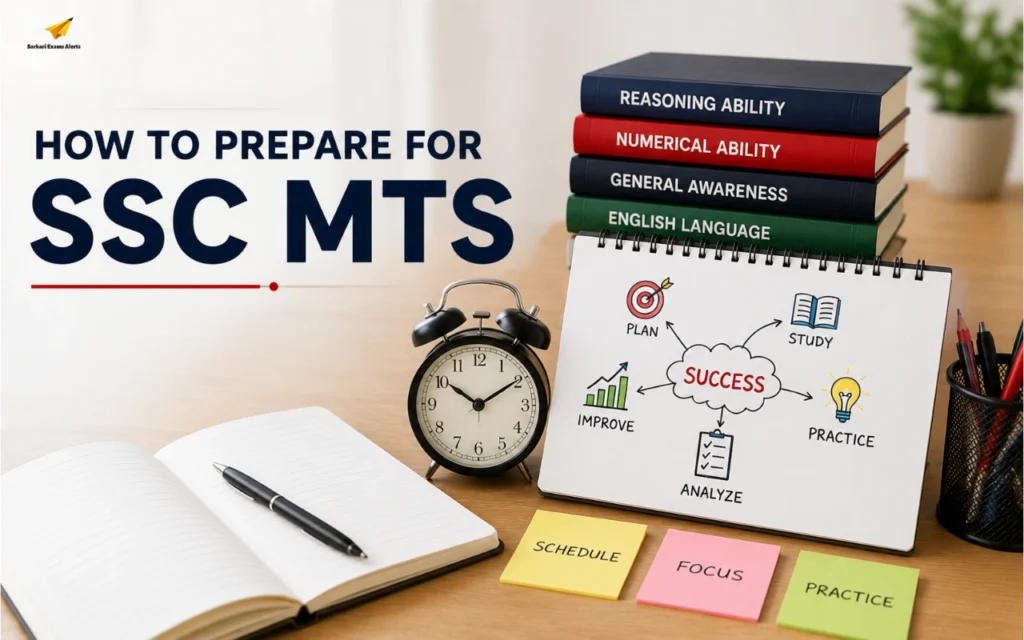
SSC MTS Preparation: Preparing for SSC MTS 2026 requires a clear strategy covering all four sections — Numerical Ability, Reasoning, General Awareness, and English. The exam is Class 8 to 10 level with no negative marking in Session 1 which makes it one of the more approachable SSC exams. With 3 to 4 months of dedicated preparation and the right resources, clearing SSC MTS 2026 is achievable for most candidates. The notification releases June 30, 2026 and exam is in September to November 2026, giving you 2 to 5 months from now.
What is SSC MTS Preparation?
SSC MTS preparation means systematically studying all four sections of the exam syllabus, practising previous year papers, taking regular mock tests, and staying updated on current affairs. The most important things to understand before starting preparation are the exam pattern (two sessions, no negative marking in Session 1), the syllabus (broadly Class 8-10 level), and the competition (30 to 50 lakh applicants). Preparation time required is 3 to 6 months depending on your current level.
| SSC MTS Previous Year Question Papers | SSC MTS Books |
| SSC MTS Havaldar | SSC CPO Eligibility |
| SSC CPO Cut Off | SSC CPO Result |
| SSC CPO Syllabus | SSC CPO Notification |
How to Prepare for SSC MTS 2026
Effective SSC MTS 2026 preparation starts with understanding the exam pattern and syllabus, then building subject-wise fundamentals, practising with previous year papers, and finally taking full-length mock tests under exam conditions. The biggest mistake candidates make is starting mock tests too early before completing the syllabus, or neglecting current affairs which accounts for 40% of the General Awareness section.
SSC MTS 2026 Preparation Overview
| Phase | Duration | Focus |
|---|---|---|
| Foundation | First 4 to 6 weeks | Syllabus reading, NCERT basics, vocabulary building, current affairs start |
| Main Preparation | Next 6 to 8 weeks | Complete all topics, standard books, chapter-wise practice |
| Practice Phase | Next 4 weeks | Previous year papers daily, mock tests 3-4 times per week |
| Revision Phase | Final 2 weeks | Weak topic revision, daily mock tests, current affairs revision |
Subject-wise Preparation Strategy
Numerical and Mathematical Ability
This section tests Class 8-10 level maths. If your fundamentals are weak, start with NCERT books from Class 6 to 10 before moving to any competitive exam book. The most important topics are percentage, ratio and proportion, profit and loss, time and work, and time speed and distance. These together account for 10 to 12 questions out of 20.
Practice at least 30 questions daily from these arithmetic topics. Learn shortcut methods for percentage calculations, profit-loss problems, and ratio problems as they save critical time. For mensuration, memorize area and volume formulas for all basic shapes. For data interpretation, practice reading tables, bar graphs, and pie charts quickly. Since Session 1 has no negative marking, never skip a numerical question even if you are unsure — estimate and attempt.
Reasoning Ability and Problem Solving
Reasoning is generally the highest scoring section for most candidates because once you understand the pattern, solving speed increases dramatically with practice. Focus first on high-frequency topics: series (number, alphabet, mixed), analogies, classification, coding-decoding, and non-verbal reasoning (mirror images, paper folding, figure series). These together account for 14 to 16 out of 20 questions.
Practice 40 reasoning questions daily across varied topics. Do not spend more than 30 seconds on any one reasoning question during practice. If you cannot solve it in 30 seconds, move on and come back later. Non-verbal reasoning needs visual practice — solve figure series and mirror image questions until they become automatic. Like Numerical Ability, attempt all 20 questions in Session 1 since there is no negative marking.
General Awareness
General Awareness is the most time-efficient section to prepare because reading and noting information takes far less time than solving mathematical problems. However, it requires consistency over months rather than intensive last-minute study. The section has two parts — static GK and current affairs. Current affairs accounts for approximately 10 to 12 questions out of 25 and is the differentiator between candidates.
For static GK, read Lucent GK comprehensively covering history, polity, geography, and science. Give special attention to Indian history (freedom struggle events, important movements, and key leaders), Indian polity (fundamental rights, duties, Parliament structure), and general science (everyday chemistry, biology diseases, physics laws). For current affairs, start reading one national newspaper daily from today. Focus on government schemes, appointments, sports results, awards, and science developments. Alternatively, read a monthly current affairs magazine covering the last 6 to 8 months before the exam. In Session 2, attempt only questions you are confident about due to negative marking.
English Language and Comprehension
English requires both grammar knowledge and vocabulary. For grammar, cover the rules for error detection, fill in the blanks with articles/prepositions/conjunctions, and sentence improvement. Wren and Martin is the best grammar book but focus only on the chapters relevant to SSC MTS — active passive voice, direct indirect speech, articles, prepositions, and tenses.
For vocabulary, learn 10 to 15 new words daily with their synonyms and antonyms. Norman Lewis Word Power Made Easy is excellent for systematic vocabulary building. For comprehension, practice reading short passages and identifying main ideas and specific details. English vocabulary and grammar questions are generally answerable with confidence so you should aim to attempt 18 to 22 questions in Session 2 English with high accuracy.
Daily Study Schedule for SSC MTS 2026
| Time Slot | Subject | Activity | Duration |
|---|---|---|---|
| Morning 7 AM to 8 AM | Newspaper | Read national newspaper for current affairs | 1 hour |
| 9 AM to 10:30 AM | Numerical Ability | Learn concepts and solve practice questions | 1.5 hours |
| 10:30 AM to 12 PM | Reasoning | Learn concepts and solve practice questions | 1.5 hours |
| 2 PM to 3:30 PM | General Awareness | Static GK reading and current affairs notes | 1.5 hours |
| 3:30 PM to 5 PM | English | Grammar rules, vocabulary, comprehension | 1.5 hours |
| 7 PM to 8 PM | Revision | Revise what was studied today | 1 hour |
Total daily study: 7 hours. On weekends, replace the daily schedule with 1 to 2 full mock tests followed by thorough analysis.
3-Month Preparation Plan for SSC MTS 2026
Month 1: Foundation Building
Week 1 and 2: Read the complete SSC MTS syllabus and exam pattern. Start NCERT Maths Class 6-8 for fundamentals. Start RS Aggarwal Reasoning for basic chapters. Begin reading daily newspaper. Start Lucent GK for Indian History.
Week 3 and 4: Complete NCERT Maths Class 9-10. Cover Percentage, Ratio, Profit-Loss from RS Aggarwal. Cover Analogies, Series, Coding-Decoding from Reasoning book. Study Indian Polity from Lucent. Continue newspaper reading. Start learning 10 vocabulary words daily.
Month 2: Main Preparation
Week 5 and 6: Cover SI/CI, Time-Work, Time-Distance from Maths. Cover Blood Relations, Directions, Non-Verbal Reasoning. Study Geography and Science from Lucent. Start SP Bakshi English for grammar chapters.
Week 7 and 8: Complete Maths syllabus including Mensuration and DI. Complete Reasoning syllabus. Complete English syllabus including comprehension practice. Solve 50 to 100 previous year questions per subject daily. Compile current affairs notes for last 2 months.
Month 3: Practice and Revision
Week 9 and 10: Solve 2 to 3 previous year papers per day. Analyse every wrong answer. Identify and revise weak topics. Take 1 full mock test on weekend.
Week 11 and 12: Take 4 to 5 full mock tests per week. Focus on time management. Revise current affairs for last 6 months. Final topic revision. Practice exam day strategy — Session 1 attempt all, Session 2 only confident answers.
Key Strategies for SSC MTS 2026
Maximize Session 1 Score
Since Session 1 has no negative marking, your goal should be to attempt all 40 questions and get as many correct as possible. Even if you are unsure, guess intelligently by eliminating obviously wrong options. A random guess in Session 1 has a 25% chance of being right with zero downside. Scoring 35 to 38 correct out of 40 in Session 1 gives you 105 to 114 marks out of 120 — an excellent foundation.
Smart Approach for Session 2
In Session 2, the negative marking changes everything. Do not guess randomly. Read each question and only answer if you are at least 70% confident. In General Awareness, skip questions on topics you have not studied. In English, grammar and vocabulary questions are generally more answerable than inference-based comprehension questions. Aim for 35 to 40 accurate attempts out of 50 in Session 2.
Current Affairs is Non-Negotiable
General Awareness carries 25 questions for 75 marks and 10 to 12 of these are from current affairs. This is the easiest marks to gain if you stay consistent. Read news daily or use a current affairs app. Focus on appointments, awards, sports results, government schemes, and science achievements as these repeat every year.
Mock Tests are More Important Than Books
In the last 4 to 6 weeks before the exam, taking mock tests is more valuable than reading new material. Mock tests build exam temperament, improve time management, reveal weak areas, and reduce exam day nervousness. Take at least 20 full mock tests before SSC MTS 2026.
Common Mistakes to Avoid in SSC MTS Preparation
Starting preparation with mock tests before completing the syllabus. Neglecting current affairs until the last week before exam. Spending too much time on difficult topics at the expense of easy high-frequency topics. Not analysing wrong answers in mock tests — just checking scores without understanding mistakes. Attempting Session 2 questions randomly hoping for correct guesses. Ignoring non-verbal reasoning practice — figures require visual practice that cannot be substituted by theory reading.
Frequently Asked Questions on SSC MTS Preparation
Q1. How many months are needed to prepare for SSC MTS 2026? 3 months with 6 to 7 hours daily study is sufficient for most candidates. Those with weaker fundamentals may need 4 to 5 months.
Q2. Can I prepare for SSC MTS without coaching? Yes. SSC MTS is Class 8-10 level. Self-study with the right books and online mock tests is fully sufficient.
Q3. How many mock tests should I take? Minimum 20 full-length mock tests in the two-session pattern before the exam.
Q4. Is current affairs very important? Yes. Current affairs accounts for 10 to 12 questions out of 25 in General Awareness. Daily newspaper reading from at least 6 months before exam is essential.
Q5. What is the best strategy for Session 1? Attempt all 40 questions since there is no negative marking. Never skip a question in Session 1. Even educated guesses improve your score.
Q6. Which subject should I focus on most? General Awareness if you are weak in current affairs since it has the highest potential for quick score improvement. Reasoning if you want consistent guaranteed marks. Numerical Ability requires more practice time but arithmetic topics are very learnable.
Q7. Can I clear SSC MTS with 2 months of preparation? Yes, if you are already at a reasonable academic level. Focus on high-frequency topics, solve previous year papers, and take regular mock tests. Current affairs is the critical factor for a 2-month preparation window.