
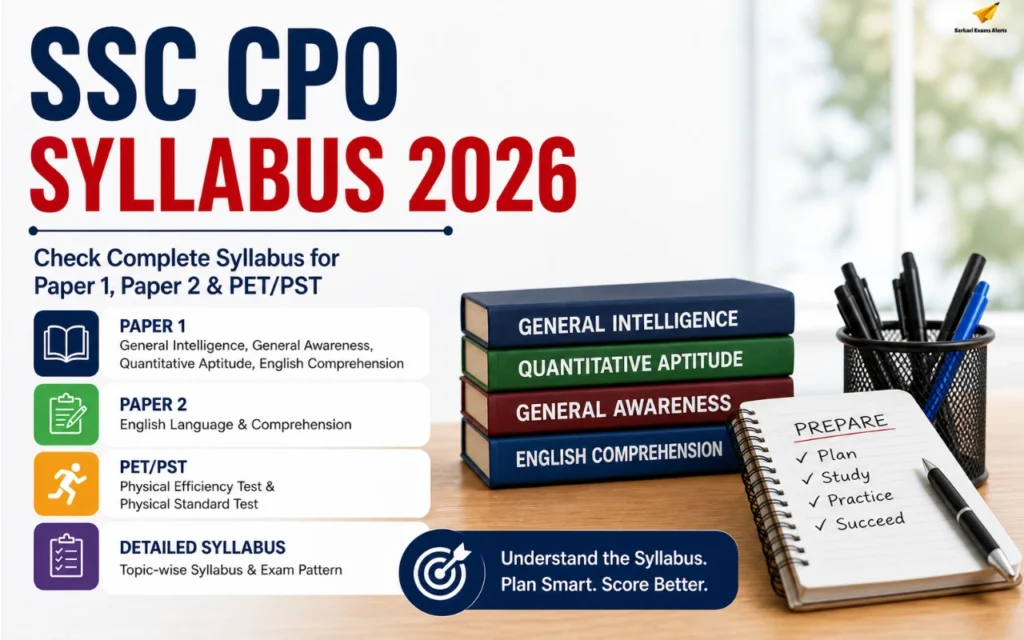
SSC CPO Syllabus: SSC CPO 2026 syllabus covers four subjects in Paper 1 — General Intelligence and Reasoning (50 questions), General Knowledge and General Awareness (50 questions), Quantitative Aptitude (50 questions), and English Comprehension (50 questions) — totalling 200 marks in 120 minutes with 30-minute sectional timing. Paper 2 covers only English Language and Comprehension with 200 questions for 200 marks. Negative marking is 0.25 marks per wrong answer in both papers.
What is SSC CPO Syllabus?
SSC CPO syllabus is the list of all topics from which questions are asked in Paper 1 and Paper 2. The Staff Selection Commission defines the syllabus in the official notification PDF. Unlike SSC MTS or CHSL, SSC CPO is a graduation level exam with a more demanding syllabus, especially in Quantitative Aptitude and Reasoning. The English paper (Paper 2) is exclusively in English and tests comprehension, grammar, and vocabulary at a higher level than Paper 1 English. Understanding the complete syllabus before starting preparation saves months of wasted effort.
| SSC CPO Physical Test | SSC CPO Preparation Tips |
| SSC CPO Physical Test | SSC CPO Eligibility |
| SSC CPO Cut Off | SSC CPO Result |
| SSC CPO Answer Key | SSC CPO Admit Card |
SSC CPO 2026 Syllabus
The complete topic-wise syllabus for SSC CPO 2026 Paper 1 and Paper 2 is given below based on the official notification and previous year question paper analysis.
SSC CPO 2026 Exam Pattern Overview
| Paper | Subject | Questions | Marks | Duration | Negative Marking |
|---|---|---|---|---|---|
| Paper 1 | General Intelligence and Reasoning | 50 | 50 | 30 min | 0.25 per wrong |
| General Knowledge and GK Awareness | 50 | 50 | 30 min | ||
| Quantitative Aptitude | 50 | 50 | 30 min | ||
| English Comprehension | 50 | 50 | 30 min | ||
| Paper 2 | English Language and Comprehension | 200 | 200 | 120 min | 0.25 per wrong |
SSC CPO Paper 1 Syllabus
1. General Intelligence and Reasoning (50 Questions)
SSC CPO Reasoning section tests logical thinking, pattern recognition, and problem-solving. The questions are more complex than SSC CHSL or MTS but similar to SSC CGL. With 30-minute sectional timing, you need to answer an average of one question every 36 seconds.
Verbal Reasoning: Analogies (word, number, letter), classification and odd one out, series completion (number, letter, alpha-numeric), coding-decoding (letter coding, number coding, substitution), blood relations (simple and complex family trees), directions and distances, ranking and ordering, input-output machines, statement and conclusion, syllogistic reasoning (all/some/no type), logical deduction, cause and effect, statement and assumptions, course of action.
Non-Verbal Reasoning: Mirror and water images, paper folding and cutting, embedded figures, figure series, figure classification, figure matrix, grouping of identical figures, completion of incomplete figure, counting of geometrical figures, dot situation analysis, cube and dice problems, space visualization.
Topic-wise Weightage (Paper 1 Reasoning): Analogies and Classification appear most frequently with 8 to 12 questions combined. Series questions (number and letter) account for 6 to 8 questions. Non-verbal reasoning (mirror images, paper folding, figure series) accounts for 8 to 12 questions. Coding-decoding appears with 4 to 6 questions. Blood relations and directions each contribute 3 to 5 questions.
2. General Knowledge and General Awareness (50 Questions)
General Awareness is often the difference-maker in SSC CPO. A well-prepared candidate can score 38 to 45 out of 50 in this section which significantly boosts overall rank.
Current Affairs: National and international events from the last 6 to 8 months. Government schemes and policies, appointments of important officials (ministers, heads of organizations, ambassadors), sports events (cricket, football, hockey, Olympics, Asian Games), awards (Padma Awards, Nobel Prize, Booker Prize, Filmfare), important summits and bilateral agreements, science and technology developments including ISRO missions and defence achievements, important national and international days.
History: Ancient India (Indus Valley Civilization, Vedic period, Mauryan, Gupta, Harsha periods), Medieval India (Delhi Sultanate, Mughal Empire, Bhakti and Sufi movements, regional kingdoms), Modern India (British rule, 1857 revolt, Indian National Congress, freedom struggle leaders, major movements — Non-Cooperation, Civil Disobedience, Quit India, Cabinet Mission Plan, Partition and Independence).
Indian Polity: Constitution — Preamble, Fundamental Rights (Articles 12-35), Fundamental Duties (Article 51A), Directive Principles. President, Prime Minister, Council of Ministers, Parliament (Lok Sabha and Rajya Sabha), Supreme Court, High Courts, Election Commission, CAG, UPSC, Attorney General. Constitutional amendments. Emergency provisions. Panchayati Raj and urban local bodies.
Geography: Physical geography of India (Himalayan ranges, Deccan Plateau, Indo-Gangetic Plains, Coastal Plains, major rivers). States, capitals, and union territories. Soils, natural vegetation, rainfall, and climate zones. World geography (continents, countries, capitals, important rivers, mountains, deserts, oceans, straits). Economic geography (agriculture, minerals, industries, trade routes).
Economy: Basic macroeconomics (GDP, GNP, NNP, inflation, deflation, fiscal deficit). Five year plans and NITI Aayog. Union Budget. RBI and monetary policy. Banking system. Major government schemes (PM-KISAN, PMAY, Ayushman Bharat, etc.). Stock markets and SEBI basics. International organizations (IMF, World Bank, WTO).
Science: Physics (laws of motion, gravitation, optics, electricity, magnetism, nuclear physics basics). Chemistry (periodic table, atomic structure, chemical bonding, acids-bases-salts, organic chemistry basics, polymers, common chemicals). Biology (cell structure and function, human body systems, plant physiology, genetics basics, diseases and their causes, vaccines, nutrition, environment and ecology).
Static GK: Books and authors (including recent winners), important national and international organizations and headquarters, inventions and inventors, first in India and world, national symbols, UNESCO World Heritage Sites in India, national parks and wildlife sanctuaries.
3. Quantitative Aptitude (50 Questions)
Quantitative Aptitude in SSC CPO is at a higher difficulty level than SSC CHSL. Questions often involve multiple concepts in a single problem. With 30-minute sectional timing (36 seconds per question), you need strong speed and accuracy. Arithmetic topics dominate this section.
Number System: LCM and HCF, prime numbers, divisibility rules, factors, surds and indices, number properties, unit digit problems, cyclicity of numbers.
Arithmetic (Very High Weightage — 25 to 30 questions): Percentage (all types including successive change), ratio and proportion (simple, compound, componendo-dividendo), averages (simple and weighted), simple interest and compound interest (all variations including quarterly and half-yearly), profit and loss (CP, SP, MP, discount, successive discount, false weights), partnership (simple and compound), mixture and alligation, time and work (individual, combined, pipes and cisterns), time speed and distance (speed calculations, average speed, relative speed, trains, boats and streams).
Algebra: Linear equations in one and two variables, quadratic equations, algebraic identities, polynomials, surds and indices. Important identities: (a+b)², (a-b)², (a³+b³), (a³-b³) and their applications.
Geometry: Properties of triangles (similarity, congruence, Pythagoras theorem, centres — circumcenter, incenter, centroid, orthocenter). Quadrilaterals (square, rectangle, parallelogram, rhombus, trapezium) and their properties. Circles (chords, tangents, secants, angles in circles). Coordinate geometry basics (distance formula, section formula, midpoint formula, slope, area of triangle).
Trigonometry: Basic ratios (sin, cos, tan, cosec, sec, cot), standard values (0°, 30°, 45°, 60°, 90°), complementary angles, heights and distances (two angles of elevation, angle of depression), trigonometric identities (sin²θ + cos²θ = 1, etc.).
Mensuration: Area and perimeter of 2D shapes (triangle, rectangle, square, parallelogram, rhombus, trapezium, circle, sector, segment). Surface area and volume of 3D shapes (cube, cuboid, cylinder, cone, sphere, hemisphere). Combined figures.
Statistics and Data Interpretation: Reading tables, bar graphs, pie charts, line graphs, histograms. Mean, median, mode. Probability basics.
4. English Comprehension in Paper 1 (50 Questions)
Paper 1 English tests basic reading comprehension, grammar, and vocabulary at a moderate difficulty level. This is different from Paper 2 which is more advanced and exclusively English-focused.
Vocabulary: Synonyms, antonyms, one word substitution, idioms and phrases, correct spelling, word usage in context.
Grammar: Error spotting in sentences (subject-verb agreement, tense, article, preposition, pronoun), fill in the blanks, sentence improvement, active and passive voice, direct and indirect speech, para jumbles.
Reading Comprehension: Short passages with questions on main idea, specific details, vocabulary in context, and inference. Cloze test passages with blanks.
SSC CPO Paper 2 Syllabus (English Language and Comprehension)
Paper 2 is exclusively English and is more advanced than Paper 1 English. It tests detailed understanding of grammar, extensive vocabulary, and comprehension of complex passages. Paper 2 is only in English — there is no bilingual option.
Advanced Vocabulary: Synonyms and antonyms (higher difficulty), one word substitution (complex phrases), idioms and phrases (including less common ones), correct spelling from commonly confused words, word formation (prefixes, suffixes), homonyms and homophones.
Advanced Grammar: Spot the error in complex sentences, sentence improvement with multiple possible corrections, fill in the blanks with the most appropriate word, ordering of sentences to form a coherent paragraph, rearrangement of parts of a sentence, cloze test (long passage with blanks).
Reading Comprehension: Longer passages (400 to 600 words) with 5 to 10 questions testing comprehension, inference, critical reasoning, vocabulary in context, and author’s tone. Expect 3 to 4 comprehension passages in Paper 2. Questions test deeper understanding beyond literal meaning.
Other English Topics: Sentence transformation, direct-indirect speech conversion in complex sentences, active-passive voice for complex tenses, antonyms and synonyms in contextual passages.
Frequently Asked Questions on SSC CPO Syllabus
Q1. Is SSC CPO syllabus same as SSC CGL? Paper 1 topics are similar to SSC CGL Tier 1. Paper 2 (English only) is similar to SSC CGL Tier 2 English module. However, SSC CPO also has a PET/PST physical stage which SSC CGL does not.
Q2. Is there sectional timing in SSC CPO Paper 1? Yes. Each of the four sections has a fixed timer of 30 minutes. You cannot carry forward time from one section to another.
Q3. Is Paper 2 syllabus different from Paper 1 English? Yes. Paper 2 English is at a higher difficulty level, exclusively in English, and has 200 questions compared to 50 in Paper 1. Paper 2 tests deeper comprehension and advanced grammar.
Q4. What is the negative marking in SSC CPO? 0.25 marks (one-fourth) deducted for each wrong answer in both Paper 1 and Paper 2.
Q5. Which section has highest weightage in Paper 1? All four sections have equal weightage of 50 marks each. However, GK and English are generally considered easier to score in consistently.