
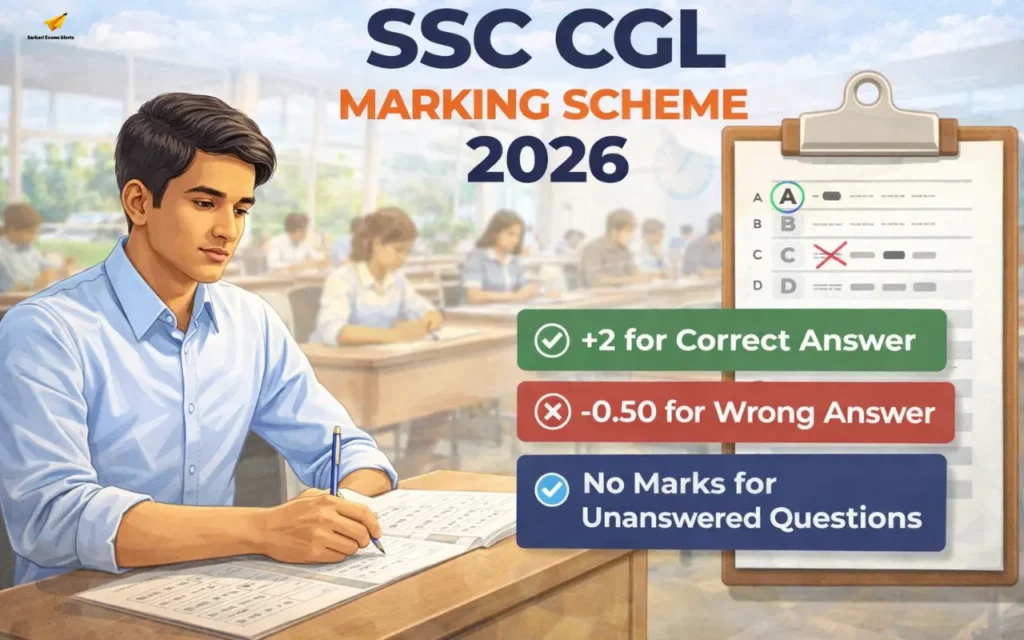
SSC CGL Marking Scheme 2026: The SSC CGL 2026 marking scheme follows a specific pattern with negative marking for wrong answers. Tier 1 exam has 0.5 marks deduction for each incorrect answer, while Tier 2 Paper 1 has 1 mark negative marking. Understanding this marking scheme is crucial for exam strategy and time management.
| Exam Details | Information |
|---|---|
| Official Website | ssc.gov.in |
| Notification Date | March 31, 2026 |
| Tier 1 Exam Date | May-June 2026 (Tentative) |
| Tier 1 Negative Marking | 0.5 marks per wrong answer |
| Tier 2 Negative Marking | 1 mark per wrong answer (Paper 1) |
| Total Questions (Tier 1) | 100 Questions |
| Total Marks (Tier 1) | 200 Marks |
SSC CGL Marking Scheme 2026 Tier 1
The SSC CGL Tier 1 exam is qualifying in nature and follows a standardized marking pattern. Each question carries 2 marks, making the total marks 200 for 100 questions. The exam duration is 60 minutes, giving candidates just 36 seconds per question on average.
The negative marking in Tier 1 is 0.5 marks for every wrong answer. This means if you answer a question incorrectly, 0.5 marks will be deducted from your total score. Questions left blank do not attract any negative marking.
| Subject | Questions | Marks | Negative Marking |
|---|---|---|---|
| General Intelligence & Reasoning | 25 | 50 | 0.5 marks per wrong answer |
| General Awareness | 25 | 50 | 0.5 marks per wrong answer |
| Quantitative Aptitude | 25 | 50 | 0.5 marks per wrong answer |
| English Comprehension | 25 | 50 | 0.5 marks per wrong answer |
| Total | 100 | 200 | 0.5 marks per wrong answer |
SSC CGL 2026 Tier 2 Marking Scheme
SSC CGL Tier 2 is the main exam that determines your final selection and rank. Unlike Tier 1, Tier 2 scores are used for merit preparation and final selection. The marking scheme varies across different papers in Tier 2.
Tier 2 consists of three sessions conducted on the same day. The negative marking is 1 mark per wrong answer in Paper 1, while other papers may have different patterns. The exact structure will be confirmed in the official notification.
| Paper | Questions | Marks | Duration | Negative Marking |
|---|---|---|---|---|
| Paper 1: Mathematical Abilities & Reasoning | 90 | 270 | 2 hours | 1 mark per wrong answer |
| Paper 2: English Language & Comprehension | 45 | 135 | 1 hour | As per official notification |
| Paper 3: General Awareness | 50 | 150 | 1 hour | As per official notification |
Paper 1: Mathematical Abilities & Reasoning
This is the most crucial paper in SSC CGL Tier 2 as it carries the maximum weightage. The paper includes both mathematical problems and reasoning questions. Each question carries 3 marks, and wrong answers result in 1 mark deduction.
The mathematical section covers topics like algebra, geometry, trigonometry, statistics, and number systems. The reasoning section includes logical reasoning, data interpretation, and analytical reasoning questions.
Paper 2: English Language & Comprehension
The English paper tests your language skills including grammar, vocabulary, comprehension, and writing ability. Each question typically carries 3 marks. The negative marking pattern will be specified in the official notification.
This paper includes reading comprehension passages, error detection, sentence improvement, synonyms, antonyms, and cloze test questions. Strong English skills can significantly boost your overall score.
| SSC CGL Application Form | SSC CGL Post Preference |
| SSC CGL Tier 2 Admit Card | SSC CGL Income Tax Inspector |
| SSC CGL Application Fee | SSC CGL Preparation Tips |
How Negative Marking Affects Your Score
Negative marking plays a crucial role in determining your final score and rank in SSC CGL 2026. Understanding its impact helps you develop an effective exam strategy. Let’s see how different scenarios affect your total marks.
In Tier 1, if you answer 80 questions correctly and 20 incorrectly, your score would be (80 × 2) – (20 × 0.5) = 160 – 10 = 150 marks out of 200. If you left those 20 questions blank instead, your score would be 160 marks.
| Scenario | Correct Answers | Wrong Answers | Unattempted | Final Score (Tier 1) |
|---|---|---|---|---|
| Conservative Approach | 70 | 5 | 25 | 140 – 2.5 = 137.5 |
| Moderate Risk | 75 | 15 | 10 | 150 – 7.5 = 142.5 |
| Aggressive Approach | 80 | 20 | 0 | 160 – 10 = 150 |
| Perfect Strategy | 85 | 10 | 5 | 170 – 5 = 165 |
Subject-wise Marking Strategy
Each subject in SSC CGL requires a different approach due to varying difficulty levels and your personal strengths. Developing subject-specific strategies can maximize your score while minimizing the impact of negative marking.
General Intelligence & Reasoning
Reasoning questions often have definitive answers, making them ideal for confident attempts. Focus on topics like series, coding-decoding, and blood relations where you can be certain of your answers. Avoid guessing in complex puzzles or seating arrangements.
Questions in logical reasoning, verbal reasoning, and non-verbal reasoning typically have clear-cut solutions. If you’re unsure about a particular question type, it’s better to skip it rather than guess randomly.
General Awareness
General awareness is often considered unpredictable, but strategic preparation can help. Focus on current affairs from the last 6-12 months, Indian history, geography, and static GK. If you’re completely unsure about a question, it’s safer to skip it.
Some topics like Indian constitution, important dates, and scientific facts have factual answers. Build strong knowledge in these areas to attempt questions confidently without worrying about negative marking.
Quantitative Aptitude
Math questions can be time-consuming but often have definitive solutions. Prioritize topics you’re comfortable with like percentage, profit and loss, and simple interest. Skip complex geometry or trigonometry problems if you’re not confident.
Use elimination techniques for multiple-choice questions. Even if you can’t solve completely, eliminating obviously wrong options increases your chances of guessing correctly while managing the negative marking risk.
English Comprehension
English questions often allow for elimination of clearly incorrect options. Grammar rules are definitive, so if you know the rule, attempt confidently. For vocabulary questions, use root word knowledge and context clues.
Reading comprehension passages provide direct answers within the text. These questions are ideal for confident attempts as the answers are explicitly mentioned or can be inferred logically from the passage.
Calculating Your Safe Score
Determining a safe score helps you set realistic targets for SSC CGL 2026. Based on previous years’ trends, a score above 130-140 in Tier 1 generally ensures qualification. However, the exact cut-off varies each year based on difficulty level and competition.
For Tier 2, the scoring pattern is different as it determines your final rank. A good score in Tier 2 Paper 1 (Mathematical Abilities & Reasoning) significantly impacts your overall ranking. Aim for at least 60-70% accuracy in this crucial paper.
| Category | Expected Tier 1 Cut-off | Safe Target Score | Recommended Attempts |
|---|---|---|---|
| General | 140-150 | 155+ | 85-90 questions |
| OBC | 135-145 | 150+ | 80-85 questions |
| SC | 120-130 | 135+ | 75-80 questions |
| ST | 110-120 | 125+ | 70-75 questions |
Time Management and Marking Scheme
Effective time management is crucial when dealing with negative marking. Spend adequate time on each question to ensure accuracy, but don’t get stuck on difficult problems. Develop a time allocation strategy for each subject based on your strengths.
In Tier 1, allocate approximately 12-15 minutes per subject (25 questions each). This gives you time to review your answers and make informed decisions about which questions to attempt. Always reserve 5-10 minutes for final review.
- Start with your strongest subject to build confidence and secure marks early
- Attempt questions you’re completely sure about first
- Mark doubtful questions for review and come back to them later
- Use the process of elimination for multiple-choice questions
- Skip questions where you have no clue rather than random guessing
- Review all attempted questions before final submission
Common Mistakes to Avoid
Many candidates make critical errors that cost them valuable marks due to negative marking. Understanding these common mistakes helps you develop a better exam strategy and avoid unnecessary mark deduction.
Random guessing is the biggest mistake in SSC CGL. If you can’t eliminate at least two options, it’s better to leave the question unattempted. The probability of getting a random guess correct is only 25%, while the certainty of losing marks for wrong answers is 100%.
- Attempting too many questions without adequate confidence
- Spending excessive time on difficult questions
- Not reviewing attempted questions for silly mistakes
- Ignoring time management leading to rushed decisions
- Changing correct answers during review due to overthinking
- Not practicing with negative marking scenarios during preparation
Preparation Tips for Better Score Management
Preparing specifically for negative marking scenarios improves your exam performance significantly. Practice with mock tests that simulate actual exam conditions including time pressure and marking schemes.
Take regular mock tests and analyze your performance to understand your accuracy levels in different subjects. This helps you make informed decisions during the actual exam about which questions to attempt and which to skip.
- Practice mock tests with the same marking scheme as SSC CGL 2026
- Analyze your accuracy percentage subject-wise and topic-wise
- Develop strong fundamentals in all subjects to increase confidence
- Learn quick elimination techniques for multiple-choice questions
- Practice time management with 60-minute mock tests for Tier 1
- Focus on building speed and accuracy simultaneously
Important Updates for SSC CGL 2026
SSC may introduce changes in the marking scheme or exam pattern for 2026. Stay updated with official notifications released on ssc.gov.in. The notification expected on March 31, 2026, will provide complete details about any modifications.
Based on the SSC Calendar 2026-27, the Tier 1 exam is scheduled for May-June 2026. Some sources suggest it might extend to June-September 2026 depending on the number of applicants and logistical arrangements.
The application process starts on March 31, 2026, with the last date to apply being April 30, 2026 (some sources indicate May 31, 2026 as per the official notification). Candidates should regularly check the official website for any updates or changes.
Frequently Asked Questions
What is the negative marking in SSC CGL Tier 1 2026?
SSC CGL Tier 1 2026 has 0.5 marks negative marking for each wrong answer. Since each question carries 2 marks, a wrong answer deducts 0.5 marks from your total score. Questions left unattempted do not attract any negative marking.
How much negative marking is there in SSC CGL Tier 2 2026?
SSC CGL Tier 2 Paper 1 (Mathematical Abilities & Reasoning) has 1 mark negative marking per wrong answer. The negative marking pattern for other papers in Tier 2 will be specified in the official notification expected on March 31, 2026.
Should I attempt all questions in SSC CGL 2026 despite negative marking?
No, you should not attempt all questions randomly. Only attempt questions where you’re confident or can eliminate at least 2-3 options. Strategic selection based on your knowledge and confidence level is better than attempting all questions with negative marking.
What is a good score in SSC CGL Tier 1 2026 considering negative marking?
A good score in SSC CGL Tier 1 2026 would be around 140-160 marks out of 200 for General category candidates. This typically requires attempting 75-85 questions with high accuracy rather than attempting all 100 questions with lower accuracy.
How to calculate my expected score with negative marking in SSC CGL 2026?
For Tier 1: Multiply correct answers by 2, multiply wrong answers by 0.5, then subtract the second from the first. For example, 70 correct and 10 wrong = (70×2) – (10×0.5) = 140 – 5 = 135 marks. Unattempted questions don’t affect the score.
Does SSC CGL 2026 have negative marking in all papers?
SSC CGL 2026 Tier 1 definitely has 0.5 marks negative marking. Tier 2 Paper 1 has 1 mark negative marking. The negative marking pattern for other Tier 2 papers will be confirmed in the official notification. There is no interview stage in SSC CGL.
Can I clear SSC CGL 2026 by attempting only 60-70 questions?
Yes, you can clear SSC CGL Tier 1 by attempting 60-70 questions if your accuracy is very high (90-95%). However, this strategy is risky as you need almost perfect accuracy. A balanced approach of attempting 75-85 questions with 85-90% accuracy is more practical.
What happens if I get negative marks in SSC CGL 2026?
If your negative marking exceeds your positive marks, your score becomes zero, but it cannot go below zero. However, such scenarios are extremely rare. Focus on maintaining good accuracy and attempting questions strategically to avoid excessive negative marking.
Stay updated with all the latest information about SSC CGL 2026 including notification, application process, exam dates, and marking scheme details by bookmarking Sarkari Exams Alerts. We provide accurate and timely updates to help you succeed in your government exam preparation.