
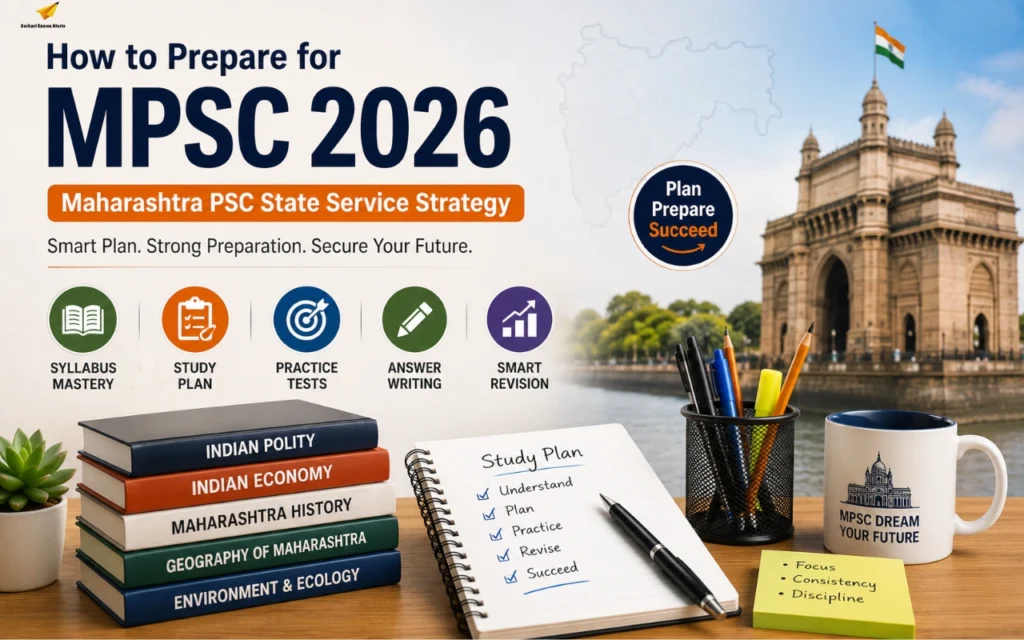
Prepare for MPSC: The Maharashtra Public Service Commission (MPSC) conducts the MPSC State Services Examination to recruit candidates for prestigious administrative positions such as Deputy Collector, Deputy Superintendent of Police (DSP), Block Development Officer (BDO), Assistant Commissioner, and other Group A and Group B services in the Maharashtra Government. Every year, thousands of aspirants compete for a limited number of vacancies, making the MPSC State Service Exam one of the most competitive state civil services examinations in India.
If you are planning to appear for MPSC 2026, success requires much more than completing the syllabus. Candidates need a well-planned preparation strategy, conceptual clarity, strong answer-writing skills, regular revision, and continuous practice through mock tests. Since the examination consists of multiple stages, aspirants should prepare for the Preliminary Examination, Main Examination, and Interview simultaneously.
This comprehensive guide explains the complete MPSC 2026 preparation strategy, including the selection process, exam pattern, subject-wise study plan, Maharashtra-specific preparation tips, answer-writing strategy, revision plan, common mistakes, expert preparation tips, and frequently asked questions.
MPSC Rajyaseva Prelims Strategy
Paper 1 (General Studies, 100 questions, 200 marks): Maharashtra and India history, geography, polity, economy, science, current affairs. Maharashtra-centric: Maratha history (Shivaji to Peshwas), social reform movements (Phule, Ambedkar, Agarkar), Maharashtra formation, geography of Deccan Plateau, Western Ghats, major rivers (Godavari, Krishna, Bhima), Maharashtra government schemes. Paper 2 (CSAT, 80 questions, 200 marks): Qualifying, 23% cutoff.
6-Month Preparation Roadmap for MPSC 2026
A well-structured preparation plan is one of the most important factors in clearing the MPSC State Service Examination. Instead of studying different subjects randomly, divide your preparation into phases so that you can build concepts, complete the syllabus on time, revise effectively, and practice regularly. The following six-month roadmap is designed to help candidates prepare systematically for both the Preliminary and Main Examinations.
Month 1–2: Build Strong Fundamentals
The first two months should focus on building a strong conceptual foundation. Begin by understanding the latest MPSC syllabus and exam pattern so that you know exactly what to study and what to avoid. Cover the basics using NCERT textbooks and Maharashtra State Board books, especially for History, Geography, Polity, Economy, and Science. Alongside static subjects, develop the habit of reading newspapers daily and start preparing current affairs notes. Rather than memorizing facts, focus on understanding concepts and prepare concise handwritten notes that will help during revision. This phase lays the groundwork for the rest of your preparation, so avoid rushing through topics and prioritize clarity over speed.
Month 3–4: Complete the Syllabus and Start Answer Writing
Once your fundamentals are clear, the next two months should be dedicated to completing the remaining syllabus and strengthening your preparation. Cover advanced topics from standard reference books and begin integrating Maharashtra-specific subjects such as state history, geography, economy, culture, and government schemes into your study routine. This is also the ideal time to start answer-writing practice for the Mains examination. Writing one or two answers daily will improve your presentation skills, analytical thinking, and time management. In addition, begin solving sectional tests after completing each subject and revise all previously studied topics every week to improve long-term retention.
Month 5: Intensive Practice and Performance Analysis
By the fifth month, your primary focus should shift from learning new topics to applying your knowledge through regular practice. Start attempting full-length mock tests for both the Preliminary and Main examinations under exam-like conditions. Solve previous year question papers to understand important topics, question trends, and the level of analytical thinking expected in the examination. Carefully analyze every mock test to identify conceptual gaps, recurring mistakes, and weak subjects. Spend additional time strengthening these weaker areas while continuing regular revision of the subjects you have already completed. This phase is crucial for improving speed, accuracy, and examination confidence.
Final Month: Revision and Exam Readiness
The last month before the examination should be reserved entirely for revision and exam-oriented preparation. Avoid starting new books or unfamiliar topics, as they can create unnecessary confusion and increase stress. Instead, revise your self-made notes, important facts, government schemes, constitutional provisions, and Maharashtra-specific topics multiple times. Continue practicing answer writing to improve speed and presentation while solving full-length mock papers to simulate the actual examination environment. Revise current affairs thoroughly, especially events from the last several months, and focus on improving time management. Maintaining a healthy routine, getting adequate sleep, and staying mentally relaxed during this phase will help you perform confidently on the examination day.
Common Mistakes to Avoid During MPSC Preparation
Many aspirants invest months of hard work in MPSC preparation but fail to achieve their desired results because of avoidable mistakes rather than a lack of ability. Identifying these common errors early can help you prepare more effectively and maximize your chances of success.
Ignoring Maharashtra-Specific Topics
One of the biggest mistakes candidates make is focusing only on national-level subjects while neglecting Maharashtra-specific history, geography, economy, polity, culture, and government schemes. These topics carry significant weight in both the Preliminary and Main examinations and often become the deciding factor in the final score. Give adequate time to state-specific preparation throughout your study plan.
Reading Too Many Books
Many aspirants keep collecting new books, coaching notes, and online resources without completing or revising any of them properly. This creates confusion and reduces revision time. Instead of studying from multiple sources, choose a few reliable books, complete them thoroughly, and revise them several times. Mastering limited resources is much more effective than reading numerous books superficially.
Not Practicing Answer Writing
The Main Examination is descriptive in nature, yet many candidates postpone answer-writing practice until after clearing the Preliminary Examination. This often leads to poor presentation skills and difficulty managing time during the actual exam. Begin writing answers early in your preparation, focusing on structured introductions, logical analysis, relevant examples, and concise conclusions. Regular practice significantly improves writing speed and quality.
Neglecting Current Affairs
Current affairs play an important role in both the Prelims and Mains examinations. Many candidates either ignore them completely or try to cover several months of current affairs just before the examination. Instead, develop the habit of reading newspapers daily, preparing monthly notes, and revising important national and Maharashtra-specific developments regularly. Consistency is the key to mastering current affairs.
Skipping Mock Tests
Some aspirants avoid mock tests because they feel underprepared or fear scoring low marks. However, mock tests are one of the most effective ways to improve performance. They help you understand the exam pattern, identify weak areas, improve time management, and build confidence. Equally important is analyzing each mock test carefully to understand why mistakes occurred and how to avoid them in the future.
Memorizing Instead of Understanding Concepts
Memorizing facts without understanding the underlying concepts may help in the short term, but it is rarely effective in a competitive examination like MPSC. Both the Preliminary and Main examinations increasingly test conceptual understanding and analytical thinking. Focus on understanding topics thoroughly so that you can apply your knowledge to different types of questions instead of relying solely on memorization.
Poor Revision Strategy
Completing the syllabus without revising it regularly is one of the most common reasons candidates forget important information before the examination. Revision should be an integral part of your study plan from the beginning. Allocate dedicated time every week to revise previously studied subjects, current affairs, and self-made notes. Multiple revisions improve retention and boost confidence.
Ignoring Previous Year Papers
Previous year question papers provide valuable insights into the examination pattern, important topics, and frequently asked themes. Candidates who ignore these papers often fail to understand the expectations of the commission. Solving at least the previous 8–10 years’ question papers under timed conditions helps improve accuracy, exam temperament, and familiarity with the question pattern.
Subject-Wise Prepare for MPSC
1. General Studies
General Studies forms the foundation of the MPSC examination. Candidates should prepare Indian History, Geography, Polity, Economy, Environment, Science & Technology, Current Affairs, and Governance while simultaneously focusing on Maharashtra-specific topics.
Instead of memorizing facts, develop conceptual clarity and relate static subjects to current events. Prepare concise notes for every topic and revise them regularly to improve retention.
2. Maharashtra History and Culture
Questions related to Maharashtra’s history, culture, freedom movement, social reformers, forts, literature, festivals, and historical personalities are regularly asked in the examination.
Candidates should understand historical events chronologically and focus on the contributions of important personalities rather than memorizing isolated facts. Revising maps, timelines, and cultural notes can significantly improve recall.
3. Maharashtra Geography
Maharashtra Geography is one of the most important sections of the MPSC examination. Candidates should study physical geography, climate, rivers, dams, agriculture, irrigation, mineral resources, industries, transportation, biodiversity, and regional development.
Understanding geographical concepts through maps and diagrams makes revision easier and improves conceptual understanding.
4. Indian Polity and Governance
Polity is one of the highest-scoring sections in MPSC. Candidates should thoroughly understand the Constitution, Fundamental Rights, Directive Principles, Parliament, State Legislature, Judiciary, Panchayati Raj, Local Government, Constitutional Bodies, and Governance.
Rather than memorizing articles, focus on understanding constitutional principles and their practical implementation in administration.
5. Economy
The Economy section tests conceptual understanding of macroeconomics, banking, budgeting, taxation, inflation, employment, agriculture, industrial development, financial inclusion, and Maharashtra’s economy.
Candidates should regularly read the Economic Survey, Union Budget, Maharashtra Budget, and important government reports to connect static concepts with current developments.
6. Environment and Science
Environment and Science questions have become increasingly important in recent years. Focus on biodiversity, climate change, pollution, environmental laws, sustainable development, renewable energy, biotechnology, and recent scientific developments.
Relating environmental concepts with current affairs helps improve both Prelims and Mains preparation.
7. Current Affairs
Current affairs are crucial for every stage of the MPSC examination. Candidates should follow national as well as Maharashtra-specific developments through newspapers, PIB, government websites, monthly magazines, and official state government portals.
Conclusion
The MPSC State Service Examination 2026 is one of the most prestigious opportunities for candidates aspiring to join the Maharashtra Civil Services. Success in the examination requires more than completing the syllabus—it demands conceptual clarity, structured preparation, answer-writing skills, and a thorough understanding of Maharashtra-specific topics.
A balanced approach that combines static subjects, current affairs, regular revision, previous year papers, and mock test practice will significantly improve your chances of success. Stay disciplined, revise consistently, and prepare strategically for every stage of the examination. With dedication, smart planning, and continuous improvement, you can achieve your goal of securing a top rank in the MPSC 2026 State Service Examination.
Frequently Asked Questions
1. How should I start preparing for MPSC 2026?
Begin by understanding the latest syllabus and exam pattern, then build a strong foundation using NCERT and Maharashtra State Board books. Along with General Studies, start reading newspapers daily, prepare Maharashtra-specific topics, and practice answer writing regularly for the Mains examination.
2. How many months are required to prepare for the MPSC State Service Exam 2026?
Most successful candidates recommend 8 to 10 months of consistent preparation for MPSC 2026. This allows enough time to complete the syllabus, revise multiple times, solve previous year papers, practice mock tests, and strengthen answer-writing skills.
3. Why are Maharashtra-specific topics important in the MPSC exam?
Maharashtra-specific topics such as state history, geography, economy, polity, culture, government schemes, and current affairs carry significant weight in both the Preliminary and Main examinations. Strong preparation in these subjects can improve your overall score and provide an advantage over other candidates.
4. What are the best books for MPSC 2026 preparation?
Some of the most recommended resources include M. Laxmikanth’s Indian Polity, Spectrum Modern India, Ramesh Singh’s Indian Economy, Shankar IAS Environment, NCERT textbooks, Maharashtra State Board books, Maharashtra Economic Survey, and monthly current affairs magazines.
5. Can I crack MPSC 2026 without coaching?
Yes. Many candidates successfully clear the MPSC State Service Examination through self-study. A structured study plan, quality study materials, regular answer-writing practice, previous year papers, mock tests, and consistent revision are sufficient to prepare effectively without coaching, provided you remain disciplined and committed throughout your preparation.