
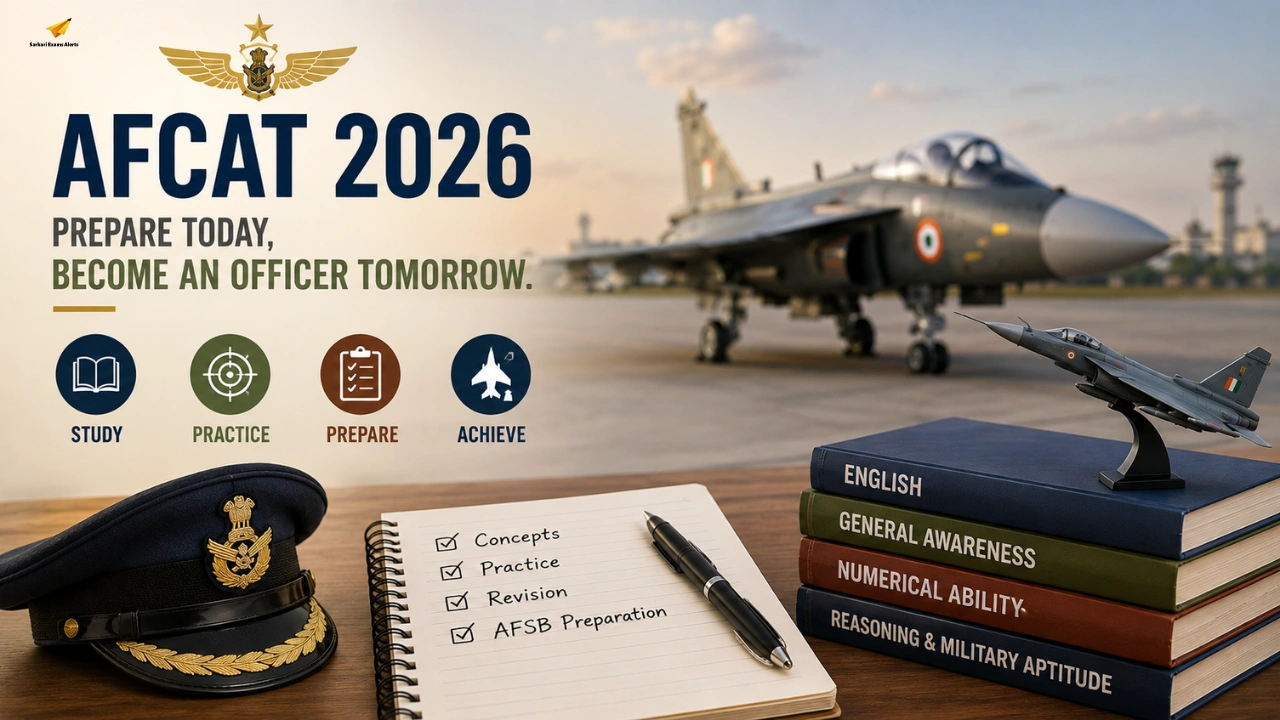
Prepare for AFCAT: The Air Force Common Admission Test (AFCAT) is more than an entrance examination—it’s the first step towards becoming an officer in the Indian Air Force. Every year, thousands of graduates compete for prestigious positions in the Flying Branch, Ground Duty (Technical), and Ground Duty (Non-Technical) branches.
Unlike many competitive exams, AFCAT doesn’t end with a written test. Candidates who qualify must also clear the Air Force Selection Board (AFSB) interview, medical examination, and document verification. Success, therefore, requires academic preparation, leadership skills, communication ability, confidence, and physical fitness.
If your goal is to wear the blue uniform in 2026, your preparation should go beyond solving MCQs. It should help you develop the qualities expected from an Air Force officer.
What is AFCAT?
AFCAT (Air Force Common Admission Test) is conducted by Indian Air Force for officer entry. Flying Branch: Lead and fly fighter jets, transport aircraft, and helicopters. Technical Branch: Maintain and service IAF aircraft and systems. Ground Duty (Administration and Logistics): Administrative, logistics, and accounts functions. Ground Duty (Education): Teaching at IAF schools and training institutions. Salary is Pay Level 10 (Rs 56,100 basic pay). Age: 20 to 24 for Flying, 20 to 26 for Technical and Ground Duty.
What Does an AFCAT Topper Prepare First?
One of the biggest misconceptions about AFCAT preparation is that success depends on studying from multiple books or enrolling in several coaching programs. In reality, most AFCAT toppers spend their initial days understanding the examination rather than rushing into preparation. They know that having a clear strategy is far more valuable than simply covering a large number of topics.
The first step is understanding the latest AFCAT syllabus. Instead of treating every topic equally, toppers identify the subjects that are consistently asked in the examination and create a preparation plan around them. Knowing the syllabus also helps avoid spending time on topics that are not relevant.
The next step is analyzing Previous Years’ Question Papers (PYQs). Solving PYQs helps aspirants understand the nature of questions, recurring concepts, and the level of difficulty. More importantly, it familiarizes them with the style of questions asked in English, General Awareness, Numerical Ability, Reasoning, and Military Aptitude.
Successful candidates also study the exam trends from recent AFCAT examinations. They observe which topics have gained importance over the years, how the difficulty level has changed, and which sections require greater attention. This trend analysis helps them prepare smarter instead of simply studying harder.
Finally, toppers understand the weightage of different sections before creating their study schedule. They prioritize high-scoring and frequently tested areas while ensuring that weaker sections receive enough practice. This balanced approach allows them to maximize their overall score without neglecting any part of the syllabus.
By investing time in understanding the examination first, AFCAT toppers build a preparation strategy that is focused, efficient, and result-oriented.
Prepare for AFCAT Exam
Every successful AFCAT preparation strategy is built on four essential pillars. Candidates who focus on only one aspect—such as completing the syllabus or solving mock tests, often struggle to perform consistently. A balanced preparation approach ensures that every stage of the recruitment process is covered effectively.
Pillar 1: Build Strong Concepts
Every great performance begins with a strong foundation. Before attempting mock tests or practicing shortcuts, focus on understanding the concepts behind each subject. Whether it’s English grammar, reasoning patterns, numerical calculations, or military aptitude, conceptual clarity helps you solve unfamiliar questions with confidence.
Instead of memorizing answers, understand why an answer is correct. Strong fundamentals reduce mistakes, improve accuracy, and make revision much easier as the examination approaches.
Pillar 2: Practice with Purpose
Once your concepts are clear, the next step is consistent practice. Practice is not about solving the highest number of questions—it’s about solving the right questions and learning from every attempt.
Regularly solve chapter-wise MCQs, previous years’ papers, and sectional tests. As your preparation progresses, move to full-length mock tests conducted under actual exam conditions. Every practice session should help improve your speed, accuracy, and decision-making ability.
The more you practice, the more confident you become in handling different question patterns during the examination.
Pillar 3: Make Revision a Continuous Process
Many aspirants complete the syllabus but fail to revise it effectively. As a result, they forget important concepts during the examination.
Successful AFCAT candidates revise continuously instead of waiting for the final month. They prepare concise notes, formula sheets, vocabulary lists, and current affairs summaries that can be reviewed quickly. Weekly and monthly revision sessions help reinforce concepts and improve long-term retention.
Remember, revision transforms preparation into performance.
Pillar 4: Prepare for AFSB from Day One
Unlike many competitive exams, clearing the AFCAT written examination does not guarantee selection. Candidates must also perform well in the Air Force Selection Board (AFSB), where their personality, communication skills, leadership qualities, and decision-making abilities are assessed.
Rather than postponing AFSB preparation until after the written exam, begin developing these qualities from the start. Read newspapers daily, improve your communication skills, participate in discussions, stay informed about national and international events, and practice expressing your thoughts confidently.
Preparing for the AFSB alongside the written examination reduces pressure later and helps you develop the officer-like qualities expected by the Indian Air Force.
Why Most Candidates Fail the AFSB?
Every year, thousands of candidates clear the AFCAT written examination, but only a limited number successfully clear the Air Force Selection Board (AFSB). The reason is simple, the AFSB is not a knowledge test; it is a personality assessment.
One of the biggest reasons candidates fail is lack of confidence. Many aspirants possess good academic knowledge but struggle to express themselves during interviews, group discussions, and psychological tests. Confidence comes from regular communication practice, self-belief, and the ability to stay calm under pressure.
Another common reason is poor communication skills. The AFSB evaluates how clearly and logically you present your thoughts. Candidates who struggle to organize their ideas or communicate effectively often leave a weaker impression, regardless of their academic abilities.
Many aspirants also underestimate the importance of current affairs and general awareness. Interviewing officers expect candidates to have a reasonable understanding of national issues, international developments, defence-related news, and the role of the Indian Air Force. Staying informed demonstrates curiosity, awareness, and maturity.
The absence of leadership qualities is another major reason for rejection. The AFSB is designed to identify individuals who can take initiative, work effectively in teams, solve problems, and make sound decisions under challenging circumstances. Leadership is reflected through your actions, attitude, and approach rather than through memorized answers.
Conclusion
Preparing for AFCAT 2026 is about more than clearing a written examination. It is about developing the knowledge, confidence, discipline, and leadership qualities expected from an Indian Air Force officer.
Whether you’re targeting the Flying Branch or Ground Duty, your preparation should combine conceptual learning, mock test practice, interview readiness, physical fitness, and continuous self-improvement.
Remember, the Indian Air Force selects future officers, not just successful exam candidates. Build your preparation around becoming the kind of person who can lead with confidence, adapt under pressure, and uphold the values of the service.
Frequently Asked Questions (FAQs)
- How should beginners prepare for AFCAT 2026?
Start by understanding the syllabus and exam pattern. Build strong fundamentals in Numerical Ability, Reasoning, English, and General Awareness while preparing simultaneously for the AFSB interview and maintaining physical fitness.
- Is the AFSB interview more difficult than the AFCAT written exam?
The AFSB interview is different rather than simply more difficult. It evaluates personality, leadership, communication, decision-making, and officer-like qualities, whereas the written exam primarily tests academic aptitude.
- How many months are enough to prepare for AFCAT?
A focused preparation period of 3–6 months is generally sufficient for most candidates, provided they study consistently, practice mock tests regularly, and prepare for the AFSB interview alongside the written examination.
- Should I prepare for the AFSB interview before clearing AFCAT?
Yes. Developing communication skills, confidence, leadership qualities, and current affairs knowledge from the beginning makes AFSB preparation much easier after qualifying the written exam.
- Can I prepare for Flying Branch and Ground Duty together?
Yes. The written examination is common for most branches, so candidates can prepare together initially. Branch-specific preparation, particularly medical standards and career requirements, should be considered once you decide your preferred entry.