
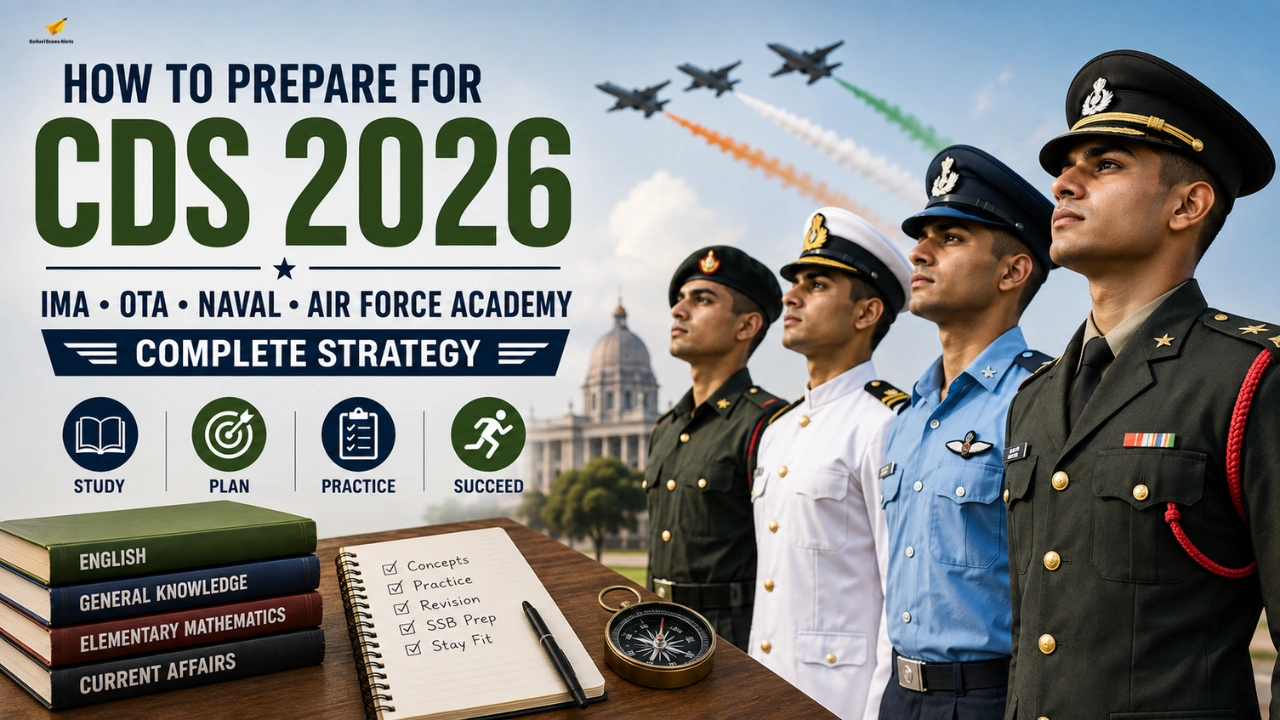
Prepare for CDS: The Combined Defence Services (CDS) Examination is one of the most prestigious defence recruitment exams conducted by the Union Public Service Commission (UPSC). Every year, thousands of graduates appear for the examination with the dream of joining the Indian Military Academy (IMA), Officers Training Academy (OTA), Indian Naval Academy (INA), or the Air Force Academy (AFA) and serving the nation as commissioned officers.
Unlike many competitive examinations, CDS is not just a written test that evaluates academic knowledge. It is a comprehensive selection process designed to identify candidates with intelligence, leadership potential, communication skills, discipline, and the ability to perform under pressure. Clearing the written examination is only the first milestone; candidates must also excel in the Services Selection Board (SSB) Interview and meet the required medical standards before earning a place in their chosen academy.
This is why preparing for CDS requires a different mindset. Success depends on building a balanced strategy that strengthens your concepts, improves your problem-solving ability, develops your personality, and prepares you for life as a future defence officer.
Whether you’re targeting the Indian Army, Navy, or Air Force, this guide will help you understand how to prepare effectively for CDS 2026 while maximizing your chances of final selection.
What is CDS?
CDS stands for Combined Defence Services. UPSC conducts CDS examination for graduate candidates to join all three armed forces as officers. IMA (Indian Military Academy) leads to Indian Army; Officers Training Academy (OTA, open to women) leads to Short Service Commission; Indian Naval Academy leads to Indian Navy; Air Force Academy leads to Indian Air Force. Salary after training is Pay Level 10 (Rs 56,100 basic pay) for Lieutenants. Age limit: 19 to 24 years for IMA, 19 to 25 for OTA and Air Force, 19 to 22 for Navy.
Also Read: UPSC Exam Calendar
How to Prepare for CDS After Graduation
CDS requires graduation as minimum qualification making post-graduation planning essential. Start preparation during final year of graduation. The exam pattern is similar to competitive exams you may have already appeared in. Graduates from technical backgrounds (Engineering, Science) find Elementary Maths easier. Arts and Commerce graduates often score higher in English and GK. Build on your strengths and address weaknesses specifically.
How to Prepare for CDS OTA (For Women)
CDS OTA is the only direct entry for women into the Army. For OTA, the written exam has only English (100 marks) and General Knowledge (100 marks) — no Maths. This makes OTA preparation simpler in scope but more competitive in those two sections. Dedicate 60% of your time to GK (current affairs, history, polity, science) and 40% to English. SSB for OTA assesses the same Officer Like Qualities as all other academies.
What Does a CDS Topper Prepare First?
Most successful CDS candidates don’t begin by purchasing multiple books or enrolling in several coaching programs. Instead, they spend time understanding the examination itself before creating their study plan.
The first priority is understanding the official syllabus. Rather than treating every topic equally, toppers identify the areas that are consistently tested in English, General Knowledge, and Elementary Mathematics. This helps them create a preparation plan that is both realistic and effective.
The next step is analyzing Previous Years’ Question Papers (PYQs). Solving PYQs gives valuable insights into the difficulty level of the examination, recurring question patterns, and frequently tested concepts. It also helps candidates understand how UPSC frames questions and what level of conceptual clarity is expected.
Successful aspirants also study the exam trends. Instead of assuming that every topic has equal importance, they identify chapters that repeatedly contribute a significant number of questions. This allows them to allocate their preparation time more efficiently while ensuring that high-weightage topics receive adequate attention.
Another important aspect is understanding the weightage of different sections. Candidates preparing for IMA, INA, and AFA know that English, General Knowledge, and Mathematics carry equal importance in the written examination. On the other hand, OTA aspirants can dedicate more time to English and General Knowledge because Mathematics is not part of their written test.
By investing time in understanding the examination before opening their books, CDS toppers avoid unnecessary confusion and build a preparation strategy based on priorities rather than assumptions.
Build Your CDS Preparation Around Three Core Pillars
Every successful CDS preparation strategy is built on three essential pillars. Candidates who focus only on completing the syllabus often struggle during later stages of the recruitment process because they overlook equally important aspects such as personality development and physical fitness.
Pillar 1: Strengthen Your Academic Foundation
The written examination is the first stage of the CDS selection process, making conceptual clarity extremely important. Instead of memorizing information, focus on understanding the concepts behind every topic.
For English, work on grammar, vocabulary, reading comprehension, and sentence improvement. In General Knowledge, build a strong understanding of history, geography, polity, economy, science, current affairs, and defence-related developments. Candidates appearing for the Mathematics paper should strengthen their basics before moving on to speed-based practice.
A strong academic foundation reduces mistakes, improves confidence, and makes revision much more effective.
Pillar 2: Practice with Consistency
Knowledge alone cannot guarantee success unless it is supported by regular practice.
After completing every topic, solve chapter-wise multiple-choice questions and previous years’ papers to understand how concepts are tested in the examination. As your preparation progresses, begin attempting sectional tests and full-length mock examinations under timed conditions.
Mock tests not only improve speed and accuracy but also help you identify weak areas that require additional revision. More importantly, they train your mind to perform under examination pressure.
Pillar 3: Prepare for the SSB from Day One
One of the biggest differences between average candidates and recommended candidates is that successful aspirants prepare for the Services Selection Board (SSB) alongside the written examination instead of waiting for the results.
The SSB is designed to assess leadership, communication, teamwork, decision-making, confidence, and officer-like qualities. These skills cannot be developed overnight.
Start reading newspapers every day, participate in discussions, improve your communication skills, observe your surroundings, and practice expressing your thoughts clearly. Developing these habits early makes SSB preparation much more natural and significantly improves your chances of recommendation.
Build an Academy-Wise Preparation Strategy
Although the CDS examination is common, every academy demands a slightly different preparation approach. Understanding these differences allows you to allocate your study time more effectively.
Indian Military Academy (IMA)
Candidates targeting IMA should maintain equal focus on English, General Knowledge, and Mathematics. Since Army officers are expected to demonstrate leadership and physical endurance, candidates should also begin preparing for the SSB interview and maintain a regular fitness routine alongside academics.
Officers Training Academy (OTA)
Since OTA candidates appear only for English and General Knowledge, they have an excellent opportunity to strengthen these subjects while simultaneously preparing for the SSB interview. Developing communication skills, confidence, and awareness of current affairs becomes particularly important because personality assessment carries significant weight during the selection process.
Indian Naval Academy (INA)
Naval Academy aspirants should focus equally on Mathematics and General Knowledge while developing strong analytical thinking. Keeping yourself updated with defence technology, maritime security, science, and international affairs can also prove beneficial during the SSB interview.
Air Force Academy (AFA)
Candidates preparing for the Air Force Academy should pay special attention to Mathematics, analytical reasoning, and General Knowledge. In addition to academics, maintaining excellent physical fitness and understanding aviation-related developments can strengthen both written examination and SSB preparation.
Make Previous Years’ Papers Your Strongest Study Resource
Every successful CDS aspirant understands the importance of Previous Years’ Question Papers (PYQs). These papers provide valuable insights into the examination pattern, frequently asked topics, and the overall difficulty level.
Instead of solving previous years’ papers only after completing the syllabus, integrate them into your preparation from the beginning. After finishing each major topic, attempt related questions from earlier examinations to test your understanding.
While solving PYQs, don’t focus only on getting the correct answer. Analyze why an answer is correct, identify concepts you struggled with, and revise those areas immediately. This habit strengthens conceptual clarity and prevents repeated mistakes.
Attempt full previous years’ papers under actual exam conditions during the later stages of preparation. This improves time management and builds confidence for the real examination.
Create a 90-Day CDS Preparation Blueprint
A structured preparation plan helps maintain consistency and prevents last-minute panic. Dividing your preparation into three phases allows you to build concepts gradually while leaving sufficient time for revision.
Days 1–30: Build the Foundation
The first month should focus on understanding concepts and establishing a disciplined study routine. Complete the basic topics in English, General Knowledge, and Mathematics according to your target academy. Alongside academics, begin reading newspapers daily and dedicate time to physical fitness through running, stretching, and basic endurance exercises. The goal during this phase is to build confidence rather than complete the syllabus quickly.
Days 31–60: Practice and Improve
After strengthening your basics, begin solving chapter-wise MCQs, previous years’ papers, and sectional mock tests. Use this phase to identify weak subjects, improve calculation speed, strengthen vocabulary, and expand your current affairs preparation. Continue developing communication skills and officer-like qualities through regular reading, discussions, and self-assessment.
Days 61–90: Revise and Simulate the Examination
The final month should be dedicated to revision and exam practice. Attempt full-length mock tests under timed conditions, revise your short notes, strengthen weak areas identified through previous mocks, and continue your physical fitness routine. Avoid starting completely new topics during this phase. Focus instead on maximizing accuracy, improving confidence, and maintaining consistency.
Conclusion
Preparing for CDS 2026 is not simply about clearing a competitive examination—it is about preparing yourself to become an officer in the Indian Army, Indian Navy, or Indian Air Force. Success requires much more than academic knowledge. It demands discipline, leadership, confidence, physical fitness, and the ability to perform under pressure.
Whether you are targeting the Indian Military Academy (IMA), Officers Training Academy (OTA), Indian Naval Academy (INA), or Air Force Academy (AFA), your preparation should be balanced across every stage of the selection process. Build strong concepts, practice consistently, solve previous years’ question papers, take regular mock tests, stay physically active, and begin preparing for the SSB interview from the very first day.
Remember, the CDS examination selects future leaders, not just successful candidates. Every chapter you complete, every mock test you analyze, every newspaper you read, and every challenge you overcome brings you one step closer to earning the honour of wearing the uniform and serving the nation.
Frequently Asked Questions (FAQs)
- How should beginners start preparing for CDS 2026?
Beginners should first understand the latest CDS syllabus, exam pattern, and the academy they wish to join. Build strong fundamentals in English, General Knowledge, and Mathematics (where applicable), solve previous years’ papers, and start preparing for the SSB interview alongside the written examination.
- Is the preparation strategy different for IMA, OTA, INA, and Air Force Academy?
Yes. While English and General Knowledge are common across all academies, candidates targeting IMA, INA, and Air Force Academy must also prepare for Elementary Mathematics. OTA aspirants can use the additional time to strengthen English, current affairs, and SSB preparation.
- How many months are enough to prepare for CDS 2026?
A focused preparation period of 4–6 months is generally sufficient for most candidates. During this time, aspirants should complete the syllabus, solve previous years’ papers, attempt mock tests, revise regularly, and develop Officer-Like Qualities for the SSB interview.
- Should I prepare for the SSB interview before clearing the written examination?
Yes. The SSB assesses personality, communication skills, leadership, and decision-making abilities, which cannot be developed in a few weeks. Starting your SSB preparation early significantly improves your chances of final recommendation.
- Are previous years’ question papers enough for CDS preparation?
Previous years’ papers are one of the most valuable preparation resources because they help candidates understand the exam pattern, important topics, and difficulty level. However, they should be complemented with conceptual study, regular revision, mock tests, and current affairs preparation for the best results.