
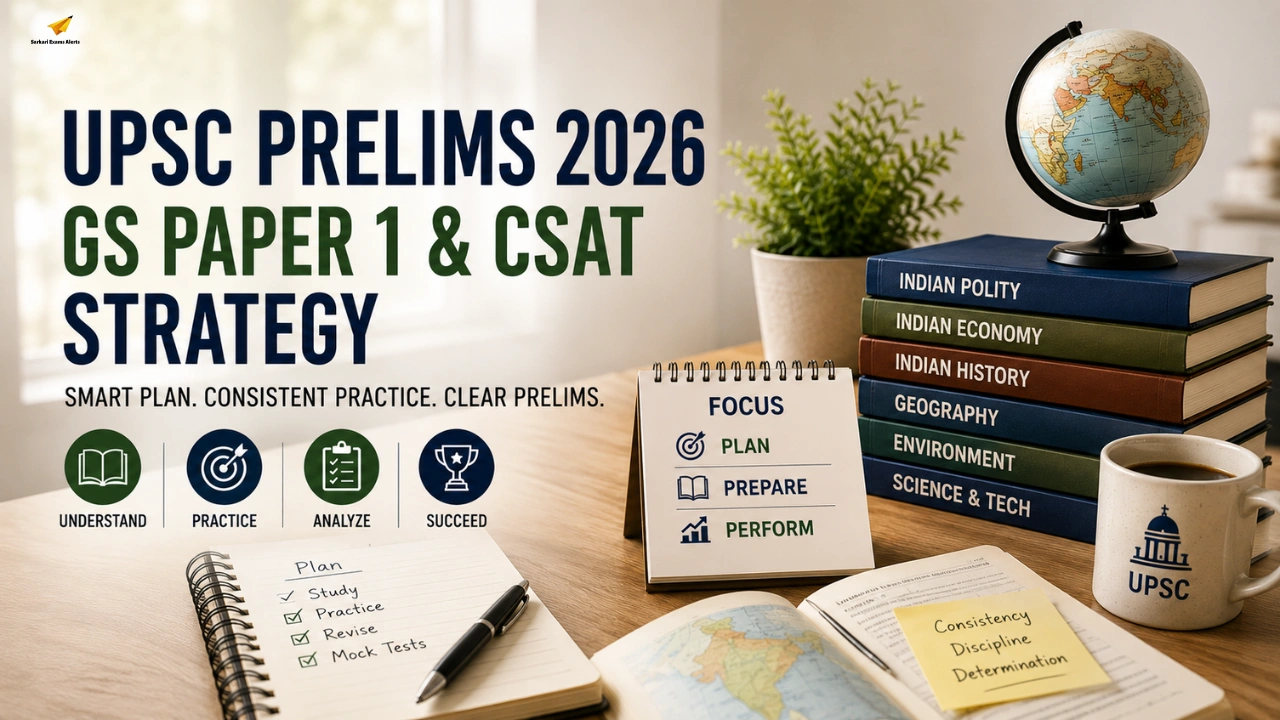
Prepare for UPSC Prelims: The UPSC Civil Services Preliminary Examination is often described as one of the toughest screening tests in India. Every year, lakhs of aspirants compete for a limited number of vacancies, but only a small percentage qualify for the Mains examination.
Unlike the UPSC Mains, where descriptive writing determines your rank, the Prelims examination tests your conceptual clarity, decision-making ability, speed, and accuracy through objective-type questions. Success in Prelims is not just about knowing the right answer, it’s also about avoiding incorrect ones through smart elimination and effective time management.
If you’re preparing for UPSC Prelims 2026, your goal should be to maximize your score in General Studies Paper 1 while comfortably qualifying the CSAT paper. This guide will help you build a practical preparation strategy that combines conceptual learning, current affairs, mock tests, revision, and exam-day techniques.
Subject-wise Strategy for UPSC Prelims 2026
History Strategy: Focus on Concepts Before Memorization
History is one of the most important subjects in UPSC Prelims GS Paper 1, with questions coming from Ancient, Medieval, Modern Indian History, and Art & Culture. Instead of trying to memorize every date and event, focus on understanding historical developments, causes, consequences, and their significance.
Begin your preparation with NCERT textbooks to build conceptual clarity before moving to standard reference books. While studying Modern Indian History, pay special attention to important movements, personalities, constitutional developments, and socio-religious reforms. For Ancient and Medieval History, concentrate on major dynasties, cultural contributions, literature, architecture, religions, and administrative systems. Art & Culture should be prepared alongside History by revising architecture, dance forms, music, paintings, UNESCO heritage sites, festivals, and Buddhism and Jainism.
History requires regular revision because factual information is easy to forget. Preparing concise notes and revisiting them every few weeks improves long-term retention.
Also Read: How to Prepare for UPSC Mains
Geography Strategy: Understand Maps and Concepts Together
UPSC increasingly asks conceptual Geography questions rather than direct factual ones. Instead of memorizing isolated facts, understand the relationship between physical geography, climate, environment, and human activities.
Start with NCERT Geography books to build a strong foundation in physical, Indian, and world geography. Practice locating important rivers, mountain ranges, national parks, passes, lakes, straits, islands, and neighbouring countries on maps. Current affairs often influence Geography questions, so connect geographical concepts with recent events such as cyclones, earthquakes, international conflicts, or environmental issues. Using maps regularly makes revision easier and significantly improves conceptual understanding.
Indian Polity Strategy: Build Strong Constitutional Fundamentals
Polity is considered one of the highest-scoring sections because many questions are directly based on constitutional provisions and governance. Begin by understanding the structure of the Constitution rather than memorizing articles. Focus on Fundamental Rights, Directive Principles of State Policy, Fundamental Duties, Parliament, President, Prime Minister, Judiciary, Constitutional Bodies, Election Commission, Finance Commission, Emergency Provisions, Local Government, and recent constitutional amendments.
Reading current affairs alongside Polity helps you understand how constitutional provisions are applied in real-life governance. Supreme Court judgments, important bills, government policies, and parliamentary developments often become relevant for Prelims. Frequent revision is essential because constitutional provisions are interconnected.
Economy Strategy: Learn Concepts Before Current Affairs
Many aspirants find Economy difficult because they begin with current affairs instead of understanding the basics. Start by learning fundamental concepts such as GDP, inflation, fiscal deficit, monetary policy, banking, taxation, budgeting, money supply, and balance of payments. Once these concepts become clear, reading the Economic Survey, Union Budget highlights, RBI updates, and business news becomes much easier.
Instead of memorizing economic data, understand the impact of government schemes, financial policies, and economic reforms on the Indian economy. Economy becomes significantly easier once the conceptual foundation is strong.
Environment and Ecology Strategy: Integrate Static and Current Affairs
Environment has become one of the most important sections in recent UPSC Prelims examinations. Prepare topics such as ecosystems, biodiversity, food chains, climate change, protected areas, wildlife conservation, environmental conventions, pollution, and sustainable development. Alongside static concepts, regularly follow current environmental issues, endangered species, Ramsar sites, biosphere reserves, national parks, tiger reserves, and international climate conferences. UPSC often combines current affairs with conceptual Environment questions, making integrated preparation essential.
Science and Technology Strategy: Focus on Applications
UPSC rarely asks deep theoretical science questions. Instead, the focus is usually on the practical application of scientific concepts. Prepare basic Physics, Chemistry, Biology, Biotechnology, Space Technology, Artificial Intelligence, Robotics, Nanotechnology, Defence Technology, and Healthcare innovations. Current scientific developments, ISRO missions, Nobel Prize-winning discoveries, vaccines, and emerging technologies should also be covered. Reading science-related current affairs becomes much easier when basic concepts are already clear.
Current Affairs Strategy: Revise Continuously, Not Occasionally
Current Affairs influence almost every subject in UPSC Prelims. Instead of studying them separately, integrate current events with History, Geography, Polity, Economy, Environment, and Science. Read newspapers daily, follow PIB updates, government reports, international organizations, awards, defence exercises, important appointments, and major policy announcements.
Rather than collecting multiple monthly magazines, prepare concise revision notes that can be reviewed repeatedly before the examination. Current Affairs become valuable only when revised consistently.
CSAT Strategy: Never Treat It as “Just Qualifying”
Although CSAT is a qualifying paper, ignoring it has cost many serious aspirants their chance of appearing for the Mains examination. Dedicate at least two or three practice sessions every week to Reading Comprehension, Logical Reasoning, Analytical Ability, Decision Making, Data Interpretation, and Basic Numeracy. Candidates from non-mathematics backgrounds should begin practicing early instead of waiting until the final months.
Attempt previous years’ CSAT papers and timed mock tests regularly to improve speed, accuracy, and confidence. Since the qualifying marks are fixed, the objective should be to comfortably clear the paper rather than aiming for perfection.
Conclusion
Preparing for UPSC Prelims 2026 is not about studying every book available in the market—it’s about studying the right resources, revising them consistently, and applying your knowledge effectively in the examination. Since the Preliminary Examination serves as the gateway to the UPSC Civil Services Mains, your preparation should focus on building strong conceptual clarity, integrating current affairs with static subjects, and developing the ability to solve objective questions with speed and accuracy.
Treat General Studies Paper 1 and CSAT with equal importance. While GS Paper 1 determines your chances of qualifying for the next stage, ignoring CSAT can end your journey despite scoring well in GS. Regular revision, previous years’ question papers, mock tests, and continuous self-analysis should become an integral part of your preparation strategy.
Remember, UPSC Prelims rewards consistency more than intensity. Stay disciplined, avoid unnecessary study resources, trust your preparation, and focus on improving a little every day. With the right strategy and dedicated effort, clearing UPSC Prelims 2026 can become the first step towards achieving your dream of becoming a civil servant.
Frequently Asked Questions (FAQs)
- How should a beginner start preparing for UPSC Prelims 2026?
Beginners should start by understanding the latest UPSC Prelims syllabus and exam pattern before selecting study resources. Build a strong foundation with NCERT books, gradually move to standard reference books, solve previous years’ question papers, and make current affairs a daily habit. Creating a realistic study schedule and revising regularly is equally important for long-term success.
- What is the best strategy to balance GS Paper 1 and CSAT preparation?
The ideal strategy is to prioritize GS Paper 1 daily while dedicating two or three sessions each week to CSAT. Regular practice of reading comprehension, logical reasoning, and aptitude questions ensures that CSAT remains manageable without affecting GS preparation. This balanced approach reduces last-minute pressure and improves overall performance.
- How important are previous years’ question papers for UPSC Prelims preparation?
Previous years’ question papers are one of the most valuable resources for UPSC Prelims. They help aspirants understand the changing question pattern, identify high-weightage topics, improve elimination techniques, and develop familiarity with the level of conceptual understanding expected by UPSC. Solving and analysing PYQs should be a regular part of every preparation plan.
- How many mock tests should I attempt before UPSC Prelims 2026?
There is no fixed number, but most successful aspirants attempt 25–40 quality mock tests before the examination. The focus should not only be on attempting mocks but also on analysing mistakes, revising weak topics, and improving accuracy. A well-analysed mock test is often more beneficial than attempting multiple tests without review.
- What are the most common mistakes to avoid while preparing for UPSC Prelims?
Some of the most common mistakes include collecting too many study materials, neglecting CSAT because it is qualifying in nature, skipping revision, relying only on current affairs without strengthening static subjects, and avoiding mock tests due to fear of low scores. Staying consistent with a limited set of trusted resources and revising them multiple times is a much more effective strategy than constantly switching between books.