
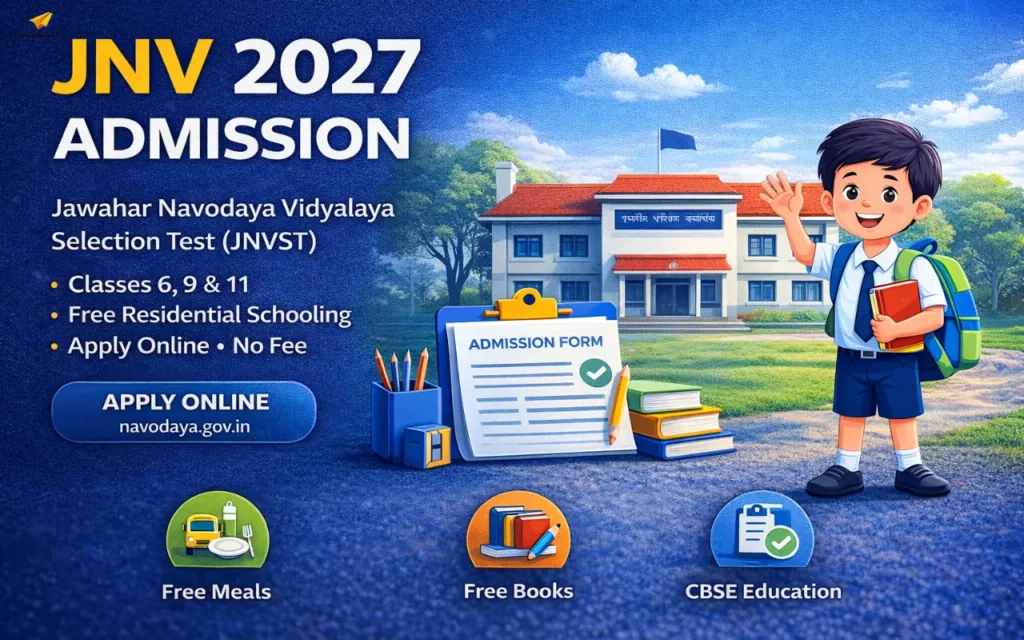
JNV Exam refers to the Jawahar Navodaya Vidyalaya (JNV) admissions for the academic year 2027-28, conducted by the Navodaya Vidyalaya Samiti (NVS) under India’s Ministry of Education. Admission is available for Class 6 through JNVST, and for Class 9 and Class 11 through the Lateral Entry Selection Test (LEST). The Class 6 application form for JNV 2027 is expected to open in June 2026 at navodaya.gov.in, with the Phase 1 exam in December 2026. The entire process is free of cost and JNV provides fully residential schooling including meals, books, uniforms, and CBSE education at no charge.
JNV Exam 2027 Quick Overview
| Detail | Information |
|---|---|
| Full Name | Jawahar Navodaya Vidyalaya Admission 2027-28 |
| Conducted By | Navodaya Vidyalaya Samiti (NVS), Ministry of Education |
| Exam Name | Jawahar Navodaya Vidyalaya Selection Test (JNVST) |
| Classes | Class 6, Class 9 (Lateral Entry), Class 11 (Lateral Entry) |
| Total JNVs in India | 661 schools across 27 States and 8 Union Territories |
| Application Mode | Online only at navodaya.gov.in |
| Application Fee | Completely free for all categories |
| Exam Mode | Offline (pen and paper based) |
| Exam Medium | Available in 29 regional languages |
| Seats Per School (Class 6) | Approximately 80 students |
| Rural Seat Reservation | Minimum 75% |
| Girl Seat Reservation | Minimum 33% in each category |
| Official Website | navodaya.gov.in |
JNV Exam 2027 Important Dates (Expected)
These dates are projected based on the confirmed 2026-27 cycle. NVS follows the same schedule every year. Official dates will be released at navodaya.gov.in. For reference, in the 2026-27 cycle: Class 6 applications were from June 1 to August 27, 2025; Phase 1 exam was December 13, 2025; Phase 2 exam was April 11, 2026; Phase 1 result was declared on March 17, 2026. Class 9 applications ran from July 30 to October 23, 2025, and the exam was February 7, 2026.
| Event | Class 6 (Expected) | Class 9 (Expected) | Class 11 (Expected) |
|---|---|---|---|
| Notification Release | June 2026 | July 2026 | July 2026 |
| Application Start | June 2026 | July 2026 | July 2026 |
| Last Date to Apply | August 2026 | October 2026 | October 2026 |
| Correction Window | August 2026 | October 2026 | October 2026 |
| Admit Card | November 2026 | January 2027 | January 2027 |
| Phase 1 Exam | December 2026 | February 2027 | February 2027 |
| Phase 2 Exam | April 2027 | Not applicable | Not applicable |
| Result Phase 1 | March 2027 | April 2027 | April 2027 |
| Result Phase 2 | May 2027 | Not applicable | Not applicable |
What is JNV Exam? A Complete Guide for Parents
Jawahar Navodaya Vidyalayas are fully residential, co-educational central government schools run by the Navodaya Vidyalaya Samiti (NVS). They were established under the National Policy on Education 1986 with one defining purpose: to find talented children from rural India and give them world-class education completely free of cost.
There are 661 JNVs spread across every district of India (except Goa and a few areas). Each school follows the CBSE curriculum and is designed so that children live, study, eat, sleep, and grow together on campus throughout their school years. This is not just a school. For many children from villages and small towns, JNV is a life-changing opportunity that opens doors to IITs, IIMs, government services, and professional careers.
What Does Your Child Get at JNV – Free of Cost?
| Benefit | What Your Child Receives |
|---|---|
| Tuition (Class 6 to 8) | 100% free for all students |
| Tuition (Class 9 to 12) | Free for girls, SC, ST, BPL, Divyang students |
| Residential Boarding | Free accommodation on campus |
| Meals | Three nutritious meals daily, completely free |
| Textbooks and Stationery | Provided by NVS at no cost |
| School Uniform | Two sets per year, free |
| Medical Care | Dedicated medical room and health facilities on campus |
| CBSE Board Exam Fee | Paid by NVS on behalf of students |
| Sports and Co-curricular | Access to sports grounds, cultural activities, annual events |
From Class 9 onwards, General and OBC category students pay Rs 600 per month toward Vidyalaya Vikas Nidhi. Girls, SC, ST, BPL, and Divyang students are fully exempt throughout their entire schooling from Class 6 to Class 12.
The Migration Scheme
One of the most distinctive features of JNV is its migration scheme. Every year, selected JNV students get the opportunity to transfer to a JNV in a different state. This helps children from Hindi-speaking states learn a regional language, and vice versa. This exposure to different cultures and languages is something no private school offers at this level.
| JNV Exam Related Links | |
| JNV Class 6 Admission | JNV Application Form Class 6 |
| JNV Class 11 Syllabus | JNV Class 9 Syllabus |
| JNV Class 11 Application Form | JNV Class 11 Admission |
| JNV Class 9 Admission | |
JNV Exam 2027 Class 6 Admission: Complete Guide
Class 6 is the primary and most popular entry point into JNV. Over 20 lakh students appear for JNVST Class 6 every year across India, competing for approximately 80 seats per school.
Eligibility Criteria for JNV Class 6 Admission 2027
Every parent must check all the eligibility conditions carefully before applying. Missing even one condition leads to rejection.
Age Limit: Your child must be born between May 1, 2015 and July 31, 2017 (both dates inclusive). This applies to all categories including SC, ST, OBC, and Divyang. No age relaxation of any kind is provided for JNVST.
Class: Your child must be studying in Class 5 during the academic year 2026-27 in a government or government-recognized school. Students who have already passed Class 5 before the 2026-27 session are not eligible.
District: Your child must be studying Class 5 in a school located in the same district as the JNV where you want to seek admission. Cross-district applications are not accepted under any circumstance.
One Attempt Only: JNVST Class 6 can be attempted only once in a lifetime. If your child appeared in any previous year’s JNVST regardless of whether they passed or failed, they cannot apply again. This is verified strictly during application processing.
School Continuity: Your child must have studied Class 3, 4, and 5 in full academic sessions. Candidates cannot be repeaters in any of these classes.
Open Schooling: Children completing the B Level Certificate Course from NIOS on or before September 15, 2026 are also eligible. They must submit a Rural Area Certificate from the District Magistrate, Tehsildar, or BDO.
JNV Exam 2027: Rural vs Urban Category Explained
This is the most confusing part of the JNV application. Read this carefully before applying.
A student is classified as rural if they have studied their complete Class 3, 4, and 5 in schools located in rural areas of the same district. At least 75% of all seats in every JNV are reserved for rural candidates.
A student is classified as urban if they have studied even a single day in an urban school at any point during Class 3, 4, or 5. Urban students compete for a maximum of 25% of seats.
This classification is based on the school’s location, not where your family lives. If your child’s school is in a rural area but your home is in a city, your child is classified as rural. If your child’s school is in an urban area even for one year, they are classified as urban permanently.
JNV Exam 2027: Reservation Policy for JNV Class 6 2027
| Category | Reservation |
|---|---|
| Rural Students | Minimum 75% of total seats |
| Urban Students | Maximum 25% of total seats |
| Scheduled Caste (SC) | As per district SC population (minimum 15%) |
| Scheduled Tribe (ST) | As per district ST population (minimum 7.5%) |
| Other Backward Classes (OBC) | 27% as per Central OBC list |
| Girl Students | Minimum 33.33% in each category |
| Divyang (PwD) | 3% of total seats |
JNV Class 6 Exam Pattern 2027 (JNVST)
The JNVST Class 6 exam is an offline pen and paper test of 2 hours. It has 80 questions for 100 marks. There is no negative marking. The exam is available in 29 regional languages.
| Section | Questions | Marks | Time |
|---|---|---|---|
| Mental Ability Test | 40 | 50 | 60 minutes |
| Arithmetic Test | 20 | 25 | 30 minutes |
| Language Test | 20 | 25 | 30 minutes |
| Total | 80 | 100 | 2 hours |
Mental Ability Test (40 Questions, 50 Marks)
This is the most important section carrying 50 of 100 marks. It tests logical thinking and pattern recognition. No textbook can be memorized for this section. Only regular practice helps. Topics include:
- Odd figure identification
- Figure matching and completion
- Pattern completion
- Figure series
- Space visualization
- Mirror and water images
- Embedded figures
- Analogies based on shapes
- Punched hole patterns
Arithmetic Test (20 Questions, 25 Marks)
This section covers mathematics from Class 3 to Class 5 level. Topics include:
- Number system and place value
- Basic operations: addition, subtraction, multiplication, division
- Fractions and decimals
- Factors, multiples, HCF and LCM
- Measurement: length, weight, time, money
- Distance, time, and speed
- Percentages
- Simple profit and loss
- Geometry: lines, angles, triangles, circles
- Area and perimeter of basic shapes
- Data handling: reading tables and simple graphs
Language Test (20 Questions, 25 Marks)
This tests reading comprehension and basic grammar in the student’s medium of study. Topics include reading comprehension passages, fill in the blanks, error detection, synonyms and antonyms, sentence arrangement, and basic grammar usage.
JNV EXam 2027 Class 9 Lateral Entry Admission: Complete Guide
Class 9 lateral entry is for students currently in Class 8 who want to join JNV directly. Seats are available only where vacancies exist. This is not available in every JNV every year.
Eligibility Criteria for JNV Class 9 Admission 2027
| Criteria | Details |
|---|---|
| Academic Class | Must be studying in Class 8 during academic year 2026-27 |
| School Type | Government or government-recognized school only |
| District | Must be studying in the same district as the JNV |
| Age Limit | Born between May 1, 2012 and July 31, 2014 (both dates inclusive) |
| Previous Attempts | Must not have previously appeared in JNVST Class 9 |
| Existing JNV Students | Students already in a JNV cannot apply for Class 9 lateral entry |
| Seat Availability | Admission only in JNVs where Class 9 seats are vacant |
Age relaxation is not given to any category for Class 9 admission. The age criteria applies equally to SC, ST, OBC, and Divyang candidates.
Class 9 Exam Pattern (JNVST LEST 2027)
The Class 9 exam is called the Lateral Entry Selection Test (LEST). It is an offline exam of 2.5 hours duration with 100 questions for 100 marks. There is no negative marking.
| Section | Questions | Marks |
|---|---|---|
| English | 15 | 15 |
| Hindi | 15 | 15 |
| Mathematics | 35 | 35 |
| General Science | 35 | 35 |
| Total | 100 | 100 |
The merit list for Class 9 admission is prepared based on: Mathematics marks + General Science marks + the higher of either English or Hindi marks. So if your child scores better in English than Hindi, English marks are counted and vice versa.
Class 9 Syllabus (JNVST 2027)
The Class 9 JNVST syllabus is based on NCERT Class 7 and Class 8 curriculum.
English Syllabus
- Word and sentence structure
- Spelling correction
- Active and passive voice
- Rearranging jumbled words
- Degrees of comparison
- Modal auxiliaries
- Tense forms
- Reported speech (direct and indirect)
- Use of prepositions
- Reading comprehension (unseen passage)
Hindi Syllabus
- Grammar and linguistic application
- Spelling and word forms
- Parts of speech
- Word classification by origin
- Correcting incorrect sentences
- Antonyms and synonyms
- Reading comprehension
Mathematics Syllabus
- Rational numbers
- Squares and square roots
- Cubes and cube roots
- Linear equations in one variable
- Understanding quadrilaterals: parallelogram, rhombus, rectangle, square, kite
- Algebraic expressions and identities
- Data handling: bar graph, pie chart, organizing data, probability
- Mensuration: area of plane figures, surface area and volume of cube, cuboid, and cylinder
- Direct and inverse proportions
- Factorization
General Science Syllabus
- Crop production and management
- Microorganisms: friends and foes
- Conservation of plants and animals
- Cell structure and function
- Reproduction in animals
- Reaching the age of adolescence
- Force and pressure
- Friction
- Sound
- Light
- Chemical effects of electric current
- Natural phenomena
JNV Exam 2027 Class 11 Lateral Entry Admission: Complete Guide
Class 11 lateral entry is for students who have passed Class 10 and want to join JNV for senior secondary education. This is merit-based and does not involve a written entrance exam.
Eligibility Criteria for JNV Class 11 Admission 2027
| Criteria | Details |
|---|---|
| Academic Qualification | Must have passed Class 10 from a recognized board |
| Age Limit | 14 to 18 years as specified in the official notification |
| District | Preference to students from the same region |
| Priority | Existing JNV Class 10 students who qualify in board exams get first preference |
| External Students | Fill remaining vacant seats based on merit |
| Streams Available | Science, Commerce, Arts/Humanities (depends on each JNV) |
How Class 11 Lateral Entry Selection Works
Unlike Class 6 and Class 9, there is no written entrance exam for Class 11. Selection is based on Class 10 board examination marks through a stream-wise merit list prepared by the concerned JNV. Students from within JNVs who completed Class 10 in JNV are given priority. External students are considered only if seats remain after internal JNV students are accommodated.
Streams Available in Class 11 at JNV
- Science with Physics, Chemistry, Biology or Mathematics
- Commerce with Accountancy, Business Studies, Economics
- Arts/Humanities with History, Geography, Political Science, Economics
Stream availability varies by school. Not every JNV offers all three streams. Parents should check with the specific JNV in their district before applying.
How to Apply for JNV Exam 2027 Online: Step-by-Step Guide
The application is completely online and free. There is no offline mode. Follow these steps carefully.
- Visit navodaya.gov.in on your phone or computer and look for the Class 6, Class 9, or Class 11 admission link in the admission section.
- Click on “Click here for New Candidate Registration” and enter your child’s basic details including name, parent’s name, mobile number, email address, district, and state.
- You will receive an OTP on the registered mobile number for verification. Enter it to proceed.
- Log in using the credentials generated and fill in the complete application form with your child’s personal details, school details, district, category, rural or urban status, and choice of exam medium.
- Upload the required documents in JPG format: candidate’s photograph (10 KB to 100 KB), candidate’s signature (10 KB to 100 KB), parent or guardian signature (10 KB to 100 KB), and headmaster-verified certificate (50 KB to 300 KB).
- Review every detail carefully before submitting. Check name spelling, date of birth, district, category, and medium. Once submitted, only limited corrections are allowed during the correction window.
- Submit the form. A registration confirmation with your registration number will appear on screen.
- Save and print the confirmation page. You will need the registration number to download the admit card later.
Common Mistakes to Avoid While Applying for JNVST Exam
- Selecting the wrong district is the most common and serious mistake. Your child can only apply to the JNV in the same district where they study.
- Uploading blurry or oversized photographs leads to application rejection.
- Selecting the wrong category causes problems during document verification.
- Selecting the wrong exam medium. Choose the language your child is most comfortable with.
- Not reviewing the form before final submission. Check every field twice before clicking submit.
Documents Required for JNV 2027 Application
- Student’s recent passport-size photograph
- Student’s signature on white paper
- Parent or guardian’s signature on white paper
- Certificate of enrollment in Class 5 verified and signed by the school headmaster
- Aadhaar card of the student (mandatory)
- Residence proof from parent if the student does not have an Aadhaar card
- Rural area certificate if applying under rural category from the District Magistrate, Tehsildar, or BDO
- Caste certificate for SC/ST/OBC candidates
- BPL card or certificate if applying for fee exemption
- Disability certificate from a competent medical authority if applicable
Best Books for JNVST 2027 Preparation
Choosing the right book makes a significant difference in preparation quality. These are the most recommended books for JNVST Class 6 preparation:
| Book | Publisher | Best For |
|---|---|---|
| JNVST Class VI Guide | Arihant Publications | Complete preparation, all sections |
| Navodaya Vidyalaya Entrance Exam | Oswaal Books | Practice questions and mock tests |
| JNVST Practice Paper Sets | MTG Learning Media | Full-length practice papers |
| JNV Class 6 Study Package | Agrawal Examcart | Comprehensive topic-wise coverage |
| Mental Ability for JNVST | R. Gupta’s Publications | Mental ability section specifically |
| Solved Papers JNVST Class VI | Upkar Prakashan | Previous year papers with solutions |
For Class 9 preparation, use Arihant’s JNVST Class IX Guide along with NCERT Mathematics and Science textbooks of Class 7 and 8.
Parents should buy one good guide book and one practice paper book. Buying too many books creates confusion. Consistency with fewer books works better than reading many books partially.
JNV 2027 Preparation Tips for Parents and Students
For Class 6: What Parents Should Do
Start preparation at least 6 months before the expected exam date. If the exam is in December 2026, start by June 2026 at the latest.
The Mental Ability section cannot be prepared from textbooks. It improves only through practice. Make your child solve at least 5 to 10 mental ability questions every single day using previous year papers and dedicated practice books.
Create a daily routine. One hour of JNVST preparation daily is more effective than five hours once a week. Consistency matters more than intensity.
Solve one complete previous year paper every week in exam conditions. This means sitting for 2 full hours without any breaks. This builds both speed and confidence together.
For the Arithmetic section, ensure your child is completely clear on NCERT Class 4 and Class 5 mathematics. Pay special attention to fractions, percentages, and geometry. These topics appear every year without fail.
For the Language section, make your child read short passages in their medium daily. Comprehension speed improves significantly with daily reading practice.
For Class 9: What Parents Should Do
Class 9 preparation requires stronger conceptual clarity since questions are based on Class 7 and Class 8 NCERT level. Start with NCERT textbooks of Class 7 and 8 for both Mathematics and Science.
Mathematics carries 35 marks, which is the highest. Focus on Rational Numbers, Mensuration, Algebraic Expressions, and Data Handling. Practice at least 10 maths questions daily.
Science also carries 35 marks. NCERT Class 8 Science chapters are most important. Understand concepts clearly rather than memorizing facts.
The merit list counts the higher of English or Hindi marks. Focus on whichever language your child is stronger in and aim to maximize that score.
General Tips for All Classes
- Solve at least 5 years of previous year papers. The pattern has remained consistent and previous papers are the best guide to what will appear.
- Do not start new topics in the last 2 weeks before the exam. Use that time for revision and full-length mock tests only.
- Practice timed mock tests from the beginning so your child learns time management under exam conditions.
- Teach your child to attempt easier questions first and come back to harder ones. This maximizes score within the time limit.
- Eat well, sleep properly, and avoid stress in the last few days before the exam. A well-rested mind performs better than an anxious one.
JNV Exam Result and Selection Process
After the exam, NVS prepares a merit list based on marks scored. The Class 6 Phase 1 result is typically declared in March, approximately 3 months after the December exam. Results are available online at navodaya.gov.in and cbseitms.rcil.gov.in, and also offline at District Education Officers’ offices and the local JNV school notice board.
After the result, parents must complete document verification at the concerned JNV within the stipulated time. Selected students get notification by SMS on the registered mobile number. Missing the document verification date leads to cancellation of the seat with no second chance.
Frequently Asked Questions about JNV Exam 2027
What is JNV 2027 and when will the notification be released?
JNV 2027 refers to the Navodaya Vidyalaya Samiti admissions for the academic year 2027-28. The Class 6 notification is expected in June 2026 at navodaya.gov.in. Class 9 and Class 11 notifications are expected in July 2026. These timelines are based on the previous year pattern.
What is the age limit for JNV 2027 Class 6 admission?
Students must be born between May 1, 2015 and July 31, 2017 (both dates inclusive). This applies equally to all categories including SC, ST, OBC, and Divyang. No age relaxation is provided for JNVST Class 6.
Is JNV admission really free? What does my child need to pay?
Yes. The application is completely free. From Class 6 to Class 8, the entire education including meals, boarding, books, and uniform is free for all students. From Class 9, General and OBC students pay Rs 600 per month. Girls, SC, ST, BPL, and Divyang students remain fully exempt throughout Class 6 to Class 12.
Can my child apply for JNV in any district?
No. Your child must apply only to the JNV in the district where they are currently studying. Applications for a different district are rejected without exception.
Can my child try JNVST Class 6 again if they fail?
No. JNVST Class 6 can be attempted only once in a lifetime. If your child does not qualify or does not appear, they cannot apply again in any future year. This rule applies to all students without exception.
What is the difference between Phase 1 and Phase 2 of JNVST?
JNVST is held in two phases. Phase 1 covers most states and is held in December. Phase 2 covers specific hilly and winter-bound districts and is held in April. Your child’s district is assigned to one phase by NVS. Parents do not choose between phases.
What is Class 9 lateral entry in JNV and who can apply?
Class 9 lateral entry allows students studying in Class 8 to apply for vacant seats in JNV Class 9. The selection is through a written exam called LEST covering English, Hindi, Mathematics, and Science for 100 marks in 2.5 hours. Seats are limited and available only in JNVs that have vacancies.
Is there a written exam for Class 11 JNV admission?
No. Class 11 admission is merit-based on Class 10 board exam marks. There is no written entrance exam. Students from within JNVs who completed Class 10 there get first priority, and remaining seats are filled by external students based on merit.
How is the JNV Class 9 merit list prepared?
The Class 9 merit list is based on total marks in Mathematics plus General Science plus the higher of either English or Hindi. So if your child scores higher in English than Hindi, English marks are counted and vice versa. There is no negative marking.
What books should my child use for JNVST 2027 Class 6 preparation?
Arihant’s JNVST Class VI Guide, Oswaal Practice Papers, and previous year papers are the most recommended. Buy one guide book and one practice paper book. Consistency with fewer books works better than reading many books partially.
How many students appear for JNV Class 6 each year?
Over 20 lakh (2 million) students appear for JNVST Class 6 every year across India, competing for approximately 80 seats per school. This makes it one of the most competitive school entrance exams in India.
What is the medium of instruction at JNV after admission?
The JNVST exam is available in 29 regional languages. Once admitted, the medium of instruction at JNV is English for Science and Mathematics from Class 6 onwards, with Hindi for other subjects. Regional language support is available in the initial years to help students transition smoothly.
Stay connected with Sarkari Exams Alerts for all JNV 2027 updates. The moment NVS releases the official JNV 2027 notification, application form link, admit card, answer key, result, and selection list, we will publish it immediately. Bookmark this page and check back regularly so your child does not miss a single deadline in the JNV 2027 admission process.