
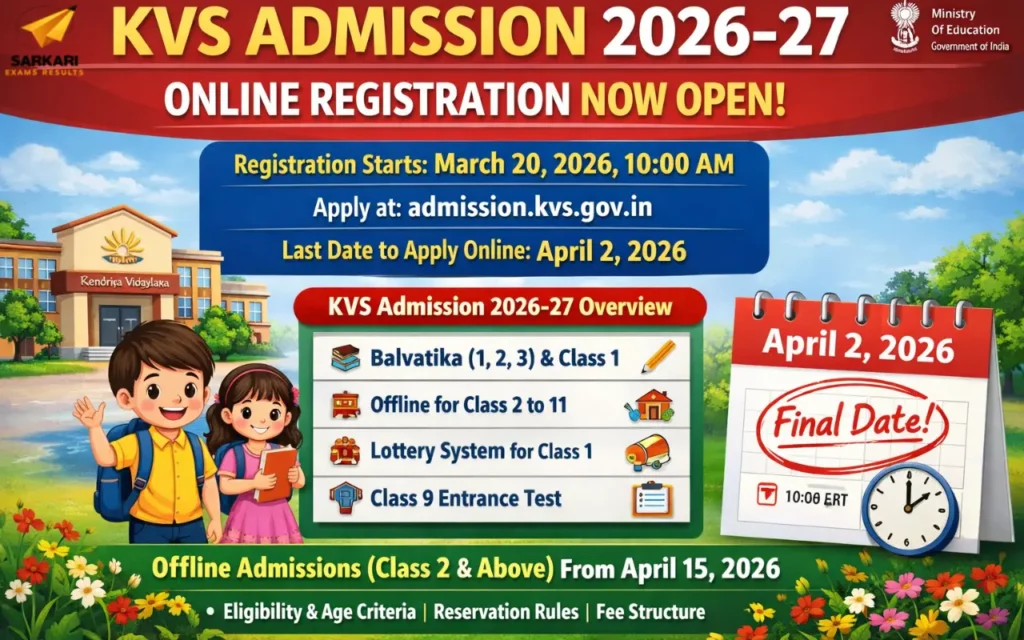
KVS Admission 2026-27 online registration is now open. As of today, March 20, 2026 at 10:00 AM, Kendriya Vidyalaya Sangathan (KVS) has activated the online portal for parents to register their children for Balvatika (1, 2, and 3) and Class 1 admissions for the academic session 2026-27. The last date to submit the online application at admission.kvs.gov.in is April 2, 2026. Admissions for Class 2 and above will be conducted offline through individual schools from April 15, 2026.
Kendriya Vidyalayas are among the most sought-after central government schools in India, managed by KVS under the Ministry of Education, Government of India. With CBSE affiliation, affordable fees, and a strong academic track record, a KV seat is competitive. Here is everything you need to know about the KV admission 2026-27 process, eligibility, age limits, lottery system, fee structure, and how to apply online step by step.
KVS Admission 2026-27 Overview
| Detail | Information |
| Conducting Body | Kendriya Vidyalaya Sangathan (KVS) |
| Academic Session | 2026-27 |
| Classes with Online Admission | Balvatika 1, 2, 3 and Class 1 |
| Classes with Offline Admission | Class 2 to Class 11 (via respective KV schools) |
| Registration Mode | Online (Class 1 & Balvatika); Offline (Class 2 onwards) |
| Online Registration Opens | March 20, 2026 at 10:00 AM |
| Online Registration Closes | April 2, 2026 |
| Official Websites | admission.kvs.gov.in, kvsonlineadmission.kvs.gov.in |
| Affiliation | Central Board of Secondary Education (CBSE) |
| Under | Ministry of Education, Government of India |
| Selection Process (Class 1) | Computerised Lottery System |
| Selection Process (Class 2-8) | Priority Category + Offline Lottery |
| Selection Process (Class 9) | Entrance Test + Priority Category |
| Selection Process (Class 11) | CBSE Class 10 Marks + Stream Eligibility |
KVS Admission 2026-27 Important Dates
The KVS Sangathan will conduct Kendriya Vidyalaya Balvatika and Class 1 admission from March 20 to April 2, 2026. The provisional list of selected students and waiting lists will be published on April 8, 2026 for Balvatika, and the Class 1 selection list will be released on April 9, 2026.
| Event | Date |
| KVS Admission 2026-27 Notification Released | March 19, 2026 |
| Online Registration Opens (Class 1 & Balvatika 1, 3) | March 20, 2026 (10:00 AM) |
| Online Registration Closes | April 2, 2026 |
| Balvatika 2 Registration Opens (Offline at School) | April 15, 2026 |
| Class 2 to 8 Offline Registration Window | April 15-20, 2026 |
| First Provisional Selection List (Balvatika 1, 2, 3) | April 8, 2026 |
| First Provisional Selection List (Class 1) | April 9, 2026 |
| Second Provisional List (if required) | To be announced |
| Class 11 Admission (after CBSE results) | May/June 2026 |
| Class 9 Admission Test | To be announced |
One important thing to note: KVS portals experience heavy traffic on the first day of registration. Log in early on March 20 and complete all fields carefully before submitting. Do not wait until April 2 — the portal may slow down close to the deadline.
KVS Admission 2026-27 Age Limit
The minimum age for all classes in KVS is calculated as of March 31, 2026. Children born on April 1 are also considered eligible at the same age bracket.
As per the KVS admission eligibility criteria, the age for Balvatika 1, 2, and 3 will be 3 to 4 years, 4 to 5 years, and 5 to 6 years respectively. The minimum age for admission in Class 1 will be 6 years.
Also Read: KVS Syllabus from Class 1 to 12
| Class | Minimum Age | Maximum Age | Age as on |
| Balvatika 1 | 3 years | 4 years | March 31, 2026 |
| Balvatika 2 | 4 years | 5 years | March 31, 2026 |
| Balvatika 3 | 5 years | 6 years | March 31, 2026 |
| Class 1 | 6 years | 8 years | March 31, 2026 |
| Class 2 | 6 years | 9 years | March 31, 2026 |
| Class 3 | 7 years | 10 years | March 31, 2026 |
| Class 4 | 8 years | 11 years | March 31, 2026 |
| Class 5 | 9 years | 12 years | March 31, 2026 |
| Class 6 | 10 years | 13 years | March 31, 2026 |
| Class 7 | 11 years | 14 years | March 31, 2026 |
| Class 8 | 12 years | 15 years | March 31, 2026 |
| Class 9 | 13 years | 16 years | March 31, 2026 |
| Class 10 | 14 years | 17 years | March 31, 2026 |
| Class 11 & 12 | No age restriction | — | — |
Age Relaxation Rules:
Children with Special Needs (CwSN) get a maximum age relaxation of 2 years for any class. For Class 11 and 12, there is no upper or lower age limit, provided the student is applying in the year of passing the previous class and has not broken the continuity of study.
Age Calculation Tip: To check if your child qualifies for Class 1, count their age as on March 31, 2026. If your child turns 6 on or before March 31, 2026, they are eligible. If they turn 6 on April 1, 2026 or later, they fall short and are not eligible for Class 1 this year. Example: A child born on September 15, 2019 will be 6 years and 6 months old as on March 31, 2026 — fully eligible for Class 1.
KVS Admission 2026-27 Eligibility Criteria
Nationality
The candidate must be an Indian citizen for admission into schools located in India. Children of Foreign Nationals residing in India may also be considered for KVS schools located in India, subject to category and seat availability.
Priority Category System
KVS does not admit students purely on merit or marks for most classes. Admission follows a strict priority category order. Your child’s chance of getting a seat depends directly on which priority category you fall under.
KVS admission is prioritised based on the service category of the parents, such as Central Government employees, Armed Forces personnel, State Government employees, and employees of Public Sector Undertakings or Autonomous Bodies. Within these categories, preference is often given based on the number of transfers a parent has had in the preceding seven years.
The priority order for Civil/Defence Sector KVs is as follows:
| Priority | Category |
| Category I | Children of Transferable/Non-transferable Central Government Employees and Ex-servicemen |
| Category II | Children of employees of Autonomous Bodies/PSUs of the Government of India |
| Category III | Children of Transferable/Non-transferable State Government Employees |
| Category IV | Children of employees of Autonomous Bodies/PSUs of State Governments |
| Category V | Children from any other background (including private sector) |
One important thing to note: admission is not restricted to government employees. KV seats are open to all, but if the seats fill up from Category I and II, families from private sector backgrounds may not get admission unless vacancies remain.
KVS Admission 2026-27 Reservation & RTE Quota
For Class 1 KVS admissions 2026-27, out of the available seats of fresh admission, 25% shall be reserved for RTE, 15% shall be reserved for Scheduled Caste (SC), 7.5% shall be reserved for Scheduled Tribe (ST), and 27% seats shall be reserved for OBC Non-Creamy Layer (OBC-NCL).
For every section of 40 students in Class 1, here is how the 40 seats are distributed:
| Category | Seats Reserved |
| RTE (Economically Weaker Section/Disadvantaged Groups) | 10 seats (25%) |
| OBC Non-Creamy Layer (OBC-NCL) | ~10 seats (27%) |
| Scheduled Caste (SC) | 6 seats (15%) |
| Scheduled Tribe (ST) | 3 seats (7.5%) |
| Unreserved / General | Remaining seats |
| Differently Abled (PwD) | 3% within each category |
Good news for OBC-NCL families: KVS reserves 27% seats for OBC-NCL students, which is one of the highest reservation percentages among central government school systems. Make sure you carry a valid OBC-NCL certificate issued by a competent authority.
KVS Class 1 Selection Process: How the Lottery Works
There is no written test or interview for Class 1 admission. There will be no admission test for Class 1 KVS admissions 2026-27. The seats are filled as per the criteria explained below.
First Lot: In this phase, 10 seats out of 40 are filled as per the RTE provision by drawing lots from all applications from SC/ST/EWS/BPL/OBC/differently-abled children. Second Lot: Lottery for differently-abled students of SC/ST/OBCNCL/unreserved category as per the priority category system. Third Lot: The remaining seats for KV admission 2026 will be filled as per the existing priority category system of Categories 1 and 2. Fourth Lot: The shortfall in the seats reserved for SC/ST/OBC-NCL will be covered by admitting SC/ST/OBC-NCL students as per the priorities of admission, irrespective of the sanctioned strength. Fifth Lot: If any seat is vacant, then priority Category 3 onwards will be taken up.
What this means for you: If you are a Central Government employee (Category I), your child has the strongest chance of getting a seat after the RTE round. If you fall under Category III or below, your child will only get a seat if vacancies remain after all higher-priority categories are filled.
KVS Balvatika Admission 2026-27: Key Differences
Balvatika is KVS’s pre-primary programme introduced under the National Education Policy (NEP) 2020. It is available in select Kendriya Vidyalayas across India.
The KV Balvatika 1 and 3 admissions will commence on March 20, 2026, while admission to KVS Balvatika 2 will be held from April 15, 2026. For admission to KV Balvatika 1 and 3, parents and guardians must fill out the online registration form through the official website admission.kvs.gov.in. Parents will have to personally go to their chosen Kendriya Vidyalaya school to complete the registration process for admission to KVS Balvatika 2.
Important: Balvatika is not available in all KVs. Students from Balvatika 3 will be directly admitted to Class 1 in KVs where it is operational. Check whether your nearest KV has Balvatika before applying.
How to Apply for KVS Online Admission 2026-27: Step-by-Step
Class 1 and Balvatika 1 and 3 applications are submitted entirely online. Here is the complete process:
Documents to keep ready before you start:
- Child’s birth certificate (from municipality/hospital/panchayat)
- Passport-size photograph of the child
- Parent/guardian’s ID proof and address proof
- Service certificate (if applicable) showing transfers in the past 7 years
- Caste certificate (SC/ST/OBC-NCL) if applicable
- CwSN disability certificate if applicable
- Mobile number and active email ID
Step 1: Visit the official KVS admission portal at admission.kvs.gov.in (also accessible at kvsonlineadmission.kvs.gov.in).
Step 2: Read the on-screen instructions displayed on the homepage. You must check the declaration box confirming you have read all guidelines before the “Proceed” button activates.
Step 3: Click “Proceed” and you will be taken to the Sign-Up / Sign-In page. First-time users must click Sign-Up.
Step 4: To register on the KVS admission portal, first-time users must sign up by entering the child’s name (as per birth certificate), date of birth, CwSN status, KVS employee details (if applicable), a valid email ID, and a working mobile number. Fields like names, date of birth, and contact details cannot be changed later. Double-check all details before proceeding.
Step 5: After sign-up, you will receive a login code on your email and mobile number. Save this code safely.
Step 6: Log in using your credentials and begin filling the application form. Enter the child’s personal details, parent/guardian information, and category details accurately.
Step 7: Select up to 3 Kendriya Vidyalayas from the list of schools available in the portal. You can apply to a maximum of three schools in a single application.
Step 8: Upload the required documents: passport-size photograph of the child, birth certificate, and any supporting documents for your priority category.
Step 9: Review all filled details carefully on the preview screen. Once submitted, core fields like name and date of birth cannot be modified.
Step 10: Submit the form. A unique Application Submission Code will be generated. This code is different from your login code. The application is NOT submitted until this code appears — make sure you receive it.
Step 11: Print or save the completed application form and the submission confirmation page for your records.
Note: The KVS mobile app is also available for downloading application forms and tracking admission updates.
KVS Admission 2026-27 for Class 2 Onwards: Offline Process
Kendriya Vidyalaya admission for Class 2 onwards will be held through the schools. Admission to Classes 2 to 8 will be given based on the Priority Category method. Registrations for Class 2 to 8 offline admissions open from April 15, 2026.
For Class 9: An entrance test is conducted by the school. The exam will include Hindi, English, Math, Social Science, and Science. The test duration will be 3 hours, and the total marks will be 100. To qualify for the test, a student has to secure a minimum of 33% marks (25% for reserved category students).
For Class 11: KV students are admitted based on Class 10 board marks first. The minimum required marks are:
| Stream | Minimum Marks Required |
| Science | 60% in Class 10 |
| Commerce | As per school/regional norms |
| Humanities | As per school/regional norms |
If you are a non-KV student seeking Class 11 admission, seats are offered only after all eligible KV students are accommodated. A school-conducted test may apply in such cases.
For Class 10 and 12: Fresh admissions are subject to seat vacancy and require a minimum of 55% marks in the previous class. The student must be from a CBSE-affiliated school.
KVS Admission 2026-27 Required Documents Checklist
(a) At Time of Online Application (Class 1 / Balvatika)
- Birth certificate of the child issued by a competent authority (Municipality/Military Hospital/Village Panchayat/Notarised)
- Passport-size photograph of the child
- Parent/guardian’s ID and address proof
- Service certificate of parent/employee showing transfers in preceding 7 years (for Priority Category I and II)
- SC/ST/OBC-NCL caste certificate from competent authority (if applicable)
- CwSN disability certificate from Civil Surgeon or Rehabilitation Centre (if applicable)
- Proof of relationship of child with parent
(b) At Time of Document Verification / Admission Confirmation
- Original birth certificate (for verification)
- Original caste/disability certificates
- Original service certificate and last posting order
- Transfer certificate (TC) from previous school, if applicable
- Proof of residence (Aadhaar, utility bill, or rental agreement)
- Recent passport-size photographs (2 copies)
Common reason for rejection at document verification: Caste certificates issued by non-competent authorities or service certificates that are outdated/unsigned by the Head of Office. Prepare your documents early.
KVS Fee Structure 2026-27
One of the strongest reasons parents prefer Kendriya Vidyalayas is the extremely affordable fee structure. KVS fees are among the lowest for a quality CBSE school in India.
| Fee Type | Amount |
| Admission Fee (one-time) | Rs 25 |
| Re-admission Fee | Rs 100 |
| Tuition Fee: Class 1 to 8 | NIL (Free for all) |
| Tuition Fee: Class 9 and 10 (Boys only) | Rs 200 per month |
| Tuition Fee: Class 11 and 12 Commerce/Humanities (Boys) | Rs 300 per month |
| Tuition Fee: Class 11 and 12 Science (Boys) | Rs 400 per month |
| Computer Fund (Class 3 onwards) | Rs 100 per month |
| Vidyalaya Vikas Nidhi (VVN) | Rs 500 per year (paid quarterly) |
Who is exempted from fees?
The single girl child is exempted from paying any fees, as per the Kendriya Vidyalaya policy. Additionally, all girls are exempt from tuition fees at all class levels. SC/ST students are also exempt from tuition fees. Children from EWS/BPL backgrounds covered under the RTE quota are exempt from all fees.
How to pay KVS fees:
Fees can be paid online through Union Bank of India, SBI, BHIM UPI, Google Pay, PhonePe, or other Bharat BillPay-enabled apps. Offline payments can be made via cash, cheque, or demand draft at any Union Bank of India branch. Fees are collected quarterly in April, July, October, and January. Always pay before the 15th of the month to avoid late fee penalties.
KVS Admission 2026-27 Result: When and How to Check
The provisional list of selected students and waiting lists will be published on April 8, 2026, for Balvatika 1, 2, and 3. The Class 1 selection list will be released on April 9, 2026.
The results are published online on the official KVS website and also displayed on the notice boards of individual schools. If your child’s name appears on the provisional list, you must complete document verification and pay the admission fee at the school within the specified window. Missing this window means your seat goes to the waiting list candidate.
If your child does not appear in the first list, wait for the second provisional list and the waiting list movement. Seats do open up as some selected families do not complete the formalities.
KVS Admission 2026-27: Smart Tips for Parents
Here is what most competitor articles skip entirely. These are the things that actually improve your child’s chances and make the process smoother.
Apply to 3 schools, not 1. The portal allows you to select up to 3 KVs in a single application. Always fill all three slots. Choose your nearest school as the first preference, then add two others within a reasonable distance. This significantly improves your odds.
Service certificate is your most critical document. If you are a Central Government employee in Category I, the number of transfers in the past 7 years determines your position within the same priority category. If two families are both in Category I, the one with more transfers gets preference. Make sure your service certificate clearly mentions the number of transfers and is signed by the Head of Office.
Balvatika is not available at every KV. Before applying for Balvatika admission, confirm with your nearest Kendriya Vidyalaya whether Balvatika classes are operational there. Not all KVs have started Balvatika yet.
Children of KVS employees get a special provision. Children of serving KVS staff can be admitted over and above the class strength at any time of the year. If your parent is a KVS employee, this is a significant advantage.
For Class 9 aspirants, prepare early. The Class 9 entrance test covers Hindi, English, Mathematics, Social Science, and Science from the Class 8 CBSE syllabus. The minimum qualifying score is 33% in aggregate (25% for reserved categories). Since this is the only class with a competitive test, begin preparation at least 2 months in advance.
Common mistakes to avoid:
- Entering the child’s name differently from the birth certificate — this causes mismatches at verification stage.
- Selecting only one school instead of three.
- Applying to a KV school in a region different from your service/residence zone without a valid reason.
- Uploading blurry or oversized photograph files that the portal rejects.
- Not saving the Application Submission Code — the application is not considered submitted without this code.
- Assuming Category III families cannot get admission — you can, but only if seats are left after Category I and II are filled. Apply anyway.
KVS Admission 2026-27 FAQ
Q: When does KVS online admission 2026-27 registration open? A: KVS online admission 2026-27 registration opened on March 20, 2026 at 10:00 AM. Parents can apply at admission.kvs.gov.in or kvsonlineadmission.kvs.gov.in. The last date for online registration is April 2, 2026.
Q: What is the age limit for Class 1 admission in KVS 2026? A: The child must be at least 6 years and not more than 8 years of age as on March 31, 2026. A child born on April 1 is also considered eligible at the same age as those born on March 31. There is no relaxation in the minimum age requirement except for CwSN students who get 2 years of age relaxation.
Q: Is there an entrance test for KVS Class 1 admission 2026-27? A: No, there is no written test or interview for KV Class 1 admission. Selection is done entirely through a computerised lottery system based on priority categories and reservation norms. Similarly, there is no entrance exam for Classes 2 to 8.
Q: How does the KVS lottery system work for Class 1 seats? A: The lottery is conducted in multiple rounds. First, 10 seats per section (out of 40) are filled under the RTE quota through a draw of lots. Then lottery rounds are held for CwSN students, followed by Priority Category I and II families. If seats remain, Category III and beyond are considered. This process ensures transparency and equal opportunity.
Q: Can a child of a state government employee get admission in a Kendriya Vidyalaya? A: Yes. Children of state government employees fall under Priority Category III. They are eligible to apply and can get admission if seats remain after Priority Category I (Central Government employees) and Category II (Central PSU/Autonomous Body employees) are accommodated. In KVs with low demand, Category III families often do get seats.
Q: How many schools can I select in the KVS admission application form? A: You can select up to 3 Kendriya Vidyalayas in a single online application. It is strongly recommended to fill all 3 choices to maximise your child’s chances of getting a seat.
Q: What documents are required for KVS Class 1 admission 2026? A: The essential documents are: child’s birth certificate, passport-size photograph of the child, parent’s ID/address proof, service certificate showing transfers in the last 7 years (for government employees), and caste certificate if applicable. All original documents must be produced at the time of document verification after selection.
Q: When will the KVS Class 1 admission list 2026 be released? A: The first provisional selection list for Class 1 will be released on April 9, 2026. The Balvatika provisional list will be published on April 8, 2026. Results are available online on the KVS website and on the notice board of the respective school.
Q: What is the KVS Balvatika 2 admission process? A: Balvatika 2 admission is conducted in offline mode. Parents must visit their chosen Kendriya Vidyalaya and collect the registration form from the school. Registration for Balvatika 2 opens from April 15, 2026. Admission is subject to seat availability at the specific KV.
Q: What is the fee for admission in Kendriya Vidyalaya 2026-27? A: The one-time admission fee is Rs 25. Tuition fees are nil for Classes 1 to 8. Boys in Classes 9 and 10 pay Rs 200 per month; Classes 11 and 12 boys pay Rs 300 or Rs 400 depending on the stream. All girls and SC/ST students are exempt from tuition fees. The single girl child is exempt from all fees.
Q: Can a private school student get direct admission in KV Class 2 or above? A: Yes, it is possible, but only through the offline admission process at the concerned school and only if a vacancy exists in that class. Admission is priority-based. A student with a Central Government employee parent will have a stronger claim than a private sector student. There is no entrance test for Classes 2 to 8, but for Class 9 an entrance test is required.
Q: What is the Class 9 entrance test syllabus for KVS admission 2026? A: The Class 9 entrance test covers 5 subjects: Hindi, English, Mathematics, Social Science, and Science. The test is 3 hours long, carries 100 marks, and is based on the CBSE Class 8 curriculum. Students must score a minimum of 33% in aggregate to qualify (25% for reserved categories).
Conclusion
KVS Admission 2026-27 is now open, and the window is short. Online registration closes on April 2, 2026 — just 13 days from today. If your child meets the age criteria for Class 1 or Balvatika, do not delay. Visit admission.kvs.gov.in, complete your registration, and select all 3 school choices.
A seat in a Kendriya Vidyalaya means quality CBSE education, affordable fees, a structured curriculum, and transfer facilities across India — all in one school system. Take this opportunity and apply today.
Also check: KVS Syllabus 2026-27 | KVS Fee Structure 2026-27 | KVS School List Near You | CBSE Class 10 Board Exam 2026 | Navodaya Vidyalaya Admission 2026