
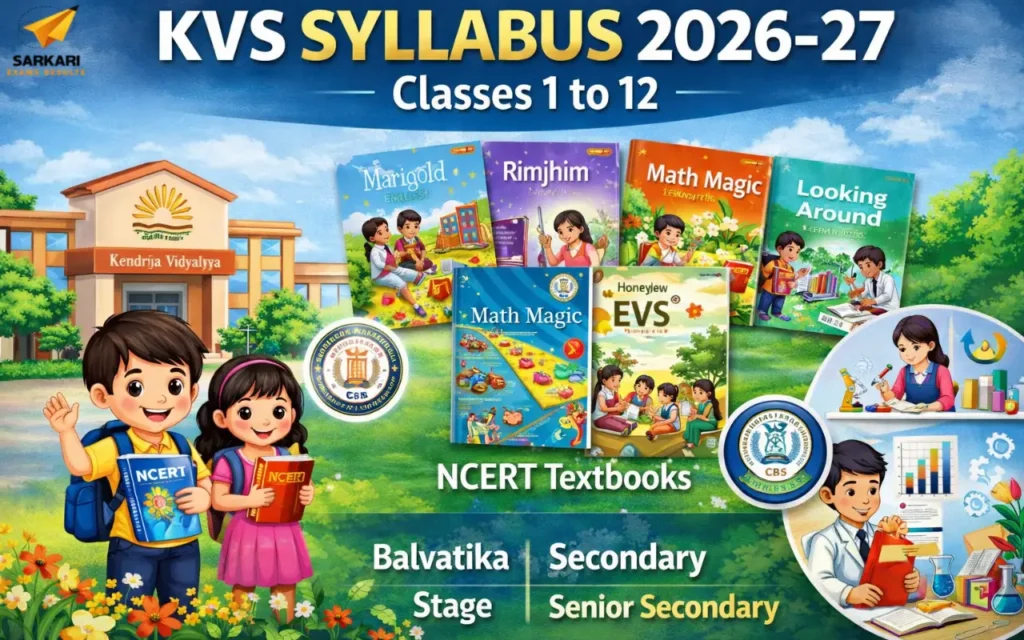
The KVS Syllabus 2026-27 for Classes 1 to 12 is based on the CBSE curriculum and uses NCERT textbooks as the official study material across all Kendriya Vidyalayas in India. All 1,257+ KVS schools follow a uniform syllabus, meaning your child studies the same subjects whether they are enrolled in a KV in Delhi, Chennai, or a remote military cantonment. This article gives you a complete, class-wise breakdown of subjects, NCERT books, assessment patterns, stream options for Class 11, and what the new academic session 2026-27 looks like under NEP 2020 implementation.
Whether you are a parent whose child just received admission in KVS Class 1 or Balvatika, a student transferring to a KV school mid-cycle, or a parent planning your child’s Class 11 stream selection, here is everything you need to know about the KVS Syllabus 2026-27.
Check KVS Admission 2026-27: Online Registration Open
KVS Syllabus 2026-27 Overview
| Detail | Information |
| Curriculum Board | Central Board of Secondary Education (CBSE) |
| Official Textbooks | NCERT (National Council of Educational Research and Training) |
| Medium of Instruction | Bilingual — English and Hindi |
| Pre-Primary Stage | Balvatika 1, 2, 3 (NEP 2020 based) |
| Primary Stage | Class 1 to 5 |
| Middle Stage | Class 6 to 8 |
| Secondary Stage | Class 9 and 10 |
| Senior Secondary Stage | Class 11 and 12 |
| Board Exams | CBSE Class 10 and Class 12 |
| Internal Assessment | Classes 1 to 8 (No Board exam) |
| Official Website | kvsangathan.nic.in |
Balvatika Syllabus 2026-27 (NEP 2020 Pre-Primary Curriculum)
Balvatika is KVS’s pre-primary programme launched under the National Education Policy (NEP) 2020. It covers Balvatika 1 (age 3-4), Balvatika 2 (age 4-5), and Balvatika 3 (age 5-6). This is the foundational stage of education and does not follow a traditional subject-based syllabus.
The Balvatika curriculum focuses on play-based, activity-centred learning across five developmental domains:
| Domain | Focus Areas |
| Physical Development | Gross and fine motor skills, body awareness, coordination activities |
| Cognitive Development | Number sense (1 to 20), shapes, colours, sorting, pattern recognition |
| Language Development | Hindi and English vocabulary, phonics, story listening, basic reading readiness |
| Social-Emotional Development | Sharing, cooperation, expressing emotions, classroom routine habits |
| Creative Arts | Drawing, colouring, singing, movement, clay modelling |
One important thing to note: Balvatika 3 (age 5-6) is the gateway to Class 1. Children who complete Balvatika 3 in a KV are given direct admission to Class 1 in the same school where Balvatika is operational. There are no written exams, report cards with marks, or formal assessments in Balvatika. Teachers use observation checklists and portfolio-based assessment.
KVS Class 1 to 5 Syllabus 2026-27 (Primary Stage)
KVS follows the CBSE primary stage curriculum for Classes 1 to 5. All subjects use NCERT textbooks. The medium of instruction is bilingual — most schools teach core concepts in both English and Hindi.
Subjects Taught in KVS Class 1 and 2
| Subject | NCERT Textbook |
| English | Marigold (Class 1) / Marigold (Class 2) |
| Hindi | Rimjhim 1 / Rimjhim 2 |
| Mathematics | Math Magic 1 / Math Magic 2 |
| Environmental Studies (EVS) | Not a separate subject — concepts integrated within English, Hindi, and Math |
Subjects Taught in KVS Class 3, 4 and 5
| Subject | NCERT Textbook |
| English | Marigold (Class 3/4/5) |
| Hindi | Rimjhim 3/4/5 |
| Mathematics | Math Magic 3/4/5 |
| Environmental Studies (EVS) | Looking Around 3/4/5 |
Assessment for Class 1 to 5: There are no Board exams for this stage. KVS follows a continuous and comprehensive internal assessment model. Performance is evaluated through class activities, oral assessments, projects, and periodic written tests. No child fails or is held back from Class 1 to Class 8, as per the Right to Education (RTE) Act.
A quick note for parents: EVS (Environmental Studies) in Classes 3, 4, and 5 is a combined subject that covers basic Science, Social Studies, and environmental awareness. It splits into separate Science and Social Science subjects from Class 6 onward.
KVS Class 6 to 8 Syllabus 2026-27 (Middle Stage)
Class 6 marks a significant step up in KVS. EVS splits into separate Science and Social Science subjects. Sanskrit is introduced as a compulsory third language. The workload increases and NCERT textbooks become more concept-dense.
Subjects Taught in KVS Class 6, 7 and 8
| Subject | NCERT Textbook |
| English | Honeysuckle + A Pact with the Sun (Class 6); Honeycomb + An Alien Hand (Class 7); Honeydew + It So Happened (Class 8) |
| Hindi | Vasant 1/2/3 + Durva 1/2/3 |
| Mathematics | Class 6 / 7 / 8 NCERT Mathematics |
| Science | Class 6 / 7 / 8 NCERT Science |
| Social Science | History (Our Pasts), Geography (The Earth Our Habitat/Our Environment), Civics (Social and Political Life) — separate NCERT books per class |
| Sanskrit | Ruchira Part 1 / 2 / 3 |
Sanskrit is taught as a compulsory subject from Classes 6 to 8 in all Kendriya Vidyalayas. It is also available as an optional subject up to Class 12. This is something many families do not know before admission — your child will study Sanskrit from Class 6 regardless of preference.
Assessment for Class 6 to 8: Internal school-based assessment. Two periodic tests per term plus a term-end examination. Marks are awarded per subject. There is no external Board exam for Class 8. Students are promoted to Class 9 based on internal school assessment.
KVS Class 9 and 10 Syllabus 2026-27 (Secondary Stage)
Class 9 is the beginning of the CBSE Secondary stage. The syllabus becomes more detailed, subject choices expand, and Class 10 ends with the CBSE Board examination — one of the most important milestones in a student’s school career.
Compulsory Subjects in KVS Class 9 and 10
| Subject | NCERT Textbook |
| English (Language and Literature) | Beehive + Moments (Class 9); First Flight + Footprints Without Feet (Class 10) |
| Hindi Course A or Course B | Kshitij + Kritika (Course A) / Sparsh + Sanchayan (Course B) |
| Mathematics | NCERT Class 9 / 10 Mathematics |
| Science | NCERT Class 9 / 10 Science |
| Social Science | History (India and the Contemporary World), Geography (Contemporary India), Political Science (Democratic Politics), Economics — separate NCERT books |
Optional/Elective Subjects in KVS Class 9 and 10
| Optional Subject | Offered at Most KV Schools |
| Sanskrit | Yes (as third language) |
| Information Technology (IT) | Yes (skill subject) |
| Artificial Intelligence (AI) | Yes (introduced under NEP) |
| German | Selected KV schools only |
| French | Selected KV schools only |
CBSE Class 10 Board Exam: Class 10 students appear for the CBSE Board examination at the end of the academic year. The exam is conducted by CBSE centrally, not by the school. The results determine eligibility and stream selection for Class 11. Passing Class 10 with the required percentage is essential for admission to Science stream in Class 11.
Assessment Pattern for Class 9 and 10:
| Component | Weightage |
| Term-End Board Examination | 80 marks |
| Internal Assessment (Periodic Tests + Notebooks + Subject Enrichment) | 20 marks |
| Total | 100 marks per subject |
KVS Class 11 and 12 Syllabus 2026-27 (Senior Secondary Stage)
Class 11 is the most important academic transition point in KVS. Students choose one of three streams — Science, Commerce, or Humanities — based on their Class 10 marks and interests. Subject selection at this stage shapes a student’s career path.
Stream Options in KVS Class 11 and 12
Science Stream
| Subject | Compulsory/Optional |
| English Core | Compulsory |
| Physics | Compulsory |
| Chemistry | Compulsory |
| Mathematics or Biology | Choose one (or both) |
| Computer Science / Informatics Practices / Physical Education / Economics | Optional (any one) |
| Hindi / Sanskrit | Optional (as second language) |
The most common combination in KVS Science stream is PCM (Physics, Chemistry, Mathematics) or PCB (Physics, Chemistry, Biology). PCM+Biology is also permitted if seats allow.
Minimum eligibility for Science stream in KVS: 60% or above in Class 10 overall, with at least 55% in Science and Mathematics (norms may vary slightly by school).
Commerce Stream
| Subject | Compulsory/Optional |
| English Core | Compulsory |
| Accountancy | Compulsory |
| Business Studies | Compulsory |
| Economics | Compulsory |
| Mathematics / Informatics Practices / Physical Education | Optional (any one) |
| Hindi / Sanskrit | Optional (as second language) |
Humanities (Arts) Stream
| Subject | Compulsory/Optional |
| English Core | Compulsory |
| History | Core subject |
| Political Science | Core subject |
| Geography / Sociology / Psychology / Economics | Optional (choose 1 or 2) |
| Hindi / Sanskrit / Fine Arts / Physical Education | Optional |
CBSE Class 12 Board Exam: Class 12 Board examinations are conducted by CBSE. Results are used for undergraduate admissions including JEE (for engineering), NEET (for medical), CUET (for central universities), and all other entrance examinations. Class 12 marks have lifelong academic significance.
Assessment Pattern for Class 11 and 12:
| Component | Weightage |
| Theory (Board Exam) | 70 or 80 marks (subject-wise) |
| Practical / Project / Internal Assessment | 30 or 20 marks (subject-wise) |
| Total | 100 marks per subject |
KVS Language Policy 2026-27: Which Languages Are Taught
Language policy is one of the most searched topics among KVS parents, yet competitors explain it poorly. Here is a clear breakdown.
| Class Group | Compulsory Languages | Optional / Additional |
| Balvatika | Hindi and English (spoken, listening focus) | — |
| Class 1 to 5 | Hindi + English | — |
| Class 6 to 8 | Hindi + English + Sanskrit | German / French (select schools) |
| Class 9 to 10 | Hindi + English (as Language and Literature) | Sanskrit / German / French |
| Class 11 to 12 | English Core (compulsory) | Hindi / Sanskrit optional |
All KVS schools share a common syllabus and offer bilingual instruction in English and Hindi. Sanskrit is taught as a compulsory subject from Classes 6 to 8 and as an optional subject until Class 12. German is available in some schools up to Class 10.
One thing many parents ask: can a child opt out of Sanskrit in Classes 6-8? The answer is no. Sanskrit is compulsory across all KVS schools in this stage. However, if your child’s KV offers German or French, they may be available as an additional language elective.
KVS Assessment and Exam Pattern for Students 2026-27
Understanding the assessment pattern helps parents set the right expectations. KVS follows different evaluation models at different stages.
Classes 1 to 5 — No Marks, Activity-Based Assessment
KVS does not award numerical marks to students in Classes 1 to 5. Assessment is based on continuous observation, oral responses, classwork, projects, and participation. Parents receive descriptive report cards. No detention policy applies — no child is held back.
Classes 6 to 8 — School-Based Internal Assessment
Students are assessed through:
- 2 Periodic Tests per term (10 marks each)
- Notebook and assignment evaluation (5 marks)
- Subject enrichment activities (5 marks)
- Term-End Examination (80 marks)
Classes 9 and 10 — CBSE-Pattern with Board Exam in Class 10
- Periodic internal assessments throughout the year (20 marks)
- Class 10 CBSE Board Examination (80 marks)
- Practical examinations and projects for Science, Computer Science, and languages
Classes 11 and 12 — CBSE Board with Practicals
- Internal assessment (20 or 30 marks depending on subject)
- CBSE Class 12 Board Examination (70 or 80 marks depending on subject)
- Practical examinations mandatory for Science subjects
NEP 2020 and KVS Curriculum 2026-27: What Has Changed
KVS has been one of the early adopters of the National Education Policy (NEP) 2020. Here are the key changes that impact students in the 2026-27 session:
Balvatika introduced: Pre-primary education (ages 3-6) is now formally part of the school structure under the 5+3+3+4 framework replacing the old 10+2 system.
Foundational literacy and numeracy focus (Classes 1-3): The National Initiative for Proficiency in Reading with Understanding and Numeracy (NIPUN Bharat) framework is being implemented. This means stronger emphasis on reading fluency and basic arithmetic in the early years.
Flexibility in subject choices from Class 9: Under NEP, students will gradually gain more flexibility in mixing subjects from different streams. While full implementation is phased, KVS schools are moving toward allowing students to choose from a broader menu.
Vocational Education from Class 6: KVS schools offer introductory vocational and life skills modules from Class 6 onward as part of the skill-based learning push under NEP.
Reduced curriculum load: NCERT has revised textbooks to reduce content load and increase conceptual depth. The new NCERT books (being phased in from 2024) follow this philosophy.
NCERT Textbooks Used in KVS 2026-27: Quick Reference
All KVS schools use NCERT books exclusively. Students can download NCERT textbooks free of cost from ncert.nic.in.
| Class Group | Subjects | Where to Get Books |
| Balvatika | Activity and workbook-based material provided by school | Given by KV school |
| Class 1 to 5 | Marigold, Rimjhim, Math Magic, Looking Around (EVS) | NCERT website + school |
| Class 6 to 8 | Subject-wise NCERT books including Ruchira (Sanskrit) | NCERT website + school |
| Class 9 to 10 | Full CBSE curriculum NCERT textbooks | NCERT website + school |
| Class 11 to 12 | Stream-specific NCERT books | NCERT website + school |
Download link: ncert.nic.in (select class and subject for free PDF download)
KVS Syllabus 2026-27 Preparation Tips for Students
For Class 1 to 5 students: NCERT books are the only resource you need. Do not buy guide books or extra reference material at this stage. Focus on reading comprehension, basic math operations, and EVS concepts from the NCERT textbooks.
For Class 6 to 8 students: Sanskrit is a new addition and can feel challenging initially. Start with Ruchira basics — the alphabet, simple sentences, and the first three chapters. Consistent daily reading of 20 minutes is more effective than last-minute cramming.
For Class 9 students: This is the first year where marks matter for stream selection in Class 11. Science and Mathematics scores in Class 9 carry particular weight. Use NCERT as the primary source and solve all in-chapter and end-chapter exercises.
For Class 10 students (Board year): CBSE Class 10 follows NCERT exactly. Previous year CBSE question papers from the last 5 years are the best preparation tool. Solve one paper per week from October onward.
For Class 11 and 12 students: NCERT is the base — especially in Physics, Chemistry, and Biology for Science students. For Mathematics, supplement with RD Sharma or RS Aggarwal after completing NCERT. For Board exams, NCERT is the most important book at this stage.
Common mistake to avoid: Buying expensive guide books and extra reference material for Class 1 to 8. NCERT plus regular classroom practice is sufficient. Spending more money on study material before Class 9 rarely improves results and puts unnecessary pressure on young children.
KVS Syllabus 2026-27 FAQ
Q: Does KVS follow NCERT or its own textbooks? A: KVS follows the CBSE curriculum and uses NCERT textbooks as the official and only prescribed textbooks for all classes from 1 to 12. Students do not need to purchase any additional books from private publishers for core subjects.
Q: What subjects are taught in KVS Class 1? A: KVS Class 1 covers four subjects: English (Marigold), Hindi (Rimjhim), Mathematics (Math Magic), and Environmental Studies concepts integrated within other subjects. EVS becomes a standalone subject from Class 3 using the NCERT book “Looking Around.”
Q: Is Sanskrit compulsory in KVS schools? A: Yes. Sanskrit is compulsory for all students from Class 6 to Class 8 in all Kendriya Vidyalayas without exception. From Class 9 onwards, Sanskrit becomes an optional subject that students can choose as their second or third language.
Q: What stream options are available in KVS Class 11? A: KVS offers three streams in Class 11 and 12: Science (PCM or PCB or both), Commerce (Accountancy, Business Studies, Economics as core), and Humanities (History, Political Science, Geography/Sociology/Psychology). Admission to Science stream generally requires 60% or above in Class 10.
Q: Does KVS conduct Board exams for Class 9? A: No. Class 9 is assessed through internal school-based examinations only. The CBSE Board examination begins from Class 10. A strong performance in Class 9 is important primarily because it influences stream selection at the end of Class 10.
Q: What is the Balvatika syllabus in KVS schools? A: The Balvatika curriculum is play-based and activity-centred, following NEP 2020’s foundational stage framework. It focuses on language readiness (Hindi and English), early number sense, physical development, and creative arts. There are no textbooks or marks-based assessment at the Balvatika stage.
Q: Is German or French available in Kendriya Vidyalaya schools? A: German and French are available in select KV schools as an additional language option from Classes 6 to 10. Availability varies by school. Parents should confirm with the specific KV school at the time of admission whether German or French classes are offered. German was discontinued briefly but was later resumed in some schools.
Q: When does the CBSE Class 12 Board exam happen for KVS students? A: CBSE Class 12 Board examinations are held annually in February-March. For the academic session 2026-27, the Class 12 Board exams are expected in February-March 2027. Results are typically declared in May. KVS students follow the same CBSE Board exam schedule as all other CBSE-affiliated school students across India.
Q: Can a student change stream from Science to Commerce after Class 11? A: Yes, but only within the first few weeks of Class 11 admission, subject to seat availability in Commerce and the school’s approval. Once the academic year progresses beyond the initial registration period, changing streams becomes very difficult administratively. Choose your stream carefully at admission time.
Q: How many subjects does a KVS Class 10 student study? A: A typical KVS Class 10 student studies 6 subjects: English (Language and Literature), Hindi, Mathematics, Science, Social Science, and one optional subject (Sanskrit, Information Technology, or Artificial Intelligence). All 6 subjects are examined in the CBSE Class 10 Board examination.
Q: Are NCERT books available for free? A: Yes. All NCERT textbooks from Class 1 to 12 are available as free PDF downloads on the official NCERT website at ncert.nic.in. Students can download subject-wise and chapter-wise PDFs at no cost. Physical copies are also available at subsidised prices through NCERT sales counters.
Q: Does KVS follow NEP 2020? What changes has it brought? A: Yes, KVS has been implementing NEP 2020 progressively. Key changes include the introduction of Balvatika (pre-primary classes), the 5+3+3+4 school stage structure replacing the old 10+2 pattern, emphasis on foundational literacy and numeracy in Classes 1-3, vocational skill modules from Class 6, and gradual increase in subject flexibility from Class 9 onward.
Conclusion
The KVS Syllabus 2026-27 is built on a clear, consistent framework: CBSE curriculum, NCERT textbooks, bilingual instruction, and a progressive assessment model that moves from activity-based evaluation in primary years to the CBSE Board examinations in Classes 10 and 12. There are no surprises here — what makes KVS special is not a unique syllabus but the quality and consistency of its delivery across 1,257 schools.
If your child has just received KVS admission 2026-27, focus on the NCERT books for their class, understand the language policy (especially Sanskrit from Class 6), and plan stream selection discussions early when Class 9 begins. A KV education gives students a solid, nationally recognised academic foundation.
Also check: KVS Admission 2026-27 | KVS Fee Structure 2026-27 | CBSE Class 10 Board Exam 2026 | NCERT Books Free Download | Navodaya Vidyalaya Admission 2026